

ADVERTISEMENT

Mayon records highest sulfur dioxide emissions in 26 years

Phivolcs warns of possible explosive activity

Published Jul 12, 2026 08:40 am  |  Updated Jul 12, 2026 01:36 pm

At A Glance

  • In an advisory issued at 10:15 p.m. on Saturday, July 11, Phivolcs said Mayon's sulfur dioxide emissions averaged 13,128 tons, the highest recorded at the volcano in the last 26 years and only slightly lower than the levels measured during its 2000 explosive eruption.
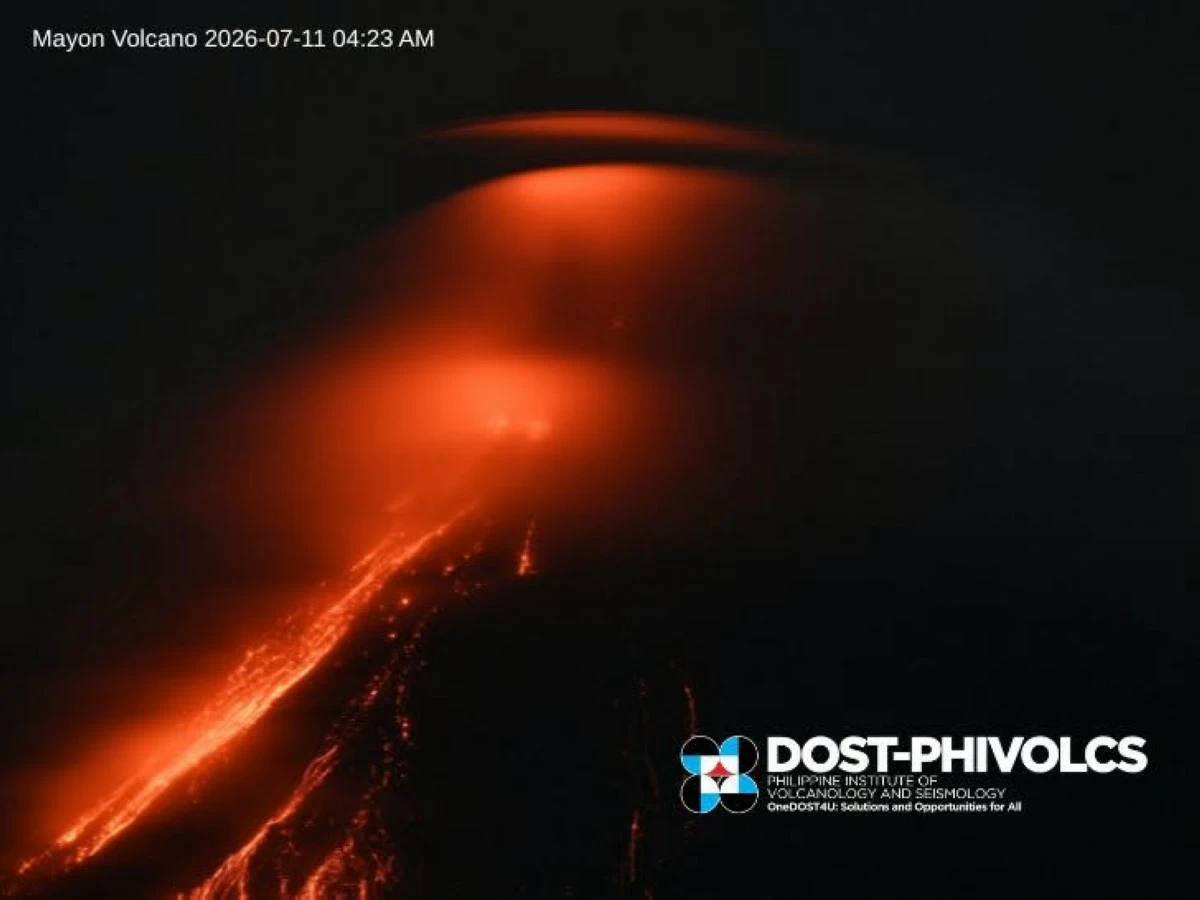
Mayon Volcano (Phivolcs)
Mayon Volcano sustained its lava effusion on Sunday, July 12, a day after the Philippine Institute of Volcanology and Seismology (Phivolcs) warned that record high sulfur dioxide emissions could lead to more explosive volcanic activity.
In an advisory issued at 10:15 p.m. on Saturday, July 11, Phivolcs said Mayon's sulfur dioxide emissions averaged 13,128 tons, the highest recorded at the volcano in the last 26 years and only slightly lower than the levels measured during its 2000 explosive eruption.
“This abrupt rise has been accompanied by an increase in the occurrence of low frequency volcanic earthquakes or LFVQs that are attributed to volcanic degassing and minor strombolian activity at the crater, and increased rockfall linked to collapses from new lava flows,” Phivolcs said.
A strombolian activity refers to short explosive bursts that eject glowing volcanic material and produce brief lava fountains.
In its latest monitoring bulletin issued Sunday, Phivolcs recorded 125 volcanic earthquakes and 344 rockfall events during the past 24 hours.
While the volcano's overall activity remains consistent with its ongoing lava effusion, Phivolcs said the elevated sulfur dioxide emissions could lead to more explosive eruptive activity.
“Elevated volcanic SO2 emissions could forewarn of further or even a potential shift to explosive eruptive activity at the summit crater that could generate volcanic hazards all around the volcano, the impacts of which can be worsened by the prevailing poor weather conditions,” the agency said.
Mayon remains under Alert Level 3, which means “intensified unrest” or “magmatic unrest.”
Phivolcs reminded the public not to enter the six-kilometer permanent danger zone.
It urged communities within areas identified as vulnerable to pyroclastic density currents to remain prepared should volcanic activity escalate.
It also advised vigilance against lahars and sediment laden streamflows during periods of sustained heavy rainfall.
Pilots are also warned against flying close to the volcano's summit due to possible ash emissions and ballistic fragments.

Related Tags

PHIVOLCS MAYON VOLCANO SULFUR DIOXIDE LAVA EFFUSION ERUPTION
ADVERTISEMENT
.most-popular .layout-ratio{ padding-bottom: 79.13%; } @media (min-width: 768px) and (max-width: 1024px) { .widget-title { font-size: 15px !important; } }

{{ articles_filter_1561_widget.title }}

.most-popular .layout-ratio{ padding-bottom: 79.13%; } @media (min-width: 768px) and (max-width: 1024px) { .widget-title { font-size: 15px !important; } }

{{ static_articles_1562_widget.title }}

.most-popular .layout-ratio{ padding-bottom: 79.13%; } @media (min-width: 768px) and (max-width: 1024px) { .widget-title { font-size: 15px !important; } }

{{ articles_filter_1563_widget.title }}

{{ articles_filter_1564_widget.title }}

.mb-article-details { position: relative; } .mb-article-details .article-body-preview, .mb-article-details .article-body-summary{ font-size: 17px; line-height: 30px; font-family: "Libre Caslon Text", serif; color: #000; } .mb-article-details .article-body-preview iframe , .mb-article-details .article-body-summary iframe{ width: 100%; margin: auto; } .read-more-background { background: linear-gradient(180deg, color(display-p3 1.000 1.000 1.000 / 0) 13.75%, color(display-p3 1.000 1.000 1.000 / 0.8) 30.79%, color(display-p3 1.000 1.000 1.000) 72.5%); position: absolute; height: 200px; width: 100%; bottom: 0; display: flex; justify-content: center; align-items: center; padding: 0; } .read-more-background a{ color: #000; } .read-more-btn { padding: 17px 45px; font-family: Inter; font-weight: 700; font-size: 18px; line-height: 16px; text-align: center; vertical-align: middle; border: 1px solid black; background-color: white; } .hidden { display: none; }
function initializeAllSwipers() { // Get all hidden inputs with cms_article_id document.querySelectorAll('[id^="cms_article_id_"]').forEach(function (input) { const cmsArticleId = input.value; const articleSelector = '#article-' + cmsArticleId + ' .body_images'; const swiperElement = document.querySelector(articleSelector); if (swiperElement && !swiperElement.classList.contains('swiper-initialized')) { new Swiper(articleSelector, { loop: true, pagination: false, navigation: { nextEl: '#article-' + cmsArticleId + ' .swiper-button-next', prevEl: '#article-' + cmsArticleId + ' .swiper-button-prev', }, }); } }); } setTimeout(initializeAllSwipers, 3000); const intersectionObserver = new IntersectionObserver( (entries) => { entries.forEach((entry) => { if (entry.isIntersecting) { const newUrl = entry.target.getAttribute("data-url"); if (newUrl) { history.pushState(null, null, newUrl); let article = entry.target; // Extract metadata const author = article.querySelector('.author-section').textContent.replace('By', '').trim(); const section = article.querySelector('.section-info ').textContent.replace(' ', ' '); const title = article.querySelector('.article-title h1').textContent; // Parse URL for Chartbeat path format const parsedUrl = new URL(newUrl, window.location.origin); const cleanUrl = parsedUrl.host + parsedUrl.pathname; // Update Chartbeat configuration if (typeof window._sf_async_config !== 'undefined') { window._sf_async_config.path = cleanUrl; window._sf_async_config.sections = section; window._sf_async_config.authors = author; } // Track virtual page view with Chartbeat if (typeof pSUPERFLY !== 'undefined' && typeof pSUPERFLY.virtualPage === 'function') { try { pSUPERFLY.virtualPage({ path: cleanUrl, title: title, sections: section, authors: author }); } catch (error) { console.error('ping error', error); } } // Optional: Update document title if (title && title !== document.title) { document.title = title; } } } }); }, { threshold: 0.1 } ); function showArticleBody(button) { const article = button.closest("article"); const summary = article.querySelector(".article-body-summary"); const body = article.querySelector(".article-body-preview"); const readMoreSection = article.querySelector(".read-more-background"); // Hide summary and read-more section summary.style.display = "none"; readMoreSection.style.display = "none"; // Show the full article body body.classList.remove("hidden"); } document.addEventListener("DOMContentLoaded", () => { let loadCount = 0; // Track how many times articles are loaded const offset = [1, 2, 3, 4, 5, 6, 7, 8, 9, 10]; // Offset values const currentUrl = window.location.pathname.substring(1); let isLoading = false; // Prevent multiple calls if (!currentUrl) { console.log("Current URL is invalid."); return; } const sentinel = document.getElementById("load-more-sentinel"); if (!sentinel) { console.log("Sentinel element not found."); return; } function isSentinelVisible() { const rect = sentinel.getBoundingClientRect(); return ( rect.top < window.innerHeight && rect.bottom >= 0 ); } function onScroll() { if (isLoading) return; if (isSentinelVisible()) { if (loadCount >= offset.length) { console.log("Maximum load attempts reached."); window.removeEventListener("scroll", onScroll); return; } isLoading = true; const currentOffset = offset[loadCount]; window.loadMoreItems().then(() => { let article = document.querySelector('#widget_1690 > div:nth-last-of-type(2) article'); intersectionObserver.observe(article) loadCount++; }).catch(error => { console.error("Error loading more items:", error); }).finally(() => { isLoading = false; }); } } window.addEventListener("scroll", onScroll); });

Sign up by email to receive news.