






Manila Bulletin
 Philippines
National
'Habagat' rains to persist over parts of Luzon, Visayas despite Typhoon Inday's exit
Philippines
National
'Habagat' rains to persist over parts of Luzon, Visayas despite Typhoon Inday's exit
Philippines
National
'Habagat' rains to persist over parts of Luzon, Visayas despite Typhoon Inday's exit
'Habagat' rains to persist over parts of Luzon, Visayas despite Typhoon Inday's exit
Published Jul 12, 2026 07:44 am
|
Updated Jul 12, 2026 01:32 pm


At A Glance
- PAGASA weather specialist Obet Badrina said the weakening of the habagat is expected after Typhoon Inday (international name: Bavi) exited the Philippine Area of Responsibility on Saturday morning, July 11, and moved over mainland China, where it is forecast to dissipate in the coming days.
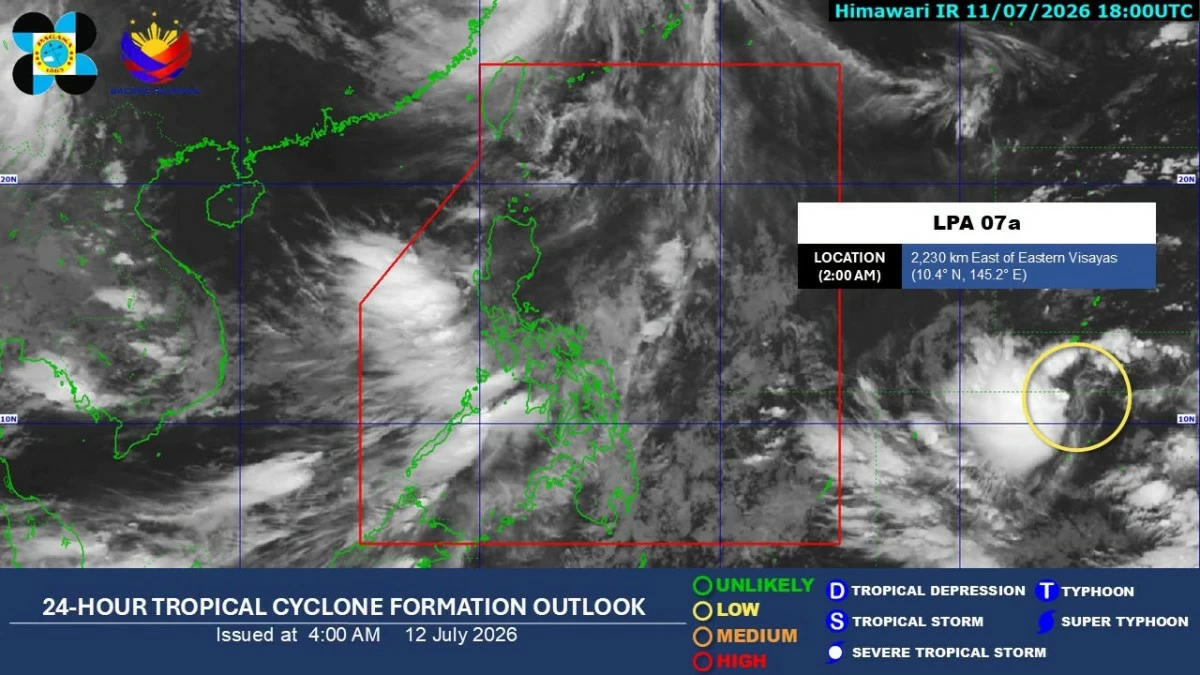
Satellite image courtesy of PAGASA
The Philippine Atmospheric, Geophysical and Astronomical Services Administration (PAGASA) said on Sunday, July 12 that the southwest monsoon or “habagat” will continue to bring rains over parts of Luzon and Visayas, although its effects are expected to gradually weaken.
PAGASA weather specialist Obet Badrina said the weakening of the habagat is expected after Typhoon Inday (international name: Bavi) exited the Philippine Area of Responsibility on Saturday morning, July 11, and moved over mainland China, where it is forecast to dissipate in the coming days.
“As the effects of the southwest monsoon weaken, we expect the occurrence of heavy rains to decrease in the next few days,” Badrina said in Filipino.
For Sunday, occasional rains remain likely over Ilocos Region, Bataan, Zambales, Occidental Mindoro, and Antique due to the habagat.
The rest of Luzon and Visayas may experience cloudy skies with scattered rain showers and thunderstorms, while rainfall is expected to ease over Cagayan Valley and Bicol Region.
Meanwhile, Mindanao, will continue to experience isolated rain showers or thunderstorms caused by localized thunderstorms.
Badrina said occasional heavy rains may still affect parts of the Ilocos Region on Monday, July 13, before weather conditions gradually improve.
Despite the expected weakening of the habagat, PAGASA advised residents in areas experiencing prolonged rainfall to remain alert for possible flash floods and landslides.
Meanwhile, PAGASA is monitoring a low-pressure area (LPA) located more than 2,000 kilometers east of Eastern Visayas.
Badrina said the weather disturbance currently has a low chance of developing into a tropical cyclone and is not affecting any part of the country as of Sunday.
He advised the public to continue monitoring the PAGASA’s weather advisories, particularly regarding the LPA outside the Philippine area of responsibility.