







PEF: Swift collaborative action saved PH Eagle's life
Published Jul 11, 2026 05:10 pm


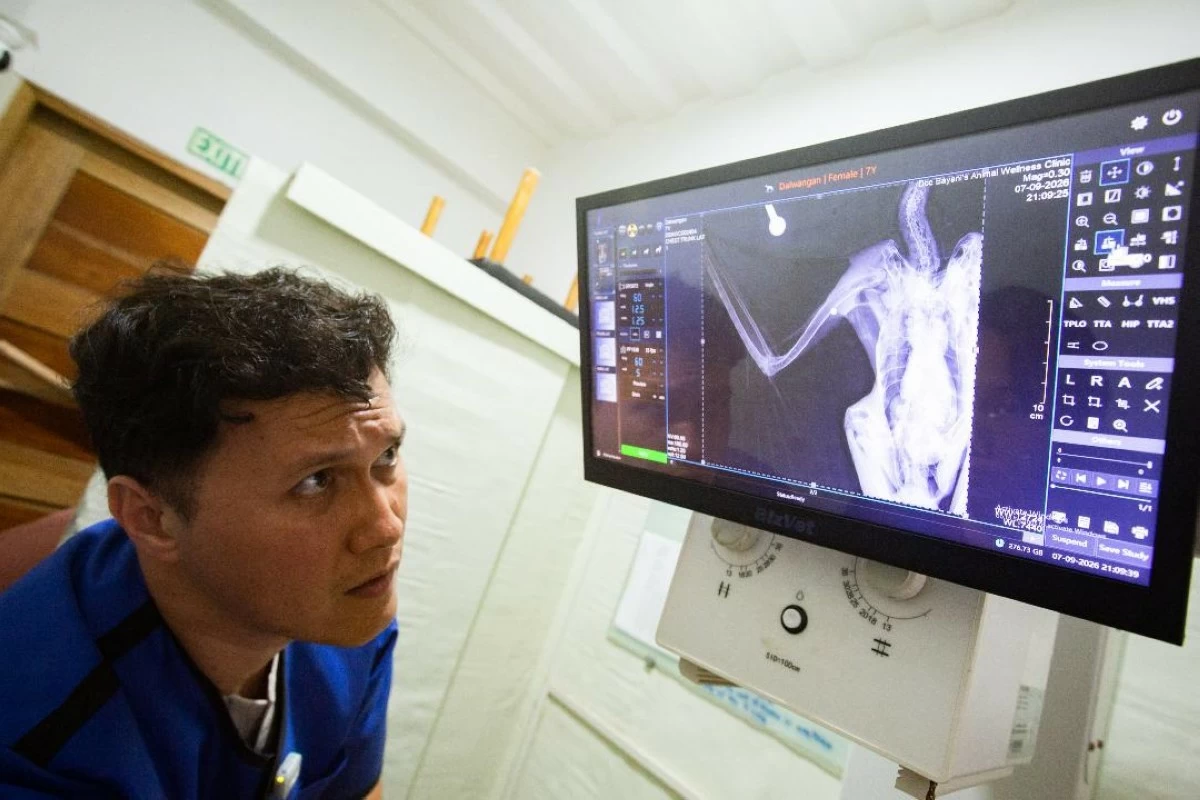
VETERINARIAN Bayani Vandenbroeck conducting an X-ray scan on the injured Philippine Eagle to locate and remove embedded airgun pellets. (Keith Bacongco)
DAVAO CITY – A Philippine Eagle rescued in the province of Bukidnon is recovering well, eight days after he was turned over to authorities as the Philippine Eagle Foundation emphasized that swift collaborative action saved the raptor’s life.
PEF acknowledged the collaborative efforts of their team, local communities, and the Department of Environment and Natural Resources (DENR).
The critically endangered Philippine Eagle was in bad shape when a PEF team arrived in Malaybalay City from the Philippine Eagle Center in Barangay Malagos here.
“The bird was reported to PEF at around 11a.m., then before midnight nasa clinic na ni Doc Bayani (Vandenbroeck). If nadelay pa ‘yan ng two days baka ang mga maggots nasa loob na ng katawan ng bird and it would be too late,” said PEF Director of Operations Dr. Jayson Ibañez.
Veterinarian Bayani Vandenbroeck recalled that the eagle named Sawaga-Dalwangan was in bad shape when he arrived here.
Vandenbroeck added the bird was covered in mud and infested with maggots. “We think if another 24 to 48 hours had passed, we could have lost it.”
Eight days after the rescue, he said that the raptor’s condition is improving. “It’s clean now, the wounds are much better, and he has a good appetite. Demeanor is also much improved compared to when he was first brought to the clinic, he’s more alert and aggressive when approached, which are all good signs,” said Vandenbroeck.
Initial checkup showed the eagle’s wing was heavily soiled and severely infested with maggots, showing the urgent need for rescue and veterinary treatment, the PEF said.
“The wounds, together with her severe dehydration, soiled feathers, damaged plumage, and the advanced maggot infestation, suggested that her injuries were not recent. He had likely been unable to move normally for several days. But what caused those injuries is still unknown,” the PEF said.
Another X-ray examination was conducted on Sawaga-Dalwangan on Thursday night, July 9, to confirm the location of the airgun pellets still lodged inside his body.
Vandenbroeck confirmed that two pellets were lodged in his right wing and left thigh. He did not find any fresh entry wound, indicating that he was injured for some time.
The pellet in his right wing was removed as it was protruding just under his skin. They tried to locate the other pellet on his thigh by hand but failed.
“The other pellet is too deeply embedded into the muscle so it would mean major surgery to remove it. This is something we can consider later on if he makes a full recovery,” Vandenbroeck said.
The eagle is still at Doc Bayani’s Animal Wellness Clinic for further monitoring and recovery.
Ibañez said they could not say yet when and where Sawaga-Dalwangan will be released as they are waiting for the results of the deoxyribonucleic acid (DNA) sexing and genomic tests.
Ibañez believes that the raptor may have been on the ground for a long time before he was turned over to the DENR due to his condition.
“We received reports that it was said to be mobbed by 30 macaque monkeys after the eagle reportedly captured one of their babies. That’s how the eagle was injured and later found along Sawaga River in Dalwangan according to the locals,” he said.
The seasoned PEF conservationist said that examination showed that the eagle's legs had rope burns, indicating that the national bird may have been tied on to the ground.
Ibañez also said that the eagle was not among the pairs that they have monitored in the area.
The PEF urged key government agencies to conduct a breeding territory survey to determine the status of the resident Philippine Eagle pair, locate any active nest, and assess threats.
The PEF reiterated their appeal to the provincial government of Bukidnon to intensify their campaign to regulate the use of pellet or jolen guns in the province since it is a known home to 23 pairs of Philippine Eagles and urged a multi-agency investigation surrounding the circumstances that led to the capture and rescue of the raptor.
Barangay Dalwangan in the Mount Kitanglad Range Natural Park is among the Philippine Eagle’s ancient nesting area and
is the second-oldest known breeding territory for the species, with breeding consistently documented since 1986. Today, fewer than 400 breeding pairs of the Philippine Eagle are believed to remain in the wild.