ADVERTISEMENT

Martha Lillard, last US polio patient using iron lung, dies at 78 in Oklahoma

Published Jul 11, 2026 12:52 pm
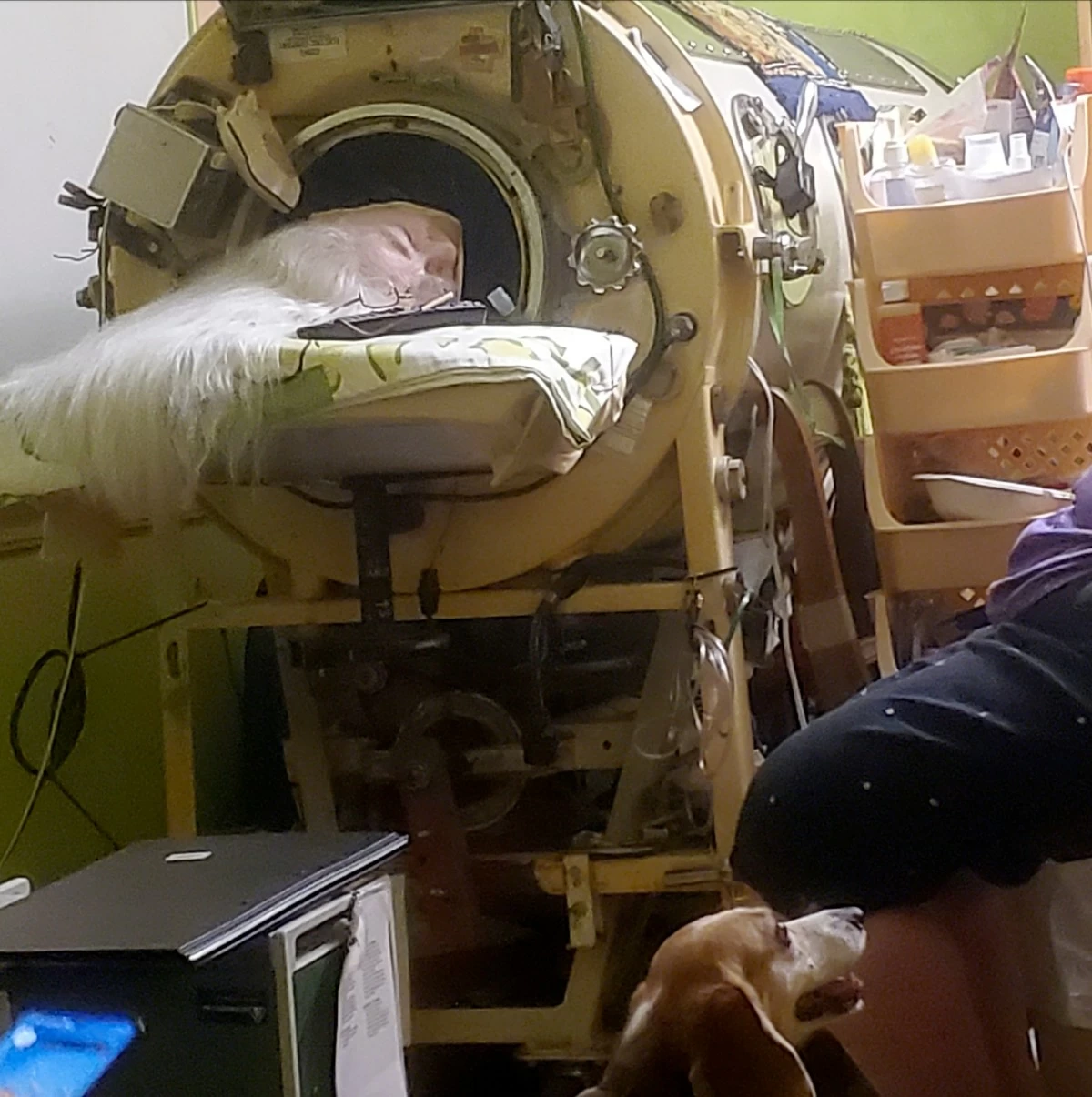
In this photo provided by Cindy McVey, her sister Martha Lillard rests in her iron lung on Friday, February 6, 2026 in Shawnee, Okla. (Cindy McVey via AP)
Martha Lillard had just turned 5 when she was diagnosed with polio and depended on an iron lung to live. She died June 26 in Oklahoma, the last U.S. polio patient who used the machine, her sister said. She was 78.
“They told her she wasn't supposed to live past 20 years old,” Lillard's younger sister, Cindy McVey, told The Associated Press on Friday. “She had the enthusiasm and the drive to continue living and make the best of her life.”
McVey attributes her sister's death to the effects of long-haul COVID-19. A death certificate lists causes as chronic pulmonary failure and post-polio syndrome, McVey said.
Lillard slept in the iron lung cylinder that encased her body as the air pressure in the chamber forced air in and out of her lungs. As a child, she went to grade school for two hours a day and was tutored the rest of the time. She attended Shawnee High School by using a phone system that allowed her to interact with her teachers and classmates through an intercom in her classrooms.
Her family went on road trips to Missouri thanks to a custom trailer and her father calling hotels to find out if they had doors wide enough to accommodate the machine Lillard slept in. Lillard was even able to drive for a time.
“To me, it was just normal,” recalled McVey, 75.
Polio was once one of the nation’s most feared diseases, with annual outbreaks causing thousands of cases of paralysis. The disease primarily affects children.
Vaccines became available starting in 1955. According to the federal Centers for Disease Control and Prevention, a national vaccination campaign cut the annual number of U.S. cases to fewer than 100 in the 1960s and fewer than 10 in the 1970s. In 1979, polio was declared eliminated in the U.S., meaning it was no longer routinely spread.
Later the internet would help Lillard stay informed and learn about all sorts of topics, including her disease, which paralyzed her from the neck down.
With therapy she was able to regain partial use of her left arm and use of her legs. But she could only move her left arm side to side at her waist. Even though she couldn't reach up, she spent many years living alone and preparing her own meals.
The internet also allowed Lillard to meet her future husband. After the Sept. 11, 2001, terrorist attacks, Lillard wanted to understand more about what happened. In a chat room, she met a man in Egypt and communicated with him online for more than 20 years, McVey said.
Lillard married Baha Salh in February after he was finally able to obtain a visa to travel to Oklahoma.
“They were really soul mates,” McVey said. “He's extremely brokenhearted.”
During the coronavirus pandemic, Lillard got COVID-19 twice. Before getting COVID-19, she had less than 25% lung capacity. The last five years of her life, she wasn't able to leave home as it became harder to breathe. For the past two years, she was in the iron lung nearly 24 hours a day, McVey said.
McVey described her sister as artistic and creative. She wrote poems and composed songs. She wrote her own obituary, which is now posted online by a funeral home. She described being a Humane Society volunteer. “She was an avid Beagle lover and assisted in animal rescue as a cross poster on Facebook,” Lillard wrote.
She later updated her obituary to say she “died of long-haul Covid 19,” but McVey added the date of her death.
In recent years, McVey and Lillard were desperate to find someone who could fix the iron lung, one of several she had over her lifetime.
“But since she's the last one, we don't need that anymore,” McVey said through tears.

Related Tags

WORLDNEWS
ADVERTISEMENT
.most-popular .layout-ratio{ padding-bottom: 79.13%; } @media (min-width: 768px) and (max-width: 1024px) { .widget-title { font-size: 15px !important; } }

{{ articles_filter_1561_widget.title }}

.most-popular .layout-ratio{ padding-bottom: 79.13%; } @media (min-width: 768px) and (max-width: 1024px) { .widget-title { font-size: 15px !important; } }

{{ static_articles_1562_widget.title }}

.most-popular .layout-ratio{ padding-bottom: 79.13%; } @media (min-width: 768px) and (max-width: 1024px) { .widget-title { font-size: 15px !important; } }

{{ articles_filter_1563_widget.title }}

{{ articles_filter_1564_widget.title }}

.mb-article-details { position: relative; } .mb-article-details .article-body-preview, .mb-article-details .article-body-summary{ font-size: 17px; line-height: 30px; font-family: "Libre Caslon Text", serif; color: #000; } .mb-article-details .article-body-preview iframe , .mb-article-details .article-body-summary iframe{ width: 100%; margin: auto; } .read-more-background { background: linear-gradient(180deg, color(display-p3 1.000 1.000 1.000 / 0) 13.75%, color(display-p3 1.000 1.000 1.000 / 0.8) 30.79%, color(display-p3 1.000 1.000 1.000) 72.5%); position: absolute; height: 200px; width: 100%; bottom: 0; display: flex; justify-content: center; align-items: center; padding: 0; } .read-more-background a{ color: #000; } .read-more-btn { padding: 17px 45px; font-family: Inter; font-weight: 700; font-size: 18px; line-height: 16px; text-align: center; vertical-align: middle; border: 1px solid black; background-color: white; } .hidden { display: none; }
function initializeAllSwipers() { // Get all hidden inputs with cms_article_id document.querySelectorAll('[id^="cms_article_id_"]').forEach(function (input) { const cmsArticleId = input.value; const articleSelector = '#article-' + cmsArticleId + ' .body_images'; const swiperElement = document.querySelector(articleSelector); if (swiperElement && !swiperElement.classList.contains('swiper-initialized')) { new Swiper(articleSelector, { loop: true, pagination: false, navigation: { nextEl: '#article-' + cmsArticleId + ' .swiper-button-next', prevEl: '#article-' + cmsArticleId + ' .swiper-button-prev', }, }); } }); } setTimeout(initializeAllSwipers, 3000); const intersectionObserver = new IntersectionObserver( (entries) => { entries.forEach((entry) => { if (entry.isIntersecting) { const newUrl = entry.target.getAttribute("data-url"); if (newUrl) { history.pushState(null, null, newUrl); let article = entry.target; // Extract metadata const author = article.querySelector('.author-section').textContent.replace('By', '').trim(); const section = article.querySelector('.section-info ').textContent.replace(' ', ' '); const title = article.querySelector('.article-title h1').textContent; // Parse URL for Chartbeat path format const parsedUrl = new URL(newUrl, window.location.origin); const cleanUrl = parsedUrl.host + parsedUrl.pathname; // Update Chartbeat configuration if (typeof window._sf_async_config !== 'undefined') { window._sf_async_config.path = cleanUrl; window._sf_async_config.sections = section; window._sf_async_config.authors = author; } // Track virtual page view with Chartbeat if (typeof pSUPERFLY !== 'undefined' && typeof pSUPERFLY.virtualPage === 'function') { try { pSUPERFLY.virtualPage({ path: cleanUrl, title: title, sections: section, authors: author }); } catch (error) { console.error('ping error', error); } } // Optional: Update document title if (title && title !== document.title) { document.title = title; } } } }); }, { threshold: 0.1 } ); function showArticleBody(button) { const article = button.closest("article"); const summary = article.querySelector(".article-body-summary"); const body = article.querySelector(".article-body-preview"); const readMoreSection = article.querySelector(".read-more-background"); // Hide summary and read-more section summary.style.display = "none"; readMoreSection.style.display = "none"; // Show the full article body body.classList.remove("hidden"); } document.addEventListener("DOMContentLoaded", () => { let loadCount = 0; // Track how many times articles are loaded const offset = [1, 2, 3, 4, 5, 6, 7, 8, 9, 10]; // Offset values const currentUrl = window.location.pathname.substring(1); let isLoading = false; // Prevent multiple calls if (!currentUrl) { console.log("Current URL is invalid."); return; } const sentinel = document.getElementById("load-more-sentinel"); if (!sentinel) { console.log("Sentinel element not found."); return; } function isSentinelVisible() { const rect = sentinel.getBoundingClientRect(); return ( rect.top < window.innerHeight && rect.bottom >= 0 ); } function onScroll() { if (isLoading) return; if (isSentinelVisible()) { if (loadCount >= offset.length) { console.log("Maximum load attempts reached."); window.removeEventListener("scroll", onScroll); return; } isLoading = true; const currentOffset = offset[loadCount]; window.loadMoreItems().then(() => { let article = document.querySelector('#widget_1690 > div:nth-last-of-type(2) article'); intersectionObserver.observe(article) loadCount++; }).catch(error => { console.error("Error loading more items:", error); }).finally(() => { isLoading = false; }); } } window.addEventListener("scroll", onScroll); });

Sign up by email to receive news.