






 Philippines
National
DFA downplays Chinese scholars' Batanes claim, says government policy—not academic views—matters
Philippines
National
DFA downplays Chinese scholars' Batanes claim, says government policy—not academic views—matters
DFA downplays Chinese scholars' Batanes claim, says government policy—not academic views—matters


At A Glance
- Foreign Affairs Secretary Ma. Theresa Lazaro downplayed Chinese academics' claims that Batanes belongs to China, saying the Philippines listens only to official government positions.
- The remarks came as the Department of National Defense ordered increased military patrols across the country's maritime domain following the controversy.
- The Chinese Embassy distanced Ambassador Jing Quan's recent visit to Batanes from the symposium, accusing Philippine officials of creating unnecessary hostility.
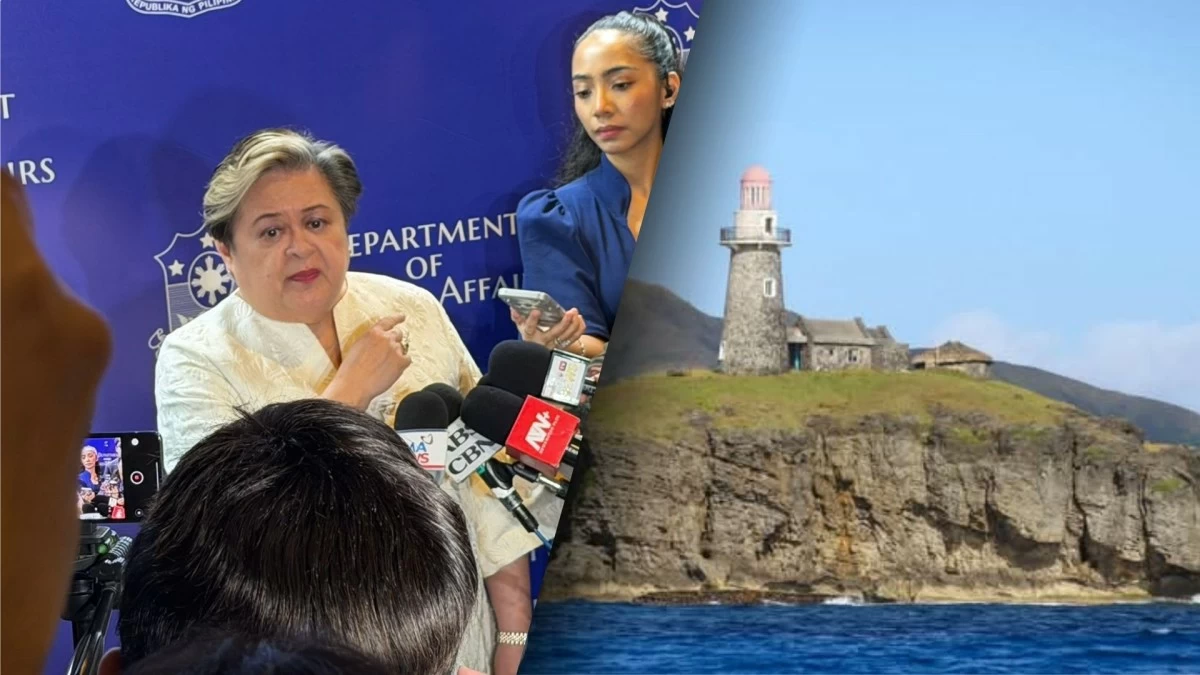
Department of Foreign Affairs (DFA) Secretary Ma. Theresa Lazaro brushed aside Chinese academics' claims that Batanes belongs to China, saying the Philippine government deals with official state positions rather than the views of individual scholars.
Responding to questions about the controversy on the sidelines of the conference marking the 10th anniversary of the 2016 Arbitral Award, Lazaro said the claims should not be viewed as an official position of Beijing.
"These are academics. Sometimes the academics really—well, they are academics," she said on July 10.
The country's top diplomat stressed that Philippine foreign policy is guided by official government pronouncements.
"We listen to government—we only listen to government. That's only what we can say," Lazaro said.
"I think we have to be very focused on what the position has taken, how it has evolved," she added.
Lazaro added that while legal decisions often face challenges, the Philippines must remain united in upholding the 2016 Arbitral Award.
"Of course, in any case, even a decision of the Supreme Court, it has its own challenges. That's why everybody should [make] a concerted effort to continue and to always look into the decisions of the arbitral tribunal," she said.
The controversy stemmed from a June 30 symposium at Jinan University in Guangzhou, where Chinese scholars claimed that Batanes is a "natural geographical extension" of Taiwan and therefore falls under China's sovereignty. They also argued that the Philippines' administration of Batanes allegedly lacks historical and legal basis.
The scholars cited historical records from the Ming and Qing dynasties, cultural ties between the Ivatan people and Taiwan's Tao community, and their interpretation of the 1898 Treaty of Paris and the 1946 Treaty of Manila to support their position.
The Chinese government has not officially endorsed the symposium's conclusions.
Embassy rejects allegations
The Chinese Embassy in the Philippines likewise rejected attempts to link Ambassador Jing Quan's recent visit to Batanes with the symposium.
Deputy Spokesperson Guo Wei criticized Philippine Coast Guard spokesperson for the West Philippine Sea, Commodore Jay Tarriela, after the latter questioned whether the ambassador's June visit was connected to Beijing's territorial narrative.
"Mr. Jay Tarriela deliberately linked the Ambassador's visit with some academic discussion and tried to create hostility between the Chinese and Filipino peoples," Guo said.
"Such old tricks fool nobody but himself," he added.
Tarriela had posted on social media that the Chinese Communist Party was "spreading propaganda," suggesting that Batanes forms part of China, and questioned whether Ambassador Jing's visit to the province had been made in goodwill or to survey territory Beijing intended to claim.
Ambassador Jing visited Batanes from June 16 to 18, where he met Governor Ronald Aguto Jr. and Vice Governor Jhong Nanud and visited projects supported by the embassy, including an organic farm and Batanes State College.
More patrols
Defense Secretary Gilberto Teodoro Jr. earlier said the Armed Forces of the Philippines (AFP) would increase patrols not only around Batanes but throughout the country's maritime domain following the controversy.
He added that maintaining a visible presence in Philippine waters is essential to preventing attempts to undermine the country's sovereignty.
Security analysts, including SeaLight Director Ray Powell, have described the symposium as part of Beijing's broader "lawfare" strategy aimed at introducing new territorial narratives without direct government endorsement.
Meanwhile, Palace ally and civic leader Jose Antonio Goitia said no historical narrative could alter Philippine sovereignty over Batanes.
"Batanes did not become Filipino by declaration. It became Filipino through generations who built their lives, raised their families, and cast their votes as citizens of this Republic,” he said.
Goitia said claims made by Chinese scholars deserved "a firm, measured response," warning that repeated false narratives could influence international perception even if they do not change historical facts.
"Scholarship that seeks truth deserves respect. Scholarship that begins with a conclusion and works backward deserves scrutiny," he said.
Goitia emphasized that geography, cultural similarities, or historical maps cannot override continuous Philippine governance over the province.
"A nation's sovereignty is not determined by proximity, propaganda, or political convenience," he said.
"It is established by history, affirmed by law, sustained by governance, and defended by the unwavering will of its people," he added.
He urged the Philippines to continue defending its sovereignty through diplomacy and adherence to the rules-based international order.
"Batanes is not merely our northern frontier. It is the enduring bond between a nation and its people," Goitia said.
"That bond cannot be broken by revisionist narratives because it has been forged through history, strengthened by freedom, and carried in the hearts of generations of Filipinos," he added.