ADVERTISEMENT

The advice these freelancers would give their younger selves

By MBrand
Published Jul 10, 2026 05:36 pm
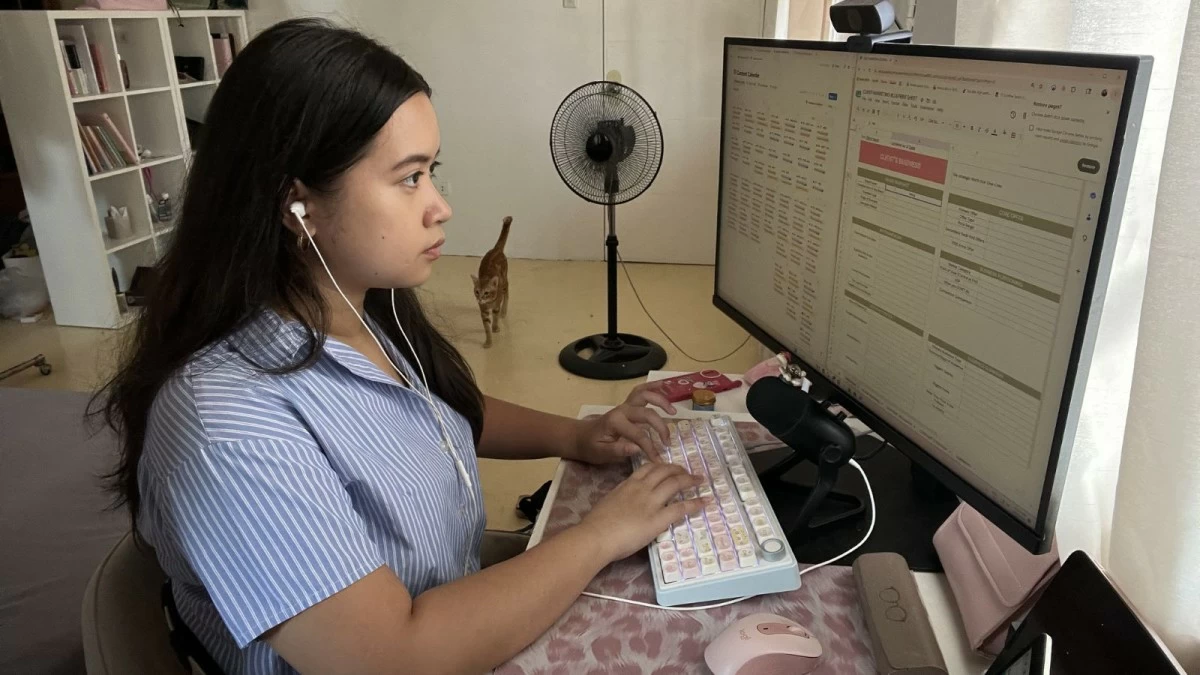
Andrea Sumida shares that freelancing requires closely tracking her projects and workload to stay on top of her finances and commitments.
What people don’t always see about freelancing is the reality of irregular income, delayed payments, and tax fees that chip away at their earnings before it even gets to them. But with the right habits and tools to manage and protect their income, freelancers can build more stability into the way they earn, making sure their income can stretch across everyday expenses and slower months. Here’s how freelancers Andrea Sumida, founder and creative strategist of Kohi Social, and Lyn Cepillo, a content creator and social media manager, make it work.
Building your budget around your most conservative income month
Because of the unpredictability that comes with freelancing work, many long-time freelancers encourage building one’s monthly budget around their lowest-income month. This way, it creates a financial safeguard and ensures essential living expenses like rent, groceries, and bills are still covered during slow periods. Anything earned beyond that can then go toward personal rewards, savings, or even investments.
“When I first started freelancing, one of my biggest struggles was treating every payment like stable income.” Andrea shares, “Since projects and payments were irregular, there were months that felt abundant and others that felt very tight. I also underestimated how important budgeting, emergency funds, and cash flow management were as a freelancer.”
Managing how your money moves across platforms
For freelancers earning in international currencies like USD, earnings often pass through multiple platforms. They receive payments through one platform, convert currencies through another, then transfer funds again to a local bank, this time just to access their earnings.
“Freelancers mostly think it’s just 1 to 3 percent, but when you actually think about it, like when it seems to accumulate, you’ll realize how big it actually is,” Lyn points out. “Imagine transferring platform to platform, and each platform has its own different conversion and transfer fees. They look at the percentages and think it’s small, but with the current economy, each deduction could be at least one meal, which is a big thing.”
Lyn Cepillo has seen how quickly fees add up, making a reliable payment solution like the GCash Virtual US Account essential when juggling multiple international clients.
To avoid these deductions, Lyn and Andrea use the GCash Virtual US Account, which removes the need to move money across multiple platforms. Once USD is deposited into this account, users have control over when to convert it and withdraw it to their GCash wallets. From there, users can pay bills, save, and even invest all within the platform.

As Andrea explains, “For me, tools like GCash help simplify day-to-day transactions, bills, transfers, and even budgeting. It removes a lot of friction from managing finances, especially when you’re handling multiple projects or clients at once.”
Freelancers can start using the GCash Virtual US Account by simply following these steps:
1. Open the GCash app. Tap US Accounts in the Explore the App section.
2. Tap Continue and verify your information.
3. Complete your account creation.

Related Tags

leisure GCash Freelance
ADVERTISEMENT
.most-popular .layout-ratio{ padding-bottom: 79.13%; } @media (min-width: 768px) and (max-width: 1024px) { .widget-title { font-size: 15px !important; } }

{{ articles_filter_1561_widget.title }}

.most-popular .layout-ratio{ padding-bottom: 79.13%; } @media (min-width: 768px) and (max-width: 1024px) { .widget-title { font-size: 15px !important; } }

{{ static_articles_1562_widget.title }}

.most-popular .layout-ratio{ padding-bottom: 79.13%; } @media (min-width: 768px) and (max-width: 1024px) { .widget-title { font-size: 15px !important; } }

{{ articles_filter_1563_widget.title }}

{{ articles_filter_1564_widget.title }}

.mb-article-details { position: relative; } .mb-article-details .article-body-preview, .mb-article-details .article-body-summary{ font-size: 17px; line-height: 30px; font-family: "Libre Caslon Text", serif; color: #000; } .mb-article-details .article-body-preview iframe , .mb-article-details .article-body-summary iframe{ width: 100%; margin: auto; } .read-more-background { background: linear-gradient(180deg, color(display-p3 1.000 1.000 1.000 / 0) 13.75%, color(display-p3 1.000 1.000 1.000 / 0.8) 30.79%, color(display-p3 1.000 1.000 1.000) 72.5%); position: absolute; height: 200px; width: 100%; bottom: 0; display: flex; justify-content: center; align-items: center; padding: 0; } .read-more-background a{ color: #000; } .read-more-btn { padding: 17px 45px; font-family: Inter; font-weight: 700; font-size: 18px; line-height: 16px; text-align: center; vertical-align: middle; border: 1px solid black; background-color: white; } .hidden { display: none; }
function initializeAllSwipers() { // Get all hidden inputs with cms_article_id document.querySelectorAll('[id^="cms_article_id_"]').forEach(function (input) { const cmsArticleId = input.value; const articleSelector = '#article-' + cmsArticleId + ' .body_images'; const swiperElement = document.querySelector(articleSelector); if (swiperElement && !swiperElement.classList.contains('swiper-initialized')) { new Swiper(articleSelector, { loop: true, pagination: false, navigation: { nextEl: '#article-' + cmsArticleId + ' .swiper-button-next', prevEl: '#article-' + cmsArticleId + ' .swiper-button-prev', }, }); } }); } setTimeout(initializeAllSwipers, 3000); const intersectionObserver = new IntersectionObserver( (entries) => { entries.forEach((entry) => { if (entry.isIntersecting) { const newUrl = entry.target.getAttribute("data-url"); if (newUrl) { history.pushState(null, null, newUrl); let article = entry.target; // Extract metadata const author = article.querySelector('.author-section').textContent.replace('By', '').trim(); const section = article.querySelector('.section-info ').textContent.replace(' ', ' '); const title = article.querySelector('.article-title h1').textContent; // Parse URL for Chartbeat path format const parsedUrl = new URL(newUrl, window.location.origin); const cleanUrl = parsedUrl.host + parsedUrl.pathname; // Update Chartbeat configuration if (typeof window._sf_async_config !== 'undefined') { window._sf_async_config.path = cleanUrl; window._sf_async_config.sections = section; window._sf_async_config.authors = author; } // Track virtual page view with Chartbeat if (typeof pSUPERFLY !== 'undefined' && typeof pSUPERFLY.virtualPage === 'function') { try { pSUPERFLY.virtualPage({ path: cleanUrl, title: title, sections: section, authors: author }); } catch (error) { console.error('ping error', error); } } // Optional: Update document title if (title && title !== document.title) { document.title = title; } } } }); }, { threshold: 0.1 } ); function showArticleBody(button) { const article = button.closest("article"); const summary = article.querySelector(".article-body-summary"); const body = article.querySelector(".article-body-preview"); const readMoreSection = article.querySelector(".read-more-background"); // Hide summary and read-more section summary.style.display = "none"; readMoreSection.style.display = "none"; // Show the full article body body.classList.remove("hidden"); } document.addEventListener("DOMContentLoaded", () => { let loadCount = 0; // Track how many times articles are loaded const offset = [1, 2, 3, 4, 5, 6, 7, 8, 9, 10]; // Offset values const currentUrl = window.location.pathname.substring(1); let isLoading = false; // Prevent multiple calls if (!currentUrl) { console.log("Current URL is invalid."); return; } const sentinel = document.getElementById("load-more-sentinel"); if (!sentinel) { console.log("Sentinel element not found."); return; } function isSentinelVisible() { const rect = sentinel.getBoundingClientRect(); return ( rect.top < window.innerHeight && rect.bottom >= 0 ); } function onScroll() { if (isLoading) return; if (isSentinelVisible()) { if (loadCount >= offset.length) { console.log("Maximum load attempts reached."); window.removeEventListener("scroll", onScroll); return; } isLoading = true; const currentOffset = offset[loadCount]; window.loadMoreItems().then(() => { let article = document.querySelector('#widget_1690 > div:nth-last-of-type(2) article'); intersectionObserver.observe(article) loadCount++; }).catch(error => { console.error("Error loading more items:", error); }).finally(() => { isLoading = false; }); } } window.addEventListener("scroll", onScroll); });

Sign up by email to receive news.