






 Philippines
National
Protecting Philippine maritime patrimony cannot be abandoned by any administration—SolGen
Philippines
National
Protecting Philippine maritime patrimony cannot be abandoned by any administration—SolGen
Protecting Philippine maritime patrimony cannot be abandoned by any administration—SolGen


At A Glance
- Solicitor General Darlene Berberabe said protecting the country's marine patrimony is a constitutional duty that transcends political administrations.
- She said the Philippines has taken "bolder steps" since 2022 to uphold and operationalize the 2016 South China Sea arbitral ruling.
- Berberabe said the arbitral award now endures through the Constitution, domestic laws, and government institutions—not just as an international legal victory.
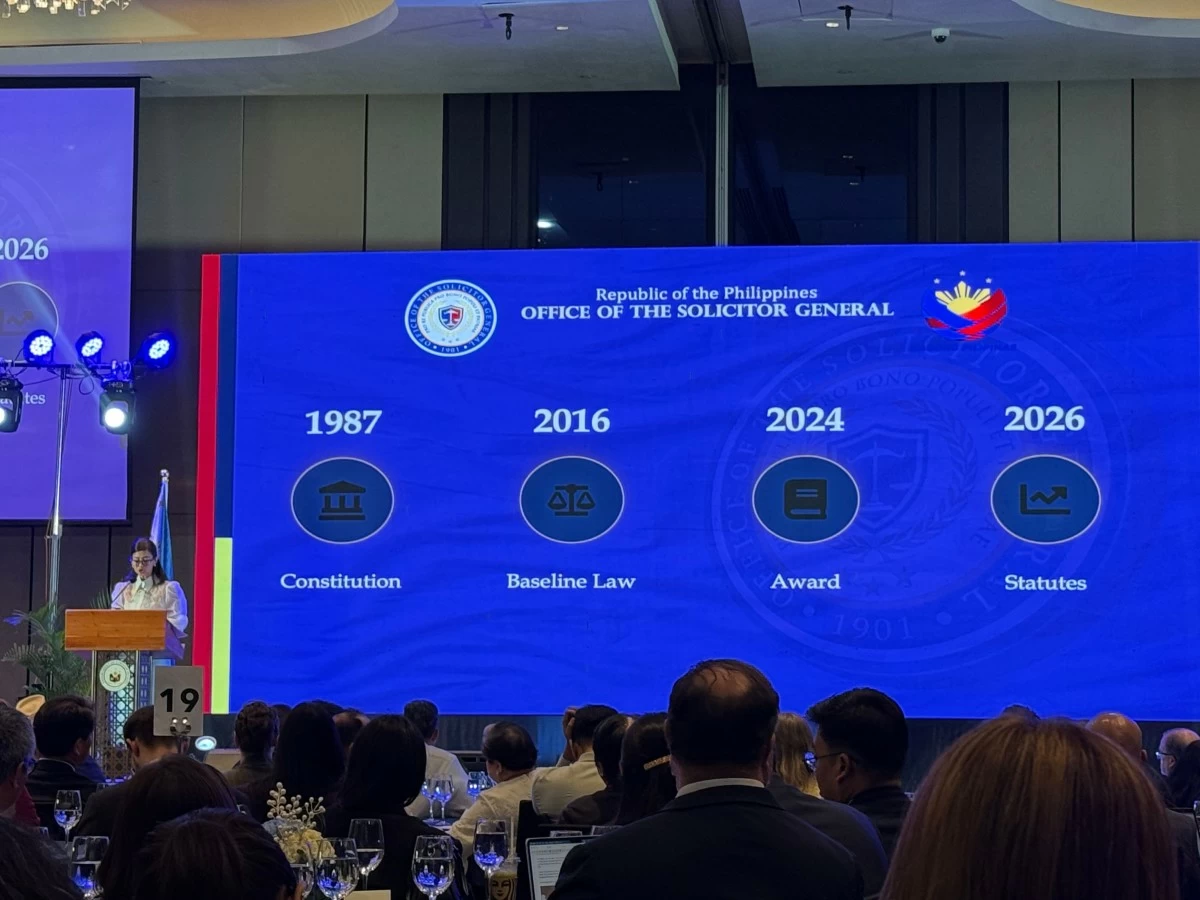
The protection of the Philippines’ marine patrimony is a constitutional obligation that no administration can simply abandon, Solicitor General Darlene Berberabe said as the country marked the 10th anniversary of the landmark South China Sea arbitral ruling.
Speaking at the commemorative conference titled “A Decade Hence: The Enduring Promise of Peaceful Dispute Settlement” in Pasay City on Friday, July 10, Berberabe said the duty to safeguard the country’s maritime rights belongs to the State itself, regardless of changes in political leadership.
“The protection of our marine patrimony is not a policy that administrations may take up or set down as they please. It is a standing constitutional duty addressed to the State itself, which is to say, to every one of us in this room,” she said.
Berberabe stressed that the Philippines’ maritime rights stem not only from the 2016 arbitral award but also from the 1987 Constitution, particularly Article XII, Section 2, which mandates the State to protect the nation’s marine wealth within its archipelagic waters, territorial sea, and exclusive economic zone (EEZ).
“The protection of our marine patrimony is not a policy… It is a standing constitutional duty,” she reiterated.
According to the Solicitor General, the arbitral ruling has already become institutionalized to the point that it can no longer be undone by changes in political leadership.
“Administrations change. Emphasis shift. Budgets rise and fall,” she said.
“The Republic, however, is a continuing client, and this decade’s work has moved the award’s protection beyond the reach of any single season of politics.”
Berberabe said the award now lives through the Constitution, national legislation, government institutions, official maps, diplomatic protests, and the daily work of Filipino fishermen.
“The award is paper until a Republic chooses to live by it. And for 10 years, through every test, the Filipino people have chosen to live by the award,” she said.
Award now embedded in Philippine law
According to Berberabe, the arbitral award has evolved beyond a single international legal decision and has become embedded in Philippine laws and institutions.
“The promulgation of a judgment is an event, but a legal protection ought not to be a singular moment, but consistent practice,” she said.
“The South China Sea Award endures to this day not because it was rendered in The Hague, but because the Republic decided—in our Constitution, in our laws, in our institutions, and outwards in our dealings with the world—to live by it,” she added.
The Solicitor General noted that the ruling inspired a series of legislative and executive measures, including the enactment of the Philippine Maritime Zones Act and the Archipelagic Sea Lanes Act in 2024, both of which President Marcos signed into law.
Earlier this year, President Marcos also issued Executive Order No. 111 directing the National Mapping and Resource Information Authority (NAMRIA) to publish official nautical charts bearing Philippine names for maritime features in the Kalayaan Island Group and reflecting the country’s maritime zones under the new law.
“I invite you to trace the arc with me—a constitutional command of 1987, the legal certainty of 2016, the statute books of 2024, the 2026 directive to publish the charts. That is what enduring protection looks like in a republic of laws,” she said.
‘Bolder steps’ under Marcos administration
Berberabe also said the Philippines has become more assertive in advancing the arbitral award and protecting the country’s maritime rights since President Marcos assumed office in 2022.
“This has not always been the case, but since 2022, the Philippines has taken bolder steps in advancing the award and its protections,” she said.
She cited the Philippine Coast Guard’s practice of publicly documenting incidents in the West Philippine Sea, saying every recorded encounter serves as potential evidence while increasing international awareness of developments in the disputed waters.
“The Coast Guard has made a practice of publishing what happens at sea. Every event is recorded. Every record is potential evidence. We have now chosen to let the world see what has been happening. And by all indications, the world now pays closer attention,” she said.
Berberabe also pointed to Executive Order No. 57, signed in March 2024, which reorganized the National Coast Watch Council into the National Maritime Council and attached the National Task Force for the West Philippine Sea to the body to strengthen interagency coordination.
She likewise cited the work of the Bureau of Fisheries and Aquatic Resources, NAMRIA, the Department of Foreign Affairs, and the Armed Forces of the Philippines in enforcing the country’s maritime rights.
“It is the Coast Guard holding station in our waters with discipline under immense provocation… It is BFAR standing beside our fisherfolk… It is NAMRIA drawing the charts. It is the Department of Foreign Affairs filing the protests patiently, one by one. It is the Armed Forces sustaining a presence that gives the law not merely a witness, but teeth,” she said.
The Philippines secured a landmark victory on July 12, 2016, when the Permanent Court of Arbitration in The Hague invalidated China’s sweeping nine-dash line claim over most of the South China Sea.
The tribunal ruled that China’s claims had no legal basis under the United Nations Convention on the Law of the Sea (UNCLOS) and affirmed the Philippines’ sovereign rights within its exclusive economic zone, including areas in the West Philippine Sea.
China has rejected the ruling and continues to disregard the decision.