






 Philippines
National
Philippines won't retreat in West PH Sea, won't let disinformation weaken democracy — Recto
Philippines
National
Philippines won't retreat in West PH Sea, won't let disinformation weaken democracy — Recto
Philippines won't retreat in West PH Sea, won't let disinformation weaken democracy — Recto


At A Glance
- Executive Secretary Ralph Recto said the Philippines will continue defending its sovereign rights in the West Philippine Sea (WPS) while remaining committed to peace.
- Recto also warned that disinformation, cyberattacks, artificial intelligence (AI), and foreign interference have become major national security threats.
- He said the Marcos administration has significantly increased funding for the National Security Council (NSC) and the National Intelligence Coordinating Agency (NICA) to address evolving security challenges.
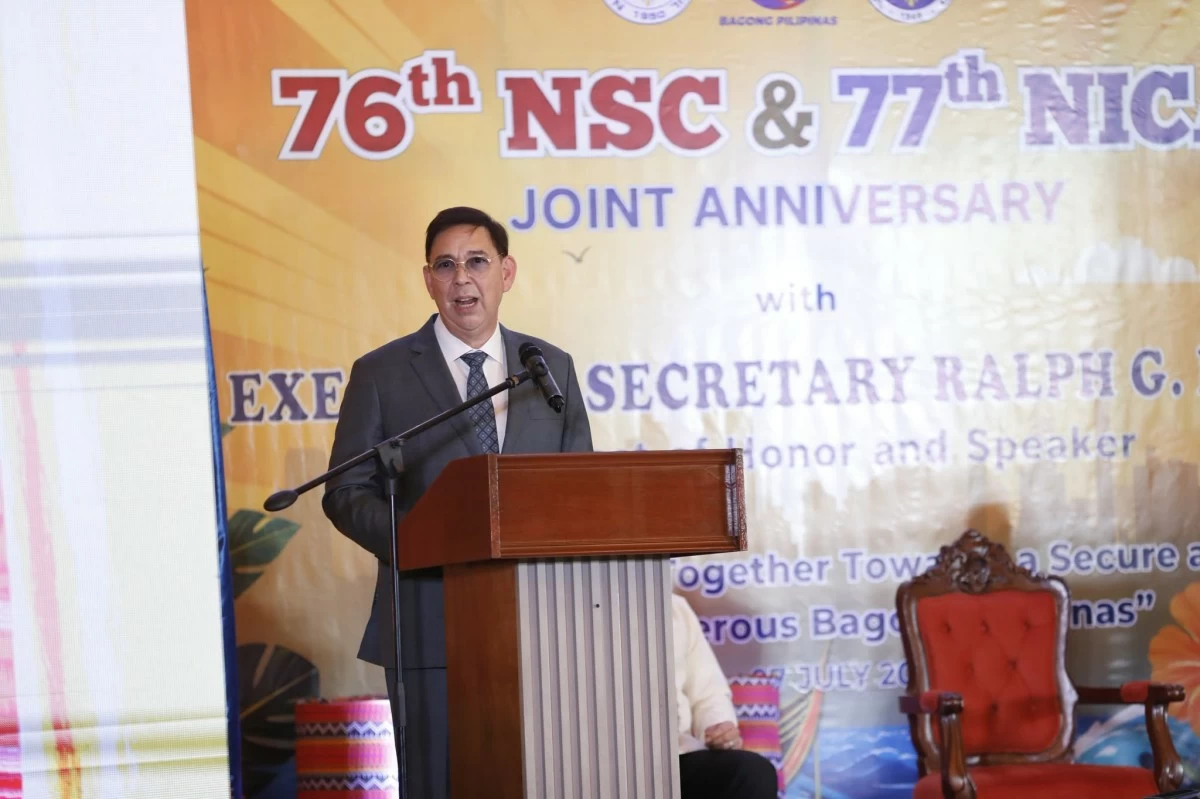
The Philippines will continue asserting its sovereign rights in the West Philippine Sea (WPS) without abandoning its commitment to peace while confronting new security threats such as disinformation, cyberattacks, and artificial intelligence-driven manipulation, Executive Secretary Ralph Recto said.
Speaking during the joint celebration of the 76th founding anniversary of the National Security Council (NSC) and the 77th anniversary of the National Intelligence Coordinating Agency (NICA), Recto said safeguarding the country's territorial integrity now goes hand in hand with protecting Filipinos from threats in cyberspace and the information environment.
"In the West Philippine Sea, security means defending every inch of our sovereign rights without surrendering our commitment to peace," Recto said on Tuesday, July 7.
"We will not provoke. But we will not retreat. We will not seek conflict. But we will not yield what is ours,” he added.
Recto said the country's maritime rights are more than territorial claims.
"For our seas are not abstract lines on a map. They are the workplace of our fishermen, the pantry of our people, the inheritance of our children," he said.
His remarks echoed President Marcos' longstanding policy of defending the country's sovereign rights in the WPS through diplomacy, adherence to international law, and partnerships with like-minded countries while avoiding actions that could escalate tensions.
The statement also comes days after Canada reaffirmed its support for the 2016 Arbitral Award and the rules-based international order during President Marcos' official visit to Vancouver, where Manila and Ottawa elevated bilateral relations to a strategic partnership.
Fake news now a security threat
Recto said the nature of national security has evolved beyond conventional military threats, warning that disinformation and online manipulation now pose serious risks to democracy and public trust.
"It may begin with a false story designed to make Filipinos distrust one another," he said as he described how future threats may emerge.
"A lie repeated a thousand times should not be allowed to defeat a truth spoken once. It becomes an attack on trust, on institutions, and on democracy itself," he added.
Recto, however, emphasized that efforts to protect national security must not come at the expense of civil liberties.
"But security must never be used as an excuse to weaken freedom," he said.
"Our duty is not to choose between a safe nation and a free nation. Our duty is to build a nation strong enough to be both," he added.
Modern threats, modern response
The Executive Secretary said national security challenges have expanded far beyond traditional battlefields.
Threats today, he said, could come in the form of cyberattacks targeting government systems, power grids, banks, hospitals, and schools; extremist groups exploiting poverty and fear; or foreign interference disguised through local actors.
"In cyberspace, security means understanding that a single breach can now do what an army once did: paralyze services, steal secrets, weaken trust, and endanger lives," Recto said.
"In the age of AI, security also means building intelligence systems that can match the challenges before us," he added.
Bigger budgets for NSC, NICA
Recto said the Marcos administration has significantly increased funding for both the NSC and NICA to strengthen the country's national security capabilities.
"This year, the National Security Council's budget stands at almost three times its level at the start of this administration," he said.
"Over the same period, NICA's budget has nearly doubled—a clear measure of this administration's trust in your mission and commitment to national preparedness," he added.
The Palace official assured personnel of both agencies that they have President Marcos' full support as they continue carrying out their mandate.
Every Filipino has a role
Meanwhile, Recto said national security is not solely the responsibility of intelligence and security agencies but of every Filipino.
"As we face the future, we must also remember that national security is not the work of one agency alone," he said.
"It is every Filipino who understands that the country is not a spectator sport. We all have a post to guard,” he added.