







Marcos: Rule of law—not might—must govern South China Sea


At A Glance
- President Marcos said the rule of law, not military or economic power, must govern the seas as the Philippines marked the 10th anniversary of the landmark 2016 Arbitral Award.
- He reaffirmed the Philippines' commitment to the United Nations Convention on the Law of the Sea (UNCLOS) and the rules-based international order.
- Marcos said the arbitral ruling is ultimately about protecting the livelihoods of Filipino fisherfolk and preserving peace in the South China Sea.
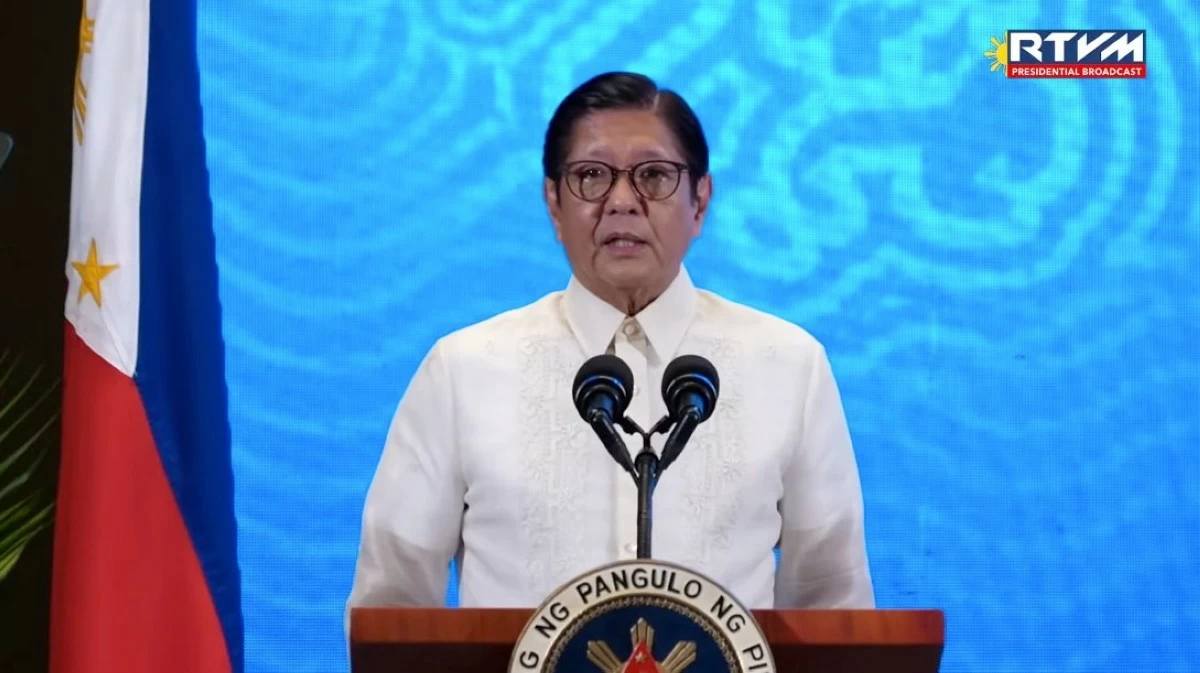
President Marcos said that the rule of law—not military or economic might—must govern the South China Sea, as he reaffirmed the Philippines' commitment to the 2016 Arbitral Award on its 10th anniversary.
Speaking before diplomats, government officials, legal experts, and international partners during a diplomatic reception commemorating the landmark ruling, the President said international law ensures that all nations, regardless of size, are treated equally.
"For the rule of law is a great equalizer of all nations," he said on Friday, July 10.
"It ensures that right is not defined by might, that justice is never dictated by the relative size of a nation's territory, military, or economic power," he added.
Marcos stressed that the rules-based international order allows sovereign states to interact as equals and ensures that treaties "must be fully respected, faithfully interpreted, and consistently applied."
The President said the Philippines' decision to pursue arbitration in 2013 demonstrated its commitment to peaceful dispute resolution.
"Thirteen years ago, when the Philippines initiated these arbitration proceedings, we stood before the world to assert a timeless, universal principle that disputes between nations must be resolved not through coercion, not through the threat or use of force, but through peaceful means and the rule of law," he said.
"In making that historic decision in 2013, which culminated in the landmark 2016 Arbitral Award, our nation chose dialogue over confrontation, law over intimidation, and peace over conflict," he added.
PH remains committed to UNCLOS
Marcos reiterated that the Philippines would continue to uphold the United Nations Charter and the 1982 United Nations Convention on the Law of the Sea (UNCLOS), which formed the basis of the arbitral proceedings.
"For the Philippines, our path forward remains clear and absolute," he said.
"We remain steadfastly committed to the United Nations Charter and to UNCLOS," he added.
The President said that pursuing peace does not mean remaining passive in the face of challenges.
"For our pursuit of peace is not passive. It requires the courage to defend what is right, to uphold our international commitments, and to engage constructively with all who seek mutual respect and shared prosperity," he said.
The Permanent Court of Arbitration in The Hague ruled on July 12, 2016, that China's expansive "nine-dash line" claim over much of the South China Sea has no legal basis under UNCLOS. The tribunal also affirmed the Philippines' sovereign rights within its exclusive economic zone in the West Philippine Sea. China has consistently rejected the ruling.
Award protects fisherfolk
Marcos emphasized that the arbitral ruling goes beyond legal principles and territorial issues, saying it directly affects the lives of ordinary Filipinos.
"But let us not forget, the 2016 Arbitral Award is not just an abstract triumph of jurisprudence. It has a profound and deeply human dimension," he said.
"At its heart, this award is about people. It is about our fisherfolk whose ancestors have cast their nets in these waters for many generations, and who deserve to fish in peace, in safety, and with the dignity to feed their own families," he added.
The President also cited coastal communities whose livelihoods depend on healthy marine ecosystems.
"When we defend the rule of law, we are not merely defending lines on a map. We are defending the lives, the livelihoods, and the future of our peoples," he said.
South China Sea 'must never be an arena of conflict'
Marcos also renewed the Philippines' call for the South China Sea to remain a region of peace and cooperation.
"We hold a simple but unwavering conviction. The South China Sea must never be an arena of conflict," he said.
"It must remain a sea of peace, cooperation, and connectivity—a body of water that sustains livelihoods, fosters trade, protects marine biodiversity, and unites rather than divides our nations," he added.
The President said the 2016 Arbitral Award has, over the past decade, become an important reference in the interpretation and application of UNCLOS and has strengthened confidence in international dispute settlement mechanisms.
Thanks partners
Marcos concluded by thanking the Philippines' international partners for supporting a rules-based international order.
"To our friends and partners from around the world, thank you for standing with the Philippines in defense of a rules-based order," he said.
He urged governments, diplomats, and citizens to continue building on the legacy of the arbitral ruling.
"Let the next decade be defined not by what international law prevents, but by what we can collectively achieve when we honor its promise to protect the vulnerable, to safeguard our oceans, and to secure a stable, peaceful world," the President said.
The diplomatic reception capped a day-long conference marking the 10th anniversary of the landmark ruling, which has been repeatedly cited by the Marcos administration as the cornerstone of the Philippines' policy in the West Philippine Sea.
The President has consistently maintained that the award is "beyond compromise and beyond negotiation," a position echoed in recent joint statements with partners including Canada, Japan, Australia, the European Union, and the United States.