






 Philippines
National
2016 South China Sea Arbitral Award 'not subject to negotiation or compromise' — DFA
Philippines
National
2016 South China Sea Arbitral Award 'not subject to negotiation or compromise' — DFA
2016 South China Sea Arbitral Award 'not subject to negotiation or compromise' — DFA


At A Glance
- Foreign Affairs Secretary Ma. Theresa Lazaro reaffirmed that the 2016 South China Sea Arbitral Award is final, legally binding, and not subject to negotiation or compromise.
- The Philippines vowed to continue anchoring its foreign policy on the arbitral ruling and the United Nations Convention on the Law of the Sea (UNCLOS).
- The DFA said Manila will use the arbitral award as the legal basis for pursuing a binding Code of Conduct in the South China Sea while strengthening partnerships with like-minded countries.
The Philippines firmly declared that the landmark 2016 South China Sea Arbitral Award is "not subject to negotiation or compromise," as it marked the ruling's 10th anniversary and reaffirmed its commitment to defending the country's maritime rights through international law.
Speaking at the commemorative conference titled "A Decade Hence: The Enduring Promise of Peaceful Dispute Settlement," Department of Foreign Affairs (DFA) Secretary Ma. Theresa Lazaro said the award remains a permanent legal foundation for the country's foreign policy despite continued challenges in the West Philippine Sea.
"This award is final. It is legally binding," she said Friday, July 10.
"It is not a mere statement of policy. It is not subject to negotiation or compromise. It is an unshakable, permanent anchor of our rules-based international order," she added.
Lazaro likened the arbitral ruling to a lighthouse that continues to guide nations amid rising geopolitical tensions.
"A lighthouse does not block the winds. It does not command the tides. It stands immovable upon bedrock, casting a steady, piercing beam to warn of hazards and guide all ships to safe harbor," she said.
The foreign affairs chief recalled that the Philippines initiated arbitration proceedings against China in 2013 not only to protect its own interests but also to uphold international law for all nations facing similar challenges.
"We did not do so for ourselves alone. We acted to speak for every nation, especially those who find in international law a vital shield against geopolitical uncertainty and the stark asymmetries of power," Lazaro said.
The Permanent Court of Arbitration in The Hague ruled on July 12, 2016, that China's expansive "nine-dash line" claim has no legal basis under the United Nations Convention on the Law of the Sea (UNCLOS). Beijing has consistently rejected the ruling.
Foreign policy anchored on ruling
Lazaro said the arbitral award and UNCLOS will remain central pillars of Philippine foreign policy as the country navigates an increasingly complex strategic environment.
She added that the Philippines’ approach is anchored in four core dynamics.
"First, we maintain a steadfast commitment to international law. With UNCLOS and the 2016 Arbitral Award as integral anchors of Philippine foreign policy, we will navigate the complexities of our strategic environment with clarity, restraint, and resolve."
She said the Philippines would continue asserting its maritime rights through peaceful and lawful means.
The Marcos administration has consistently reaffirmed that the arbitral ruling is non-negotiable, with President Marcos repeatedly declaring that the Philippines "will not yield even a square inch" of its territory and maritime entitlements.
During his recent official visit to Canada, Marcos welcomed Prime Minister Mark Carney's reaffirmation of support for the 2016 arbitral ruling as both countries elevated bilateral ties to a strategic partnership and agreed to deepen maritime and defense cooperation.
Code of Conduct
Lazaro also said the Philippines will continue engaging regional partners while using the arbitral ruling as its legal baseline in negotiations for a Code of Conduct in the South China Sea.
"Second, we keep lines of communication open. We will use this award as our clear legal and policy baseline to engage partners and pursue an effective, legally binding Code of Conduct in the South China Sea," she said.
Negotiations between ASEAN and China on the long-awaited Code of Conduct have been ongoing for years, with the Philippines pushing for an agreement that is consistent with UNCLOS and does not undermine the 2016 arbitral award.
Alliances for peace
The foreign affairs chief likewise underscored the importance of expanding partnerships with like-minded countries to promote peace and stability in the Indo-Pacific.
"Third, we maximize our alliances and partnerships," Lazaro said.
"We will reinforce our capacities through purposeful engagement because cooperation deters conflict, de-escalates tensions, and raises prospects for peace," she added.
She also said the Philippines would continue pursuing a "confident, deliberate, and principled" foreign policy that asserts the country's sovereign rights while contributing to a peaceful, stable, and rules-based maritime order.
“We will ensure our domestic capacities are fully supported by a foreign policy that firmly asserts our rights, advances our interests, and contributes to a peaceful, stable, and rules-based maritime order,” Lazaro said.
Award benefits all nations
Lazaro said the significance of the arbitral ruling now extends well beyond the Philippines, noting that it has become part of international jurisprudence and has been cited by international courts and tribunals.
"The beam of this lighthouse has reached far beyond our own coastlines. It is now an unassailable part of the fabric of international law," she said.
She added that the ruling's principles have become relevant not only to maritime disputes but also to broader issues such as marine environmental protection, biodiversity conservation, and ocean governance.
"To support the 2016 Arbitral Award is to support the very architecture of our rules-based international order," Lazaro said.
"Let this commemoration be a space to keep this lighthouse burning bright, for its light is our commitment, its clarity is our peace, and its enduring promise is a stable, rules-based world for generations to come," she added.
Commemorative stamp
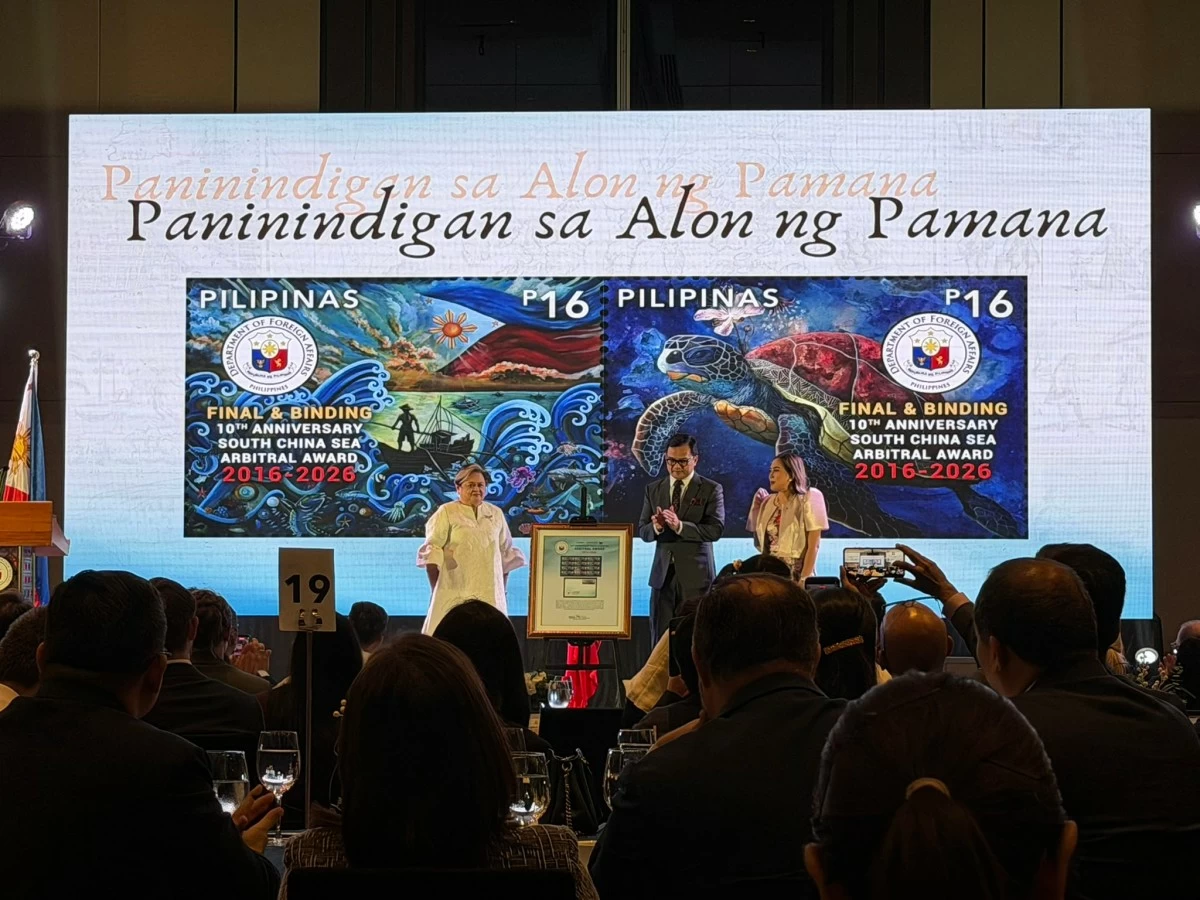
Meanwhile, Lazaro and Philippine Postal Corporation (PHLPost) Postmaster General Maximo Sta. Maria III unveiled the commemorative stamp for the 10th anniversary of the South China Sea Arbitral Award during the event.
The stamp set features two designs bearing the inscription "Final & Binding: 10th Anniversary South China Sea Arbitral Award 2016–2026," underscoring the Philippines' position that the landmark ruling remains legally binding under international law.
One stamp depicts a Filipino fisherman against the backdrop of the Philippine flag and the country's rich marine resources. While the other features a green sea turtle (pawikan), an original painting by visual artist Mary Joy Ann Tuaño.