







PNP nets P3.31-B illicit cigarettes in Caraga, highest in PH
By MBrand
Published Jul 9, 2026 02:01 pm


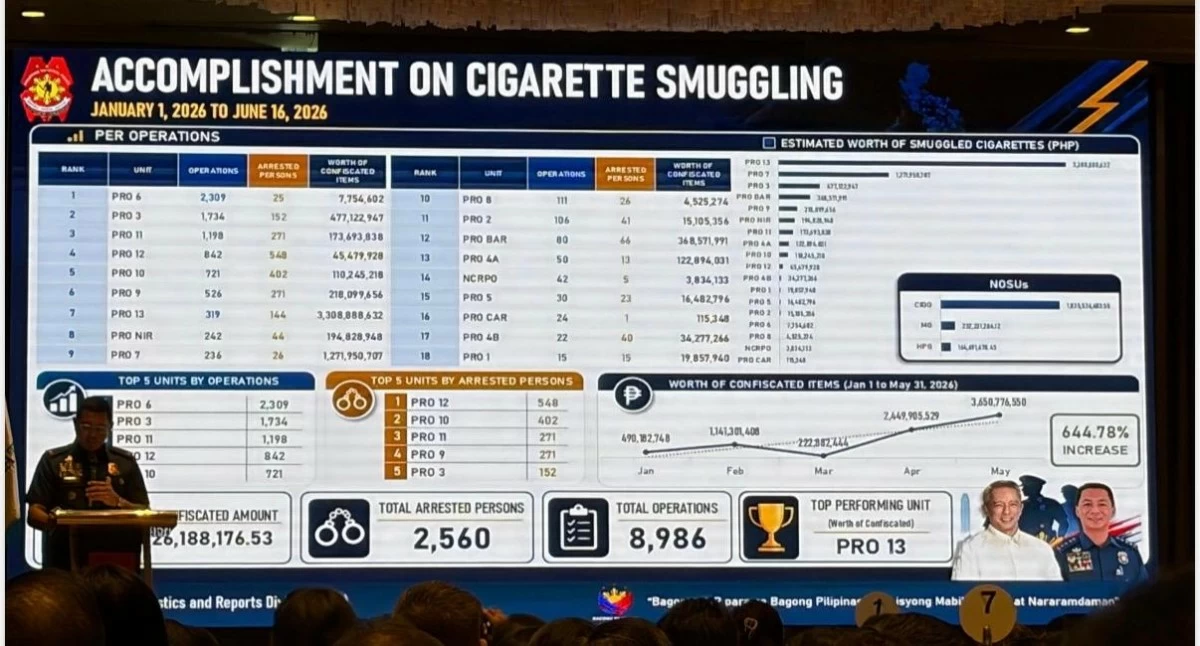
The Caraga region in Mindanao has become the country’s leading hotspot for illegal tobacco trade after posting the highest volume of police seizures in the first six months of 2026.
From January to June 2026, the Philippine National Police (PNP) seized P3.31 billion worth of illicit cigarettes in Region 13, which is under the PNP Police Regional Office (PRO) 13.
The haul came from 319 police operations that resulted in the arrest of 144 suspected smugglers.
Region 13 covers the Caraga region in northeastern Mindanao, including Agusan del Norte, Agusan del Sur, Dinagat Islands, Surigao del Norte, and Surigao del Sur.
Region 7, or Central Visayas, ranked second with P1.3 billion in seized illicit cigarettes, followed by Region 3, or Central Luzon, with nearly P500 million.
Completing the Top 5 illicit tobacco hotspots by estimated value of seized contraband were the Bangsamoro Autonomous Region in Muslim Mindanao
or BARMM, with P368.7 million, and Region 9, or the Zamboanga Peninsula, with P218.1 million.The PNP is also closely monitoring the Cordillera Administrative Region (CAR), which posted the lowest haul at P115.3 million, to prevent it from becoming another hotspot.
Police Brig. Gen. Ponce Peñones Jr. said during the recent Tobacco Summit that police arrested 2,560 people linked to the illicit tobacco trade in 8,986 operations during the six-month period.
Peñones said first-half seizures rose 644.8 percent from the same period last year. He said the raids helped the government prevent an estimated P26.2 billion in foregone revenues had the illicit cigarettes reached the market.
Peñones cited the country’s vast maritime borders, established smuggling routes, low conviction rates, and limited storage facilities as among the PNP’s biggest challenges.
Interior and Local Government Secretary Juanito Victor “Jonvic” Remulla, also a speaker at the Tobacco Summit, vowed to step up the campaign against illegal tobacco syndicates and bring those behind the trade to court.
“There will be no compromise. We will not allow criminal syndicates to undermine legitimate businesses, deprive the government of revenues, and rob Filipino tobacco farmers of their livelihoods,” Remulla told summit participants. The event was organized by the Department of Agriculture (DA) and the National Tobacco Administration (NTA).
Valentin Dinca, anti-illicit trade regional director for North and South Asia at Japan Tobacco International (JTI), said the Philippines is among the world’s strongest markets in combating illegal tobacco trade.
“Globally, yes, I would say that the Philippines is definitely among the top two markets with positive results against illegal tobacco trade,” Dinca said on the sidelines of the Tobacco Summit.
He added: “The illegal trade level is still high, it still exists, but it has improved a lot. We’re going to see a decrease in the illegal tobacco trade level in the Philippines, and compared with other countries in the region, we’re still doing very well here.”
Dinca urged the Philippines to expand the use of AI tools in combating illicit tobacco.
“There is room for improvement, not only regarding the Philippines, but regarding all law enforcement authorities in the region to enhance the use of AI tools in their day-to-day work,” he said.
The EU-ASEAN Business Council (EU-ABC) and Euromonitor International recently reported that the government lost an estimated ₱141 billion in revenue to illicit tobacco trade over the past two years, including ₱23 billion from illegal e-vape sales.
The report also found that 86 percent of e-vapes sold in the Philippines are illicit, highlighting a major source of tax leakage.
The Euromonitor study underscored the need for stronger taxation, regulation, and enforcement to curb illicit tobacco trade and protect government revenues.