






Manila Bulletin
 Philippines
National
LOOK: Filipino scholar delivers Mandarin commencement speech at Tsinghua University in China
Philippines
National
LOOK: Filipino scholar delivers Mandarin commencement speech at Tsinghua University in China
Philippines
National
LOOK: Filipino scholar delivers Mandarin commencement speech at Tsinghua University in China
LOOK: Filipino scholar delivers Mandarin commencement speech at Tsinghua University in China
Dr. Enrico Gloria uses the Filipino concept of "kapwa" and the Chinese value of "rén" to highlight empathy, human connection, and Philippines-China educational exchanges
Published Jul 9, 2026 10:52 am


At A Glance
- Filipino scholar Dr. Enrico Gloria delivered a Mandarin commencement speech at Tsinghua University's School of Social Sciences graduation ceremony on June 26.
- Gloria linked the Filipino concept of "kapwa" with the Chinese virtue of "rén" to underscore empathy, compassion, and cross-cultural understanding.
- After earning his PhD in Political Science, Gloria returned to the Philippines and plans to resume teaching at UP Diliman.
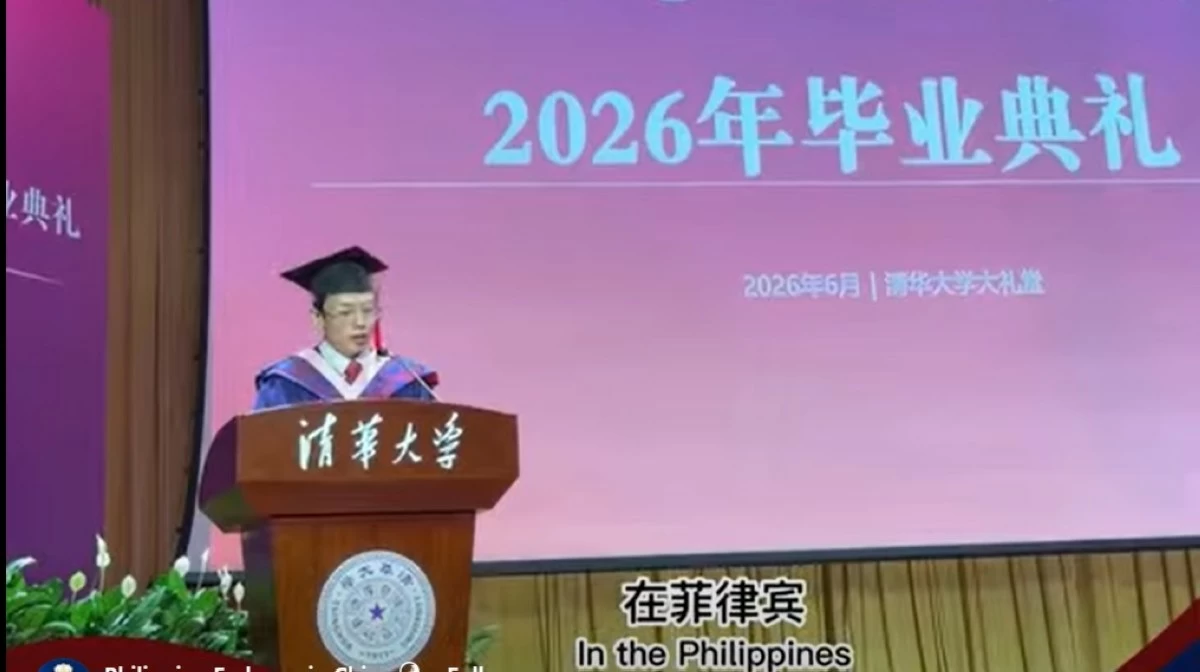
Dr. Enrico Gloria delivers a commencement speech in Mandarin during the graduation ceremony of Tsinghua University’s School of Social Sciences in Beijing, China. (Screengrab: Philippine Embassy in China / Facebook)
A Filipino scholar, Dr. Enrico Gloria, delivered a commencement speech in Mandarin at the graduation ceremony of the School of Social Sciences at Tsinghua University, using the Filipino concept of “kapwa” and the Chinese virtue of “rén” to call for greater empathy and cross-cultural understanding between the Philippines and China.
The Philippine Embassy in China, in a Facebook post on July 4, featured Gloria, who earned a PhD in Political Science from Tsinghua University.
The video showed Gloria addressing graduates during the school’s commencement ceremony on June 26, where he was chosen to represent international students.
The Philippine Embassy in China said international students comprise around 30 to 40 percent of the School of Social Sciences’ student population.
Speaking in Mandarin, Gloria drew parallels between “kapwa” — a Filipino concept that recognizes the self as deeply connected with others — and “rén,” the Chinese virtue associated with benevolence, humaneness, empathy, and moral responsibility in social relationships.
“In the Philippines, we refer to this idea as kapwa, the recognition that the self is always connected to others,” Gloria said. “Perhaps, in Chinese, it is close to the spirit of rén — a sense of humaneness, empathy, and moral responsibility in social relationships.”
Gloria said his studies in international politics had taught him that conflict, competition, and rivalry are often treated as enduring realities in relations among states.
However, his experience in China, he said, showed him that personal relationships and human connections remain essential even amid geopolitical tensions.
“Before there were states and their respective conflicts, at the most basic level, what exists are connections at the personal level,” Gloria said.
“At this level of basic human connection, kindness is still possible, mutual understanding can be established, and compassion is still something we can choose to give one another,” he added.
Breaking stereotypes through shared values
Gloria said he deliberately used concepts rooted in Filipino and Chinese culture to challenge stereotypes and emphasize shared human experiences.
“I wanted to break stereotypes by borrowing concepts that are indigenous to both Filipino and Chinese cultures,” he said. “The fact that we share these similar concepts speaks volumes about our shared experiences.”
For Gloria, while governments may have competing interests, people can still build relationships grounded in understanding and compassion.
“Before there were states, there were always people,” Gloria said. “At the most basic level of human connection, kindness and understanding are still possible, and compassion is still something we can give one another.”
The Philippine Embassy in China said Tsinghua University is widely regarded as one of China’s leading institutions of higher education and is often compared with the Massachusetts Institute of Technology in the United States.
From UP Diliman to Tsinghua University
Gloria completed his doctoral studies at Tsinghua University from 2022 to 2026. Before pursuing his PhD, he taught at the Department of Political Science of the University of the Philippines Diliman from 2018 to 2022.
He also earned his master’s degree in Political Science from Tsinghua University in 2018 and holds a bachelor’s degree in Economics from UP Diliman.
While he took his master’s program in English, Gloria developed sufficient fluency in Mandarin to complete his PhD studies in Chinese.
For Gloria, studying in China became more than an academic undertaking.
“Leaving home to study abroad is never easy,” he said. “But at Tsinghua, I realized that challenges do not have to be carried alone. I found not only mentors and classmates, but a second home.”
Mentor, friendship, and cultural exchange
Gloria credited his academic adviser, Professor Chen Qi, whom he described as a mentor and second father, for helping shape his experience at Tsinghua University.
Chen had served as Gloria’s adviser since his master’s program and encouraged him to immerse himself in Chinese culture and learn from the lived experiences of Chinese people.
Gloria later hosted Chen and several Tsinghua classmates during a familiarization visit to the Philippines, following the Philippine government’s announcement in January 2026 of a 14-day visa-free arrangement for Chinese tourists.
He accompanied them on visits to Manila, Boracay, and Cebu.
“These friends of mine had brought me to different places in China, even welcoming me to their homes during Chinese holidays,” Gloria said. “It was time to introduce the Philippines to them.”
Philippine Ambassador to China Jaime FlorCruz congratulated Gloria for completing his PhD and stressed the value of educational exchanges between the Philippines and China.
“We need more Filipinos like Dr. Enrico Gloria who have acquired deep knowledge of our neighbors like China,” FlorCruz said.
Following his graduation, Gloria returned to the Philippines and plans to resume teaching at UP Diliman.
He is also expected to join Filipino scholars who studied in China in establishing a China Politics and Foreign Relations Research Program under UP Diliman’s Department of Political Science.
The program aims to offer graduate courses and produce research on China’s politics and foreign policy.