ADVERTISEMENT

JAXA releases photo of asteroid Torifune taken by Hayabusa2

Published Jul 7, 2026 10:38 am
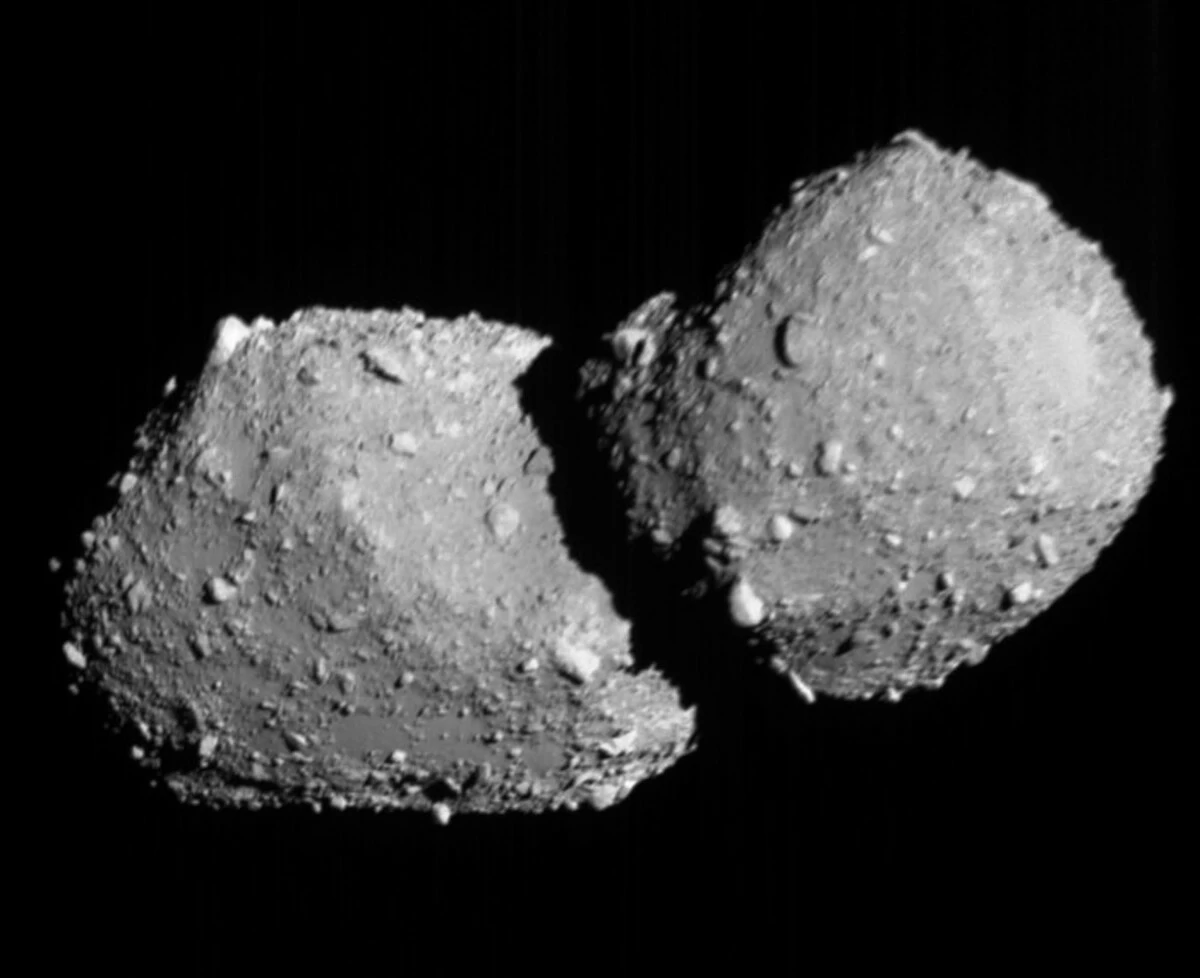
A picture of Torifune taken by Hayabusa2 just before the unmanned probe's closest approach to the asteroid on Sunday Japan time (Courtesy of the Japan Aerospace Exploration Agency)
TOKYO (Jiji Press) -- The Japan Aerospace Exploration Agency, or JAXA, on Monday released a photo of Torifune that was taken by Hayabusa2 at close range when the unmanned probe flew past the asteroid the previous day.
The photo was taken just a second before the scheduled time of Hayabusa2's closest approach to the asteroid. When the picture was taken, the distance between Hayabusa2 and Torifune was believed to be only a few hundred meters. The national space agency will identify the exact distance in a future analysis.
The picture captured details of Torifune that may provide clues to the asteroid's origin, such as the locations of rocks on the surface.
The control technology that enabled the probe's close flyby is expected to aid planetary defense, or the protection of Earth from potential asteroid collisions.
"I can't forget how shocked I was when I saw the image," Yuya Mimasu, who heads JAXA's Hayabusa2 extended mission team, told a press conference. "I was in awe about the fact that Hayabusa2 took such a good picture in a fleeting moment of the flyby," he said.
Torifune is a rocky asteroid similar to Itokawa, the asteroid from which the first Hayabusa probe brought back samples. It is estimated to be about 800 meters long and is currently located about 100 million kilometers from Earth.
The released photo showed that Torifune is shaped like a snowman and that there are many rocks on the surface. Its shape suggests that the asteroid was formed through the collision and subsequent merging of two small celestial bodies.
Around 6:30 p.m. Sunday Japan time, Hayabusa2 flew a few hundred meters from Torifune's surface at a relative velocity of 5 km per second. As well as taking photos, the probe successfully acquired data using devices including an infrared camera and a spectrometer. The data will be sent back to Earth in stages.
After its launch in 2014, Hayabusa2 collected samples of sand and other materials from asteroid Ryugu and dropped a capsule containing the samples to Earth in December 2020.
Following the Torifune flyby observation, the probe will continue its extended mission, aiming to reach its next target asteroid, 1998 KY26, in July 2031.

Related Tags

world news Japan Aerospace Exploration Agency (JAXA) asteroid Torifune
ADVERTISEMENT
.most-popular .layout-ratio{ padding-bottom: 79.13%; } @media (min-width: 768px) and (max-width: 1024px) { .widget-title { font-size: 15px !important; } }

{{ articles_filter_1561_widget.title }}

.most-popular .layout-ratio{ padding-bottom: 79.13%; } @media (min-width: 768px) and (max-width: 1024px) { .widget-title { font-size: 15px !important; } }

{{ static_articles_1562_widget.title }}

.most-popular .layout-ratio{ padding-bottom: 79.13%; } @media (min-width: 768px) and (max-width: 1024px) { .widget-title { font-size: 15px !important; } }

{{ articles_filter_1563_widget.title }}

{{ articles_filter_1564_widget.title }}

.mb-article-details { position: relative; } .mb-article-details .article-body-preview, .mb-article-details .article-body-summary{ font-size: 17px; line-height: 30px; font-family: "Libre Caslon Text", serif; color: #000; } .mb-article-details .article-body-preview iframe , .mb-article-details .article-body-summary iframe{ width: 100%; margin: auto; } .read-more-background { background: linear-gradient(180deg, color(display-p3 1.000 1.000 1.000 / 0) 13.75%, color(display-p3 1.000 1.000 1.000 / 0.8) 30.79%, color(display-p3 1.000 1.000 1.000) 72.5%); position: absolute; height: 200px; width: 100%; bottom: 0; display: flex; justify-content: center; align-items: center; padding: 0; } .read-more-background a{ color: #000; } .read-more-btn { padding: 17px 45px; font-family: Inter; font-weight: 700; font-size: 18px; line-height: 16px; text-align: center; vertical-align: middle; border: 1px solid black; background-color: white; } .hidden { display: none; }
function initializeAllSwipers() { // Get all hidden inputs with cms_article_id document.querySelectorAll('[id^="cms_article_id_"]').forEach(function (input) { const cmsArticleId = input.value; const articleSelector = '#article-' + cmsArticleId + ' .body_images'; const swiperElement = document.querySelector(articleSelector); if (swiperElement && !swiperElement.classList.contains('swiper-initialized')) { new Swiper(articleSelector, { loop: true, pagination: false, navigation: { nextEl: '#article-' + cmsArticleId + ' .swiper-button-next', prevEl: '#article-' + cmsArticleId + ' .swiper-button-prev', }, }); } }); } setTimeout(initializeAllSwipers, 3000); const intersectionObserver = new IntersectionObserver( (entries) => { entries.forEach((entry) => { if (entry.isIntersecting) { const newUrl = entry.target.getAttribute("data-url"); if (newUrl) { history.pushState(null, null, newUrl); let article = entry.target; // Extract metadata const author = article.querySelector('.author-section').textContent.replace('By', '').trim(); const section = article.querySelector('.section-info ').textContent.replace(' ', ' '); const title = article.querySelector('.article-title h1').textContent; // Parse URL for Chartbeat path format const parsedUrl = new URL(newUrl, window.location.origin); const cleanUrl = parsedUrl.host + parsedUrl.pathname; // Update Chartbeat configuration if (typeof window._sf_async_config !== 'undefined') { window._sf_async_config.path = cleanUrl; window._sf_async_config.sections = section; window._sf_async_config.authors = author; } // Track virtual page view with Chartbeat if (typeof pSUPERFLY !== 'undefined' && typeof pSUPERFLY.virtualPage === 'function') { try { pSUPERFLY.virtualPage({ path: cleanUrl, title: title, sections: section, authors: author }); } catch (error) { console.error('ping error', error); } } // Optional: Update document title if (title && title !== document.title) { document.title = title; } } } }); }, { threshold: 0.1 } ); function showArticleBody(button) { const article = button.closest("article"); const summary = article.querySelector(".article-body-summary"); const body = article.querySelector(".article-body-preview"); const readMoreSection = article.querySelector(".read-more-background"); // Hide summary and read-more section summary.style.display = "none"; readMoreSection.style.display = "none"; // Show the full article body body.classList.remove("hidden"); } document.addEventListener("DOMContentLoaded", () => { let loadCount = 0; // Track how many times articles are loaded const offset = [1, 2, 3, 4, 5, 6, 7, 8, 9, 10]; // Offset values const currentUrl = window.location.pathname.substring(1); let isLoading = false; // Prevent multiple calls if (!currentUrl) { console.log("Current URL is invalid."); return; } const sentinel = document.getElementById("load-more-sentinel"); if (!sentinel) { console.log("Sentinel element not found."); return; } function isSentinelVisible() { const rect = sentinel.getBoundingClientRect(); return ( rect.top < window.innerHeight && rect.bottom >= 0 ); } function onScroll() { if (isLoading) return; if (isSentinelVisible()) { if (loadCount >= offset.length) { console.log("Maximum load attempts reached."); window.removeEventListener("scroll", onScroll); return; } isLoading = true; const currentOffset = offset[loadCount]; window.loadMoreItems().then(() => { let article = document.querySelector('#widget_1690 > div:nth-last-of-type(2) article'); intersectionObserver.observe(article) loadCount++; }).catch(error => { console.error("Error loading more items:", error); }).finally(() => { isLoading = false; }); } } window.addEventListener("scroll", onScroll); });

Sign up by email to receive news.