







China test-launches a ballistic missile in a South Pacific nuclear-free zone
Published Jul 6, 2026 02:20 pm


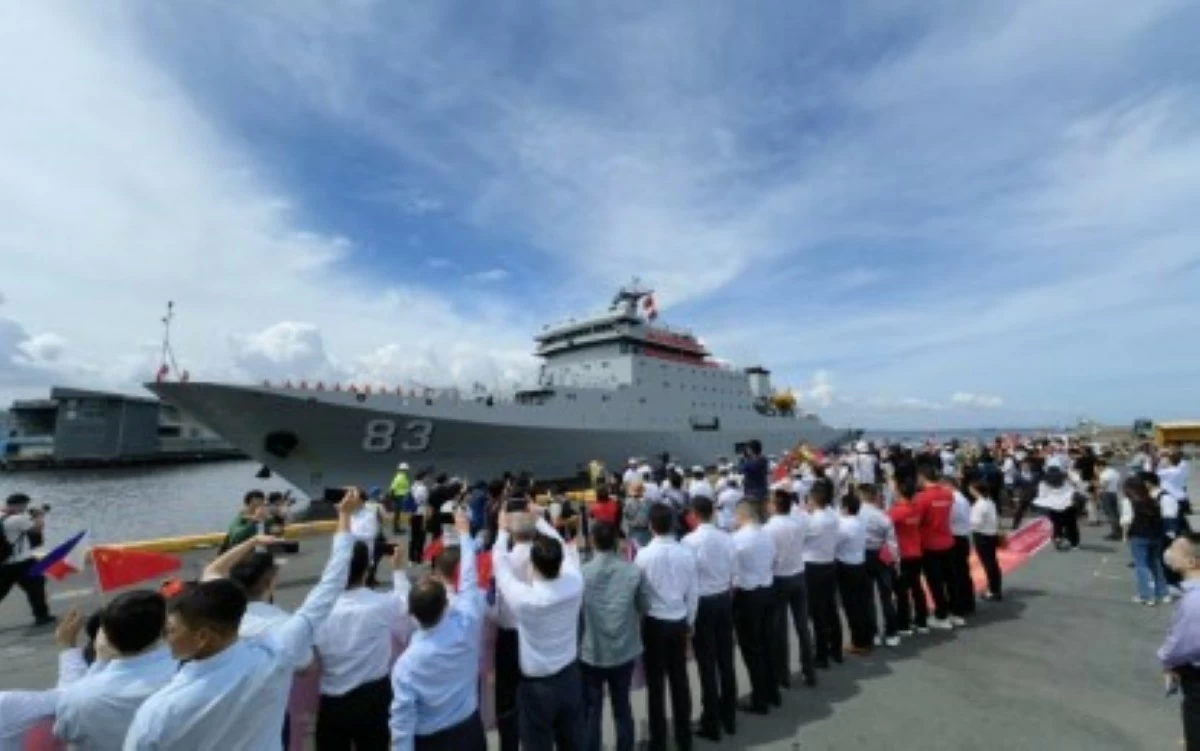
The Chinese People's Liberation Army Navy training ship Qi Jiguang docks in Manila at past 9 a.m. on Wednesday (June 14, 2023). Interested visitors only need to present a valid identification document to board the vessel. (Photo courtesy of the Chinese Embassy in Manila)
BANGKOK (AP) — China’s military test-launched a long-range ballistic missile Monday from one of its nuclear-powered submarines in the South Pacific, drawing protest and concerns from countries in the region.
The missile was launched at 12:01 p.m. and carried a dummy warhead, according to an announcement by the official Xinhua News Agency. China last conducted a missile test in the Pacific two years ago, then firing an intercontinental ballistic missile with a dummy warhead.
The launch was part of routine annual training, complied with international law and practice, and was not directed against any country or target, according to the statement from Xinhua, which was reposted by the Ministry of Defense.
Australia and New Zealand criticized the launch.
In Beijing, the Chinese People's Liberation Army (PLA) Navy said it successfully conducted the test launch of a strategic missile by a submarine.
The PLA Navy said that one strategic nuclear submarine of the navy successfully launched a strategic missile carrying a dummy warhead toward relevant high seas of the Pacific Ocean at 12:01 p.m., which landed precisely within the designated waters.
The test launch is a routine arrangement of the annual training of the PLA Navy, the navy said, adding that the Chinese side has already notified relevant countries in advance.
The test launch complies with international law and international practice, and is not directed at any specific country or target, the navy said.
The New Zealand government said it was informed of the planned launch hours beforehand and noted that the missile was fired into the South Pacific Nuclear Free Zone.
The nuclear-free zone was established by the 1986 Treaty of Rarotonga, which prohibits nuclear weapons throughout the region. China in 1987 ratified the protocols pledging not to test nuclear weapons within the zone, or to threaten to use them against signatories with territory in the region.
“It appears that despite our long-standing concerns about this type of activity, China carried out the test within hours of informing us,” Foreign Minister Winston Peters told The Associated Press in a statement.
The launch took place the same day Australia and Fiji signed a new mutual defense treaty that is meant to counter Chinese influence in the Pacific.
“Australia has been clear with China that we regard this as destabilizing to the region,” Australia's Foreign Minister Penny Wong told reporters in Fiji, in response to the test.