







Gregorio pushes for a pioneering Philippine Sports University
Published Jul 5, 2026 02:53 pm


At A Glance
- Speaking before the graduating class of the UP College of Human Kinetics at the Varsity Training Center, Gregorio challenged the nation's premier university to lead in shaping the future of sports not merely as an academic discipline, but as a force for nation-building.
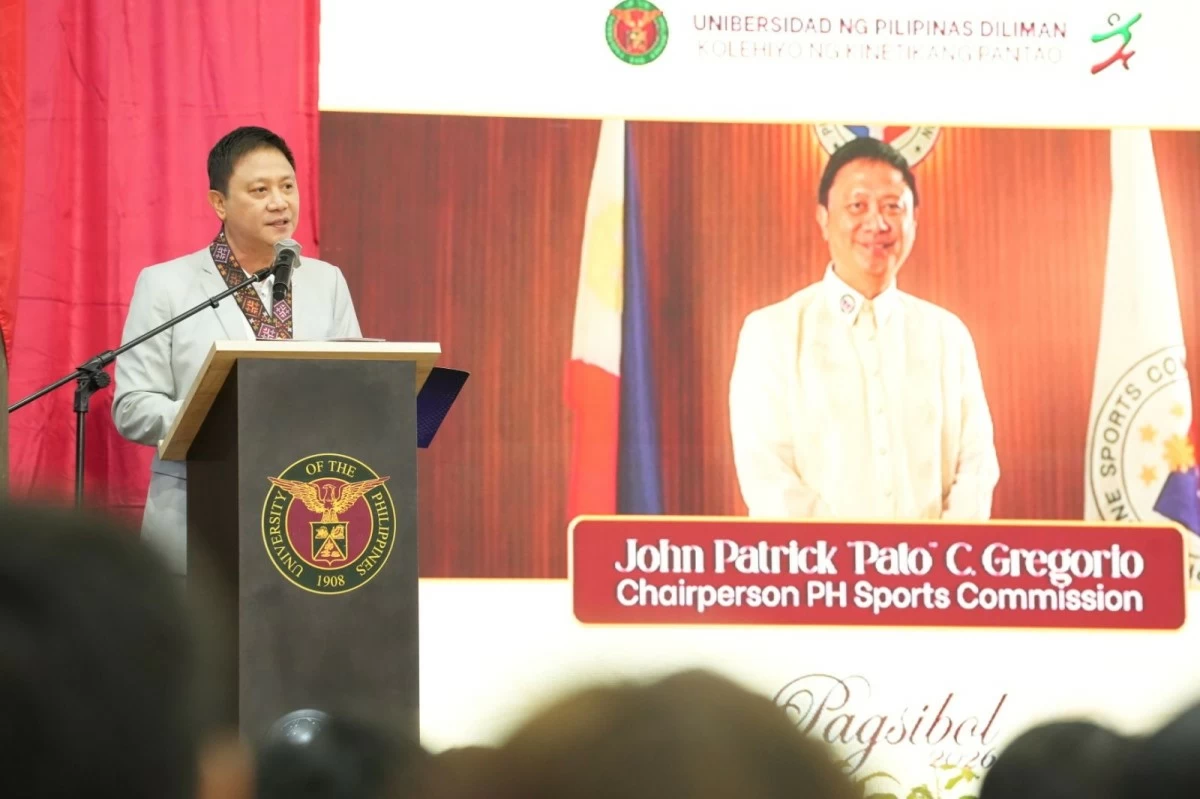
Philippine Sports Commission (PSC) Chairman Patrick C. Gregorio has unveiled a bold proposal to establish the country’s first Sports University under the University of the Philippines (UP) system, a pioneering initiative that seeks to transform Philippine sports from a pastime into a national industry of pride, education, and enterprise.
Speaking before the graduating class of the UP College of Human Kinetics at the Varsity Training Center, Gregorio challenged the nation’s premier university to lead in shaping the future of sports not merely as an academic discipline, but as a force for nation-building.
“My dream for Philippine sports is to build a proud nation. To this end, my dream for UP is to build a Sports University. A university that produces not only champions, but the coaches, scientists, educators, entrepreneurs, administrators, and innovators who make those champions possible,” said Gregorio.
For decades, sports in the Philippines was often dismissed as katuwaan—mere entertainment, secondary to “serious” pursuits. But recent triumphs by athletes like Hidilyn Diaz, the country’s first Olympic gold medalist, and gymnast Carlos Yulo, have redefined sports as a catalyst for education, tourism, economic growth, and national pride.
Gregorio emphasized that the proposed Sports University would institutionalize this momentum, producing a new generation of athletes, coaches, and leaders who embody discipline, integrity, and vision. It would also professionalize sports education, ensuring that Filipino athletes are supported by world-class systems in science, training, and management.
There are several global models of success to speak of, sports universities that have flourished worldwide by serving as engines of athletic excellence and innovation. Among them are Germany’s Deutsche Sporthochschule Köln (German Sport University Cologne), China’s Beijing Sport University, Russia’s Lesgaft National State University of Physical Education, Sport and Health, and Japan’s Nippon Sport Science University (NSSU).
German Sport University Cologne is Europe’s largest sports university, producing elite coaches, scientists, and Olympians, while Beijing Sport University is a powerhouse in sports science and athlete development, contributing to China’s dominance in Olympic competition.
Lesgaft National State University of Physical Education, Sport and Health is a historic institution that has trained generations of world-class Russian athletes, and Japan’s Nippon Sport Science University (NSSU) has been renowned for advancing sports medicine and producing Olympic champions.
Closer to home, Thailand and Vietnam have also established their own Sports Universities--the Thailand National Sports University (TNSU) and the Vietnam National University of Physical Education and Sports (VNUPES).
These institutions are the flagship centers for sports education, athlete development, and sports science research in their respective countries.
In the Philippines, the UP College of Human Kinetics has already been a cornerstone of sports education for the past 27 years, providing a strong foundation for the envisioned Sports University.
Gregorio’s vision positions the Philippines to join this league of nations that have leveraged sports universities to achieve global competitiveness.
According to the PSC chief, the proposed Sports University under UP would deliver transformative benefits with athlete development, coaching and education, industry growth, and national identity, among them.
“Gawin mong masaya ang atleta, magtatagumpay ang mga Pilipino,” said Gregorio, emphasizing that success in sports is never about one person or one institution, but about an ecosystem working together.
He also noted that the PSC can play a crucial role in funding the UP Sports University, given that in the National Academy of Sports, the PSC Chairman serves as vice chair. This institutional synergy, Gregorio stressed, can help turn the vision into reality.
As the Class of 2026 embarks on their careers, Gregorio urged them to go beyond Metro Manila, bring sports science to underserved communities, and help build industries that empower Filipinos.
“Your diploma is not the finish line. It is your starting block. Go where you are needed. Build athletes. Build communities. Build industries. Para sa kabataan at para sa bayan,” he said.
If realized, the UP Sports University would mark a historic turning point, cementing sport as a pillar of national renewal and positioning the Philippines to flourish in the international arena.
...