ADVERTISEMENT

Government must first lift productivity

Published Jul 4, 2026 12:05 am  |  Updated Jul 3, 2026 05:36 pm
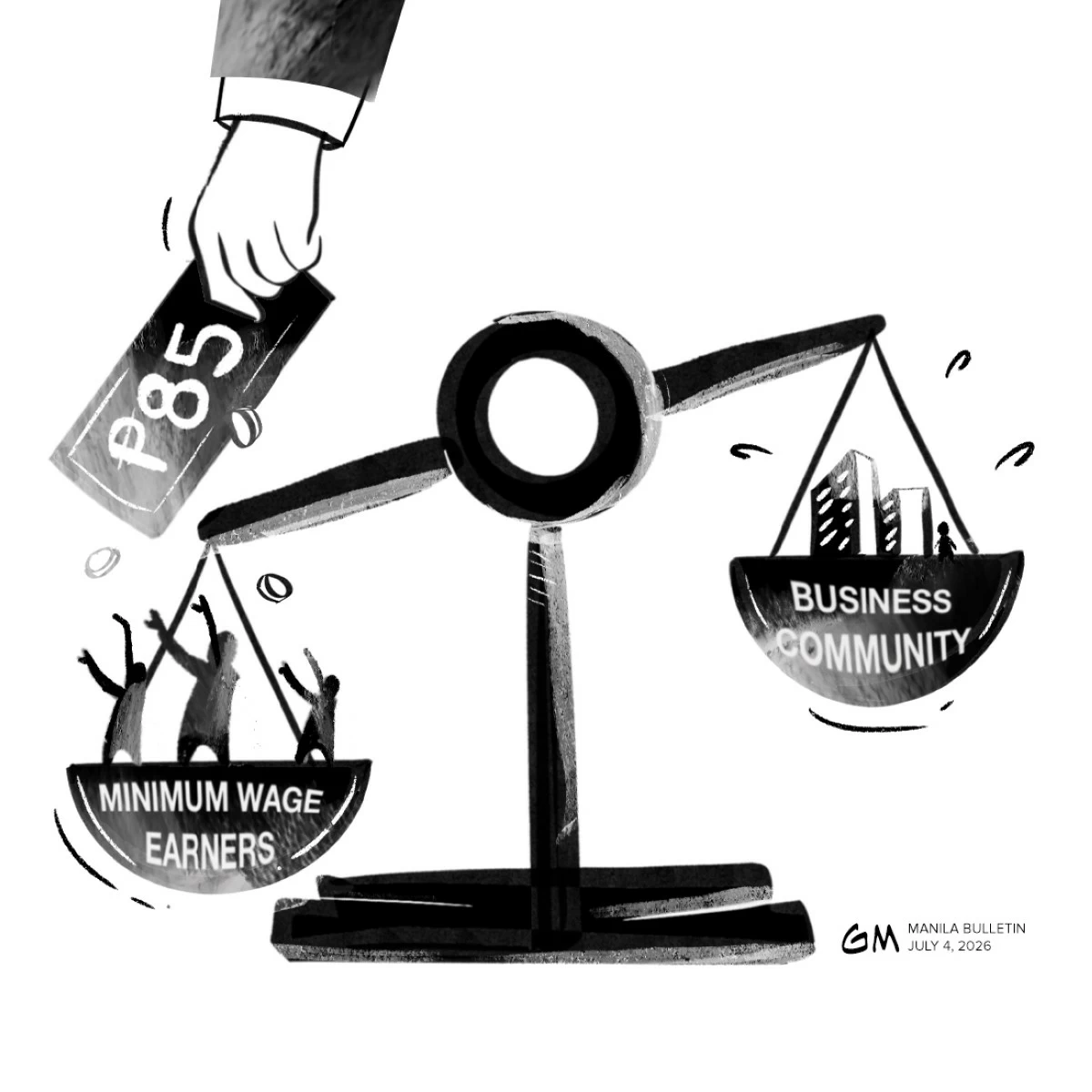
A mandated ₱85 daily minimum wage hike for Metro Manila has set off a predictable conflict between labor advocates and the business community. While the Department of Labor and Employment (DOLE) frames the two-tranche increase as a historic win for over one million workers fighting inflation, the reality for the employers who must fund it is far more precarious.
For the Philippines to achieve sustainable economic growth, policymakers must confront an uncomfortable truth: mandating higher wages without the corresponding increase in worker productivity is a recipe for inflation, reduced competitiveness, and ultimately, job losses.
The mechanics of a mandated wage floor are straightforward but destructive when disconnected from economic output. For micro, small, and medium-sized enterprises (MSMEs)—which operate on thin margins and employ the vast majority of the Filipino workforce—labor is one of the largest variable costs. When the government artificially inflates that cost, businesses cannot simply absorb the hit.
Instead, they adapt to protect their viability. They freeze expansion plans, put off capital expenditures, and cut back on new hiring. In worse cases, they downsize operations or accelerate automation simply to keep headcounts low. This dynamic turns a well-intentioned policy into a direct threat to the country’s 50-million-strong labor market.
More critically, unearned wage increases feed the inflation they are meant to cure. When a business faces higher labor costs without producing more goods or services, its unit cost of production increases. To preserve margins, the company raises consumer prices. The resulting spiral means the extra pesos in a worker’s paycheck are quickly wiped out by higher costs for food, transport, and utilities. The employee is left no better off, while the broader economy suffers from higher inflation.
The only durable path to higher living standards is productivity-driven wage growth.
When a workforce becomes more productive—whether through better training, improved technology, or more efficient supply chains—the value of what they produce rises. This efficiency expands profit margins naturally, allowing businesses to compete for talent by offering higher wages. Because these raises are funded by increased output rather than government mandates, they do not trigger inflationary pressures. Wealth is created, not just redistributed.
Right now, the government is treating the symptoms of economic strain rather than the structural causes. Instead of forcing nominal wage increases that are quickly eroded by inflation, the government should focus on reducing the structural costs of living and doing business in the country.
True economic relief will not come from a larger paycheck that buys less. It will come from lowering the cost of basic commodities, stabilizing electricity and fuel rates, and modernizing public transportation. Simultaneously, the government must cut the red tape and corruption that act as a hidden tax on local enterprises.
If the government lowers the cost of doing business, companies will have the capital to invest in technology and training that make their workers more productive. And when it costs less to live, a worker’s income goes further.
The Philippines cannot mandate its way to prosperity. Labor groups, business leaders, and government officials need to move past political talking points and focus on structural reforms.
If the country keeps raising the wage floor without raising the ceiling of productivity, it risks pricing itself out of regional competitiveness and forcing local businesses to close. To protect the workforce, the government must first protect the economic engine that employs them.
ADVERTISEMENT
.most-popular .layout-ratio{ padding-bottom: 79.13%; } @media (min-width: 768px) and (max-width: 1024px) { .widget-title { font-size: 15px !important; } }

{{ articles_filter_1561_widget.title }}

.most-popular .layout-ratio{ padding-bottom: 79.13%; } @media (min-width: 768px) and (max-width: 1024px) { .widget-title { font-size: 15px !important; } }

{{ static_articles_1562_widget.title }}

.most-popular .layout-ratio{ padding-bottom: 79.13%; } @media (min-width: 768px) and (max-width: 1024px) { .widget-title { font-size: 15px !important; } }

{{ articles_filter_1563_widget.title }}

{{ articles_filter_1564_widget.title }}

.mb-article-details { position: relative; } .mb-article-details .article-body-preview, .mb-article-details .article-body-summary{ font-size: 17px; line-height: 30px; font-family: "Libre Caslon Text", serif; color: #000; } .mb-article-details .article-body-preview iframe , .mb-article-details .article-body-summary iframe{ width: 100%; margin: auto; } .read-more-background { background: linear-gradient(180deg, color(display-p3 1.000 1.000 1.000 / 0) 13.75%, color(display-p3 1.000 1.000 1.000 / 0.8) 30.79%, color(display-p3 1.000 1.000 1.000) 72.5%); position: absolute; height: 200px; width: 100%; bottom: 0; display: flex; justify-content: center; align-items: center; padding: 0; } .read-more-background a{ color: #000; } .read-more-btn { padding: 17px 45px; font-family: Inter; font-weight: 700; font-size: 18px; line-height: 16px; text-align: center; vertical-align: middle; border: 1px solid black; background-color: white; } .hidden { display: none; }
function initializeAllSwipers() { // Get all hidden inputs with cms_article_id document.querySelectorAll('[id^="cms_article_id_"]').forEach(function (input) { const cmsArticleId = input.value; const articleSelector = '#article-' + cmsArticleId + ' .body_images'; const swiperElement = document.querySelector(articleSelector); if (swiperElement && !swiperElement.classList.contains('swiper-initialized')) { new Swiper(articleSelector, { loop: true, pagination: false, navigation: { nextEl: '#article-' + cmsArticleId + ' .swiper-button-next', prevEl: '#article-' + cmsArticleId + ' .swiper-button-prev', }, }); } }); } setTimeout(initializeAllSwipers, 3000); const intersectionObserver = new IntersectionObserver( (entries) => { entries.forEach((entry) => { if (entry.isIntersecting) { const newUrl = entry.target.getAttribute("data-url"); if (newUrl) { history.pushState(null, null, newUrl); let article = entry.target; // Extract metadata const author = article.querySelector('.author-section').textContent.replace('By', '').trim(); const section = article.querySelector('.section-info ').textContent.replace(' ', ' '); const title = article.querySelector('.article-title h1').textContent; // Parse URL for Chartbeat path format const parsedUrl = new URL(newUrl, window.location.origin); const cleanUrl = parsedUrl.host + parsedUrl.pathname; // Update Chartbeat configuration if (typeof window._sf_async_config !== 'undefined') { window._sf_async_config.path = cleanUrl; window._sf_async_config.sections = section; window._sf_async_config.authors = author; } // Track virtual page view with Chartbeat if (typeof pSUPERFLY !== 'undefined' && typeof pSUPERFLY.virtualPage === 'function') { try { pSUPERFLY.virtualPage({ path: cleanUrl, title: title, sections: section, authors: author }); } catch (error) { console.error('ping error', error); } } // Optional: Update document title if (title && title !== document.title) { document.title = title; } } } }); }, { threshold: 0.1 } ); function showArticleBody(button) { const article = button.closest("article"); const summary = article.querySelector(".article-body-summary"); const body = article.querySelector(".article-body-preview"); const readMoreSection = article.querySelector(".read-more-background"); // Hide summary and read-more section summary.style.display = "none"; readMoreSection.style.display = "none"; // Show the full article body body.classList.remove("hidden"); } document.addEventListener("DOMContentLoaded", () => { let loadCount = 0; // Track how many times articles are loaded const offset = [1, 2, 3, 4, 5, 6, 7, 8, 9, 10]; // Offset values const currentUrl = window.location.pathname.substring(1); let isLoading = false; // Prevent multiple calls if (!currentUrl) { console.log("Current URL is invalid."); return; } const sentinel = document.getElementById("load-more-sentinel"); if (!sentinel) { console.log("Sentinel element not found."); return; } function isSentinelVisible() { const rect = sentinel.getBoundingClientRect(); return ( rect.top < window.innerHeight && rect.bottom >= 0 ); } function onScroll() { if (isLoading) return; if (isSentinelVisible()) { if (loadCount >= offset.length) { console.log("Maximum load attempts reached."); window.removeEventListener("scroll", onScroll); return; } isLoading = true; const currentOffset = offset[loadCount]; window.loadMoreItems().then(() => { let article = document.querySelector('#widget_1690 > div:nth-last-of-type(2) article'); intersectionObserver.observe(article) loadCount++; }).catch(error => { console.error("Error loading more items:", error); }).finally(() => { isLoading = false; }); } } window.addEventListener("scroll", onScroll); });

Sign up by email to receive news.