






Manila Bulletin
 Technews
Zoho doubles down on the Philippines with agentic AI push ahead of Zoholics Manila 2026
Technews
Zoho doubles down on the Philippines with agentic AI push ahead of Zoholics Manila 2026
Technews
Zoho doubles down on the Philippines with agentic AI push ahead of Zoholics Manila 2026
Zoho doubles down on the Philippines with agentic AI push ahead of Zoholics Manila 2026
Published Jul 3, 2026 10:25 am


Zoho Corporation is deepening its bet on the Philippine market, riding a wave of government-backed digital transformation and gearing up to unveil its next wave of agentic AI tools at Zoholics Manila in July 2026.
The global software provider, known for its privacy-first, all-in-one business suite, says demand for AI-ready enterprise platforms is accelerating across the Philippines as the government pushes digitalization as a core economic priority.
Government push fuels digital transformation
The Philippine government has set an ambitious target for its digital economy, with the Department of Information and Communications Technology tasked with growing digital activity to 12% of GDP. The country's 2026 ASEAN Chairmanship has also put it at the forefront of regional discussions on responsible AI adoption, naming AI-driven growth for micro, small, and medium enterprises (MSMEs) as a priority economic deliverable.
That policy momentum is putting pressure on local businesses to modernize, but doing so in a way that's practical, secure, and scalable remains a challenge for many organizations.
Security gaps widen as companies add more tools
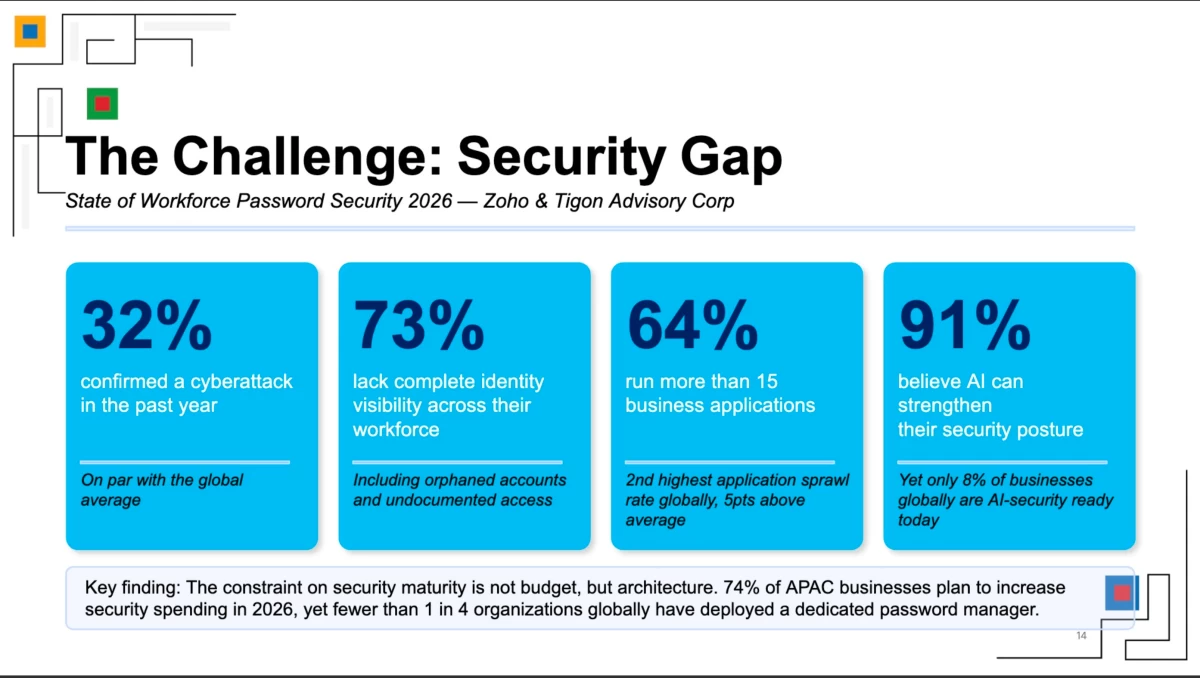
A recent Zoho report on workforce password security found that a majority of businesses across the Asia-Pacific region now run more than 15 applications, yet most lack full visibility into who has access to what across their systems. As companies layer AI tools on top of already sprawling tech stacks, that visibility gap is only growing, creating new security and governance risks alongside the productivity gains.
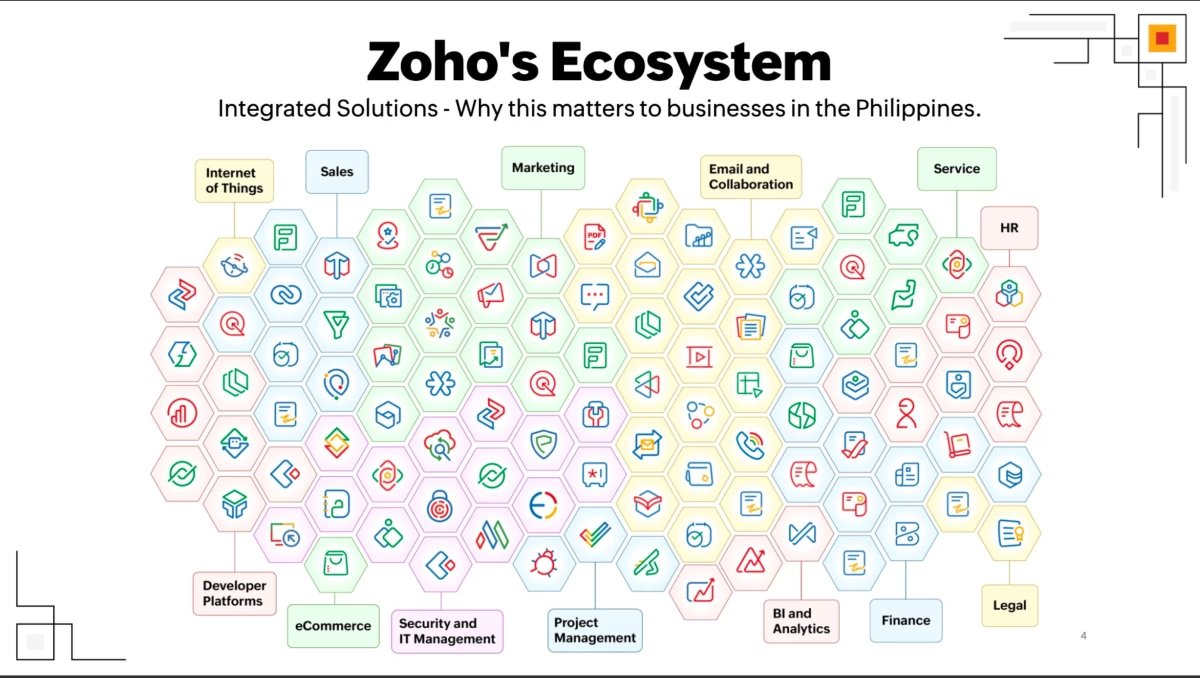
Zoho positions its integrated approach, bundling business applications, AI tools, and security under one platform, as a direct answer to this fragmentation problem. The company says this consolidation is what allows AI deployment to scale safely and sustainably.
Strong growth numbers in the Philippines
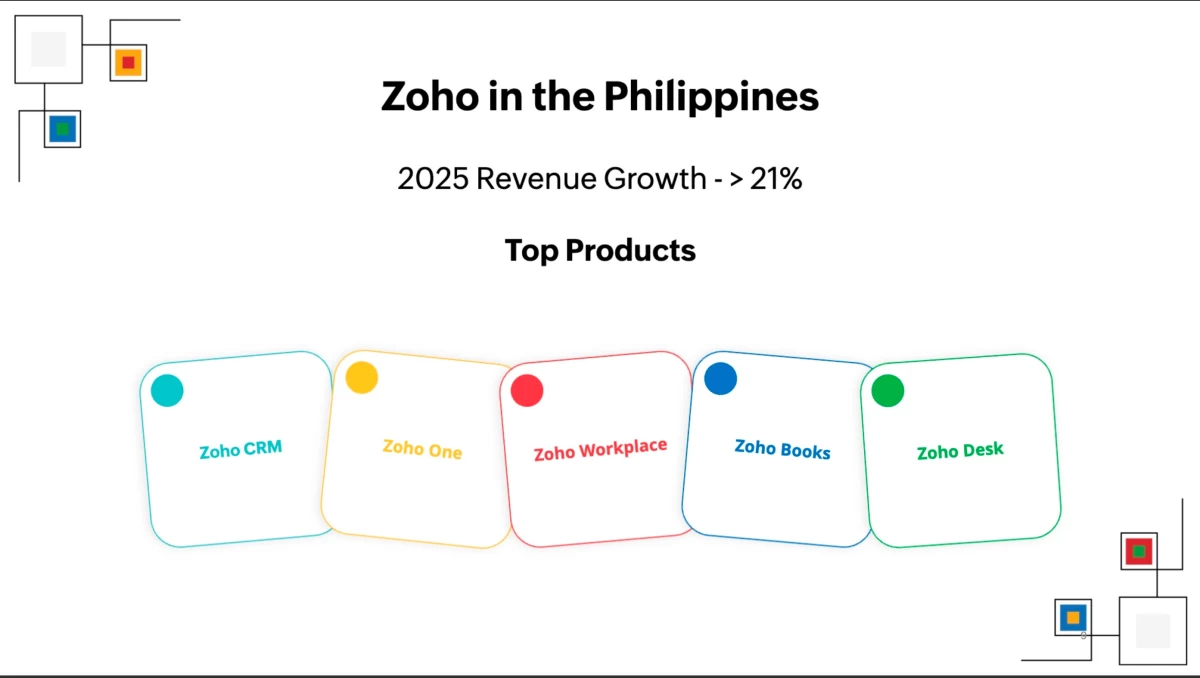
Zoho's investment in the region comes on the back of solid performance. The company posted 21% year-on-year revenue growth in the Philippines in 2025 and crossed one million paying customers worldwide in early 2026, underscoring steady global momentum for its subscription-based model.
Zoholics Manila 2026: Agentic AI takes center stage
Zoho's flagship user conference, Zoholics, returns to Manila in July 2026, where the company plans to showcase the latest phase of its AI roadmap, one centered on agentic AI, a more unified Zoho One platform, and security-ready infrastructure.
Gibu Mathew, managing director of Zoho APAC, framed the moment as a turning point for how Filipino businesses approach AI adoption, noting that companies are looking for ways to bring AI into their operations without inflating costs or opening up new security vulnerabilities as they grow. He said Zoho's unified platform and proprietary infrastructure are designed to connect with both its own and third-party AI models, giving businesses a realistic route to agentic AI while keeping data privacy and operational control intact.
Inside Zia agents: Zoho's agentic AI platform
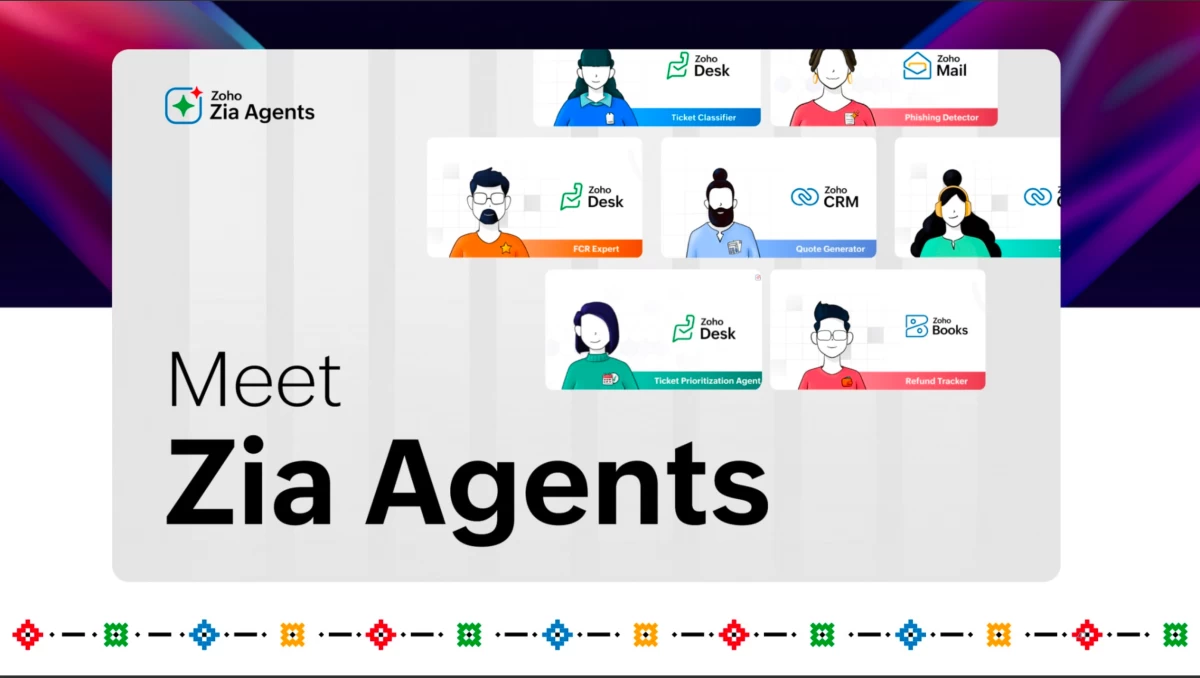
At the heart of Zoho's announcement is Zia Agents, the company's push into autonomous digital agents that work across its portfolio of more than 50 products. Zoho describes this as the next stage in a decade-long AI evolution, moving from proactive and prescriptive capabilities, to generative AI, and now to fully agentic systems.
The Zia Agents platform is built around three components:
Pre-built Zia Agents, ready-to-deploy agents covering common business functions, including an Account Manager Agent, SDR Agent, HR Agent, Customer Support Agent, IT Help Desk Agent, and SalesCoach Agent.
Zia Agent Studio, a no-code/low-code environment where businesses, partners, and developers can build custom agents using existing Zia skills, tools from across the Zoho ecosystem, a unified data layer, and a choice of language models.
Agent Marketplace, a distribution hub where Zoho, its partners, and third-party developers can publish and share specialized agents for instant deployment across the Zoho ecosystem.
Together, these three pieces are meant to give Philippine businesses a faster, lower-friction path to deploying AI agents.
Zoho One gets a major platform upgrade
Zoho also highlighted recent updates to Zoho One, its all-in-one business operating system, which now serves more than 75,000 customers globally. A significant platform overhaul announced in November 2025 brought Zoho's applications, workflows, and integrations closer together, cutting down on the friction of juggling disconnected tools.
AI features from across Zoho's product line are now consolidated within Zoho One, with Ask Zia serving as a cross-application assistant that supports contextual, in-the-moment decision-making. Rather than treating AI as an add-on, Zoho has built it directly into the tools employees already use daily.
Pricing for Zoho One remains at US$37 per user, per month, a figure the company says reflects its continued focus on keeping enterprise-grade software affordable.
What sets Zoho's AI strategy apart
Zoho is leaning heavily on data privacy and cost accessibility as its key differentiators in a crowded enterprise AI market. The company's stated commitments include:
Customer data is never used to train generic, third-party AI models
Its proprietary Zia LLM is hosted entirely within Zoho's own data centers
AI features are priced to stay accessible across business sizes, from MSMEs to large enterprises
For organizations with stricter data residency or governance requirements, Zoho's proprietary LLM offers an option to keep data fully within the Zoho environment.
The bigger picture
Taken together, Zia Agents, the revamped Zoho One, and Zoho's security portfolio form what the company calls a coherent strategy for helping Philippine businesses build AI-ready operations, one grounded in platform integration, data governance, and long-term cost control, rather than a patchwork of disconnected tools and vendors.
Zoho's expanded presence at Zoholics Manila 2026 signals the company's intent to position itself as a long-term infrastructure partner for Philippine enterprises navigating the shift toward agentic AI, rather than just another software vendor riding the AI hype cycle.