






 Philippines
National
Philippines, Canada elevate ties to strategic partnership; sign deals on energy, labor, tourism
Philippines
National
Philippines, Canada elevate ties to strategic partnership; sign deals on energy, labor, tourism
Philippines, Canada elevate ties to strategic partnership; sign deals on energy, labor, tourism


At A Glance
- The Philippines and Canada elevated bilateral ties to a strategic partnership following talks between President Marcos and Prime Minister Mark Carney in Vancouver.
- Manila and Ottawa signed agreements covering energy and natural resources, labor and migration, tourism, and culture.
- The two countries also reaffirmed their commitment to conclude negotiations for a Philippines-Canada Free Trade Agreement within the year.
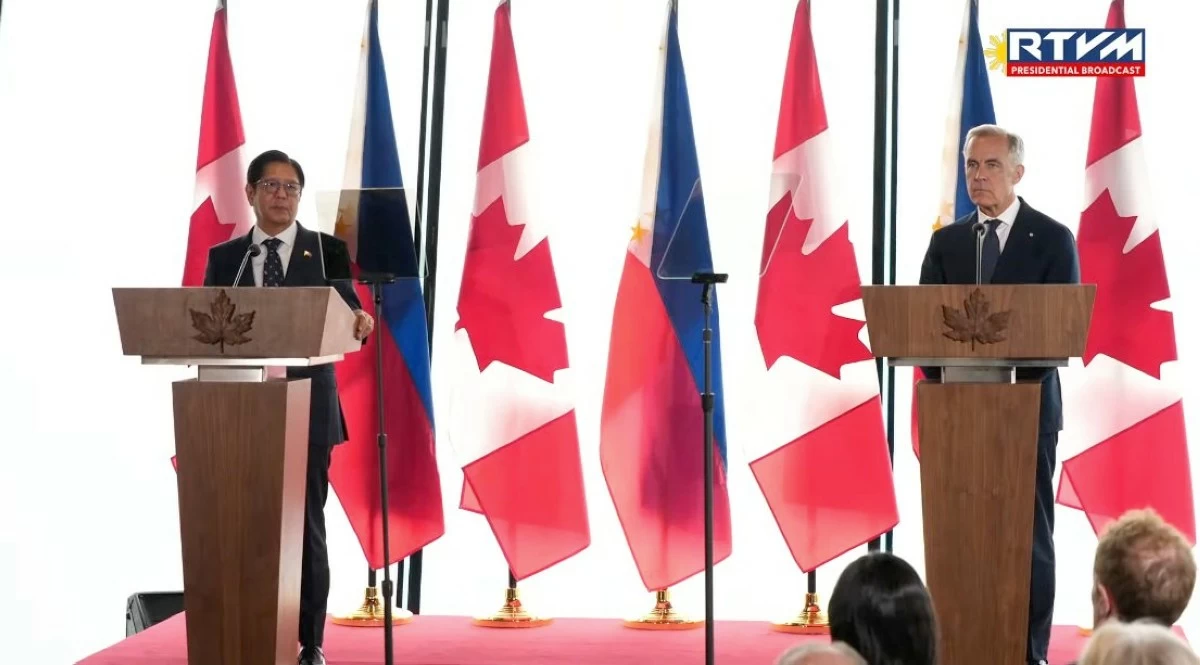
The Philippines and Canada formally elevated their bilateral relations to a strategic partnership on Friday, July 3 (Manila time), with the two countries signing a series of agreements covering energy, labor, tourism, and cultural cooperation.
The announcement came after President Marcos and Canadian Prime Minister Mark Carney held one-on-one and expanded bilateral meetings in Vancouver during the President's official visit to Canada.
"Today, I am pleased to announce the elevation of our bilateral relationship to a strategic partnership," Marcos said during a joint press statement with Carney early Friday (Manila time).
"We have tasked our foreign ministers to draw up a plan of action to pursue our shared commitment to work together in adapting to shifting global realities, addressing shared challenges, and building capacities for a future-ready partnership," he added.
Carney described the new strategic partnership as the start of "a new era of cooperation" between the two countries, citing a free trade agreement (FTA) that both countries are determined to accomplish.
"This free trade agreement would be the foundation of our new Canada-Philippines strategic partnership, where together we're launching a new era of cooperation, deepening our collaboration in trade and energy, defense and tourism," the Canadian leader said.
New agreements signed
Among the agreements signed during the visit was a Joint Declaration of Intent on Energy and Natural Resources Cooperation, which both leaders said would strengthen collaboration in critical minerals and energy development.
"We are pleased to witness the signing of the Joint Declaration of Intent on Energy and Natural Resources Cooperation," Marcos said.
Carney noted that Canada is among the world's top producers of critical minerals, while the Philippines is a major producer of nickel, cobalt, and copper.
"Together, Canada and the Philippines will put to good use their resources in order to strengthen their supply chains in critical minerals," he said.
The two countries also signed agreements on tourism and culture, as well as a Joint Declaration of Intent on Labor and Migration aimed at strengthening protections for Filipino workers and promoting ethical recruitment practices.
Carney described the labor agreement as the first of its kind for Canada.
"Filipino workers make extraordinary contributions to communities across Canada, and when they're here, we will ensure they are treated fairly, can work safely, and have their rights protected," he said.
FTA talks on track
The two leaders also reaffirmed their commitment to conclude negotiations for both the Philippines-Canada Free Trade Agreement and the Association of Southeast Asian Nations (ASEAN)-Canada Free Trade Agreement this year.
"Prime Minister Carney and I reaffirmed our commitment to conclude the negotiations for a bilateral free trade agreement this year, as we also negotiate the ASEAN-Canada Free Trade Agreement," Marcos said.
Carney said both countries remain on track to meet the target they first discussed during their meeting last year.
"We're making good progress," he said.
The Canadian Prime Minister said the Philippines, one of Southeast Asia's fastest-growing economies, offers significant opportunities for Canadian businesses.
"We have a prospect of tripling our bilateral trade—both directions—by 2035," Carney said.
Defense, maritime cooperation
The two leaders likewise highlighted growing defense and security cooperation between Manila and Ottawa.
President Marcos cited the signing of the Status of Visiting Forces Agreement in Manila in November 2025, as well as the Mutual Logistics Support Arrangement and Statement of Intent on Strengthening Defense Cooperation signed in Ottawa just two weeks ago.
"We recognize that robust defense and security cooperation underpins the strong momentum of our relations," the President said.
Prime Minister Carney said Canada expects to soon ratify the visiting forces agreement, which would allow the armed forces of both countries to train and operate more closely through joint military exercises.
"We'll soon ratify the Status of Visiting Forces Agreement, enabling our armed forces to train and operate more closely through joint military exercises in both of our countries," he said.
Support for arbitral ruling
As the Philippines prepares to mark the 10th anniversary of the 2016 arbitral ruling on the South China Sea next week, Marcos thanked Canada for its support for Manila's position in the West Philippine Sea.
"I thank Canada for its vocal and consistent support for a rules-based order in the South China Sea under the United Nations Convention on the Law of the Sea (UNCLOS) and in upholding the Arbitral Award as final and legally binding," he said.
Carney likewise reiterated Canada's support for the 2016 ruling and the rules-based international order.
"We absolutely uphold and squarely back the decisions of 2016 that are directly relevant to the territorial waters and activities of the Philippines," he said.
Filipino community 'heart and soul'
Marcos also welcomed Canada's recognition of the contribution of the nearly 1 million Filipinos living and working in the country.
The President said Filipino Canadians serve as the "heart and soul" of the growing partnership between the two countries.
"I am glad to see and hear from our Canadian friends that the one million strong Filipinos in Canada are valued and respected for their contributions to Canadian society, the economy, and government," Marcos said.
Carney echoed the sentiment, saying the Filipino community had helped build a stronger and more vibrant Canada.
"The Filipino community is at the very heart of Canada," he said.