






 Business
Banking & Finance
QR Ph overtakes cards, e-wallets to dominate Philippine business payments—PayMongo
Business
Banking & Finance
QR Ph overtakes cards, e-wallets to dominate Philippine business payments—PayMongo
QR Ph overtakes cards, e-wallets to dominate Philippine business payments—PayMongo


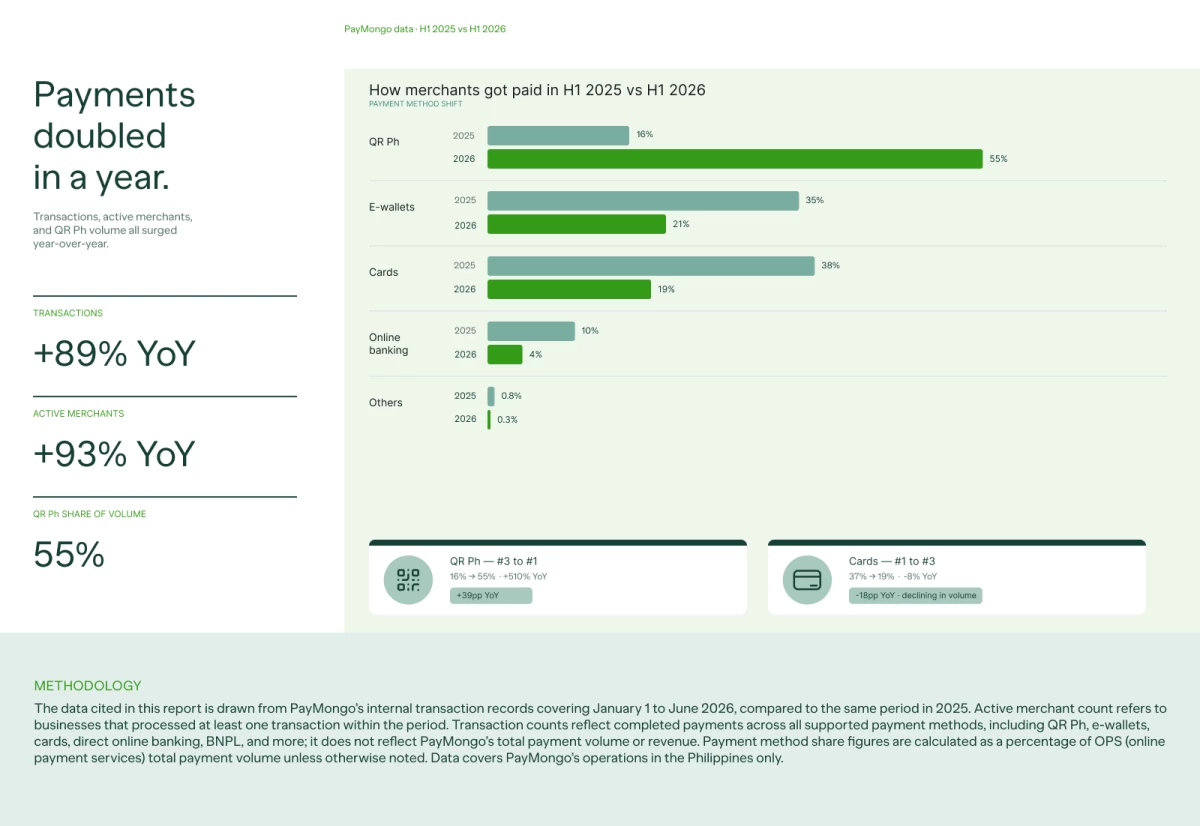
QR Ph has overtaken cards and e-wallets combined to become the dominant payment method among Philippine businesses, according to fintech firm PayMongo Group, underscoring the country’s accelerating shift toward mobile-first digital payments.
Based on PayMongo’s internal transaction data for the first half of 2026, QR Ph accounted for 55 percent of total payment volume processed on its platform, up sharply from just 16 percent in the same period last year. The payment method posted more than 510-percent year-on-year growth, while cards’ share fell to 19 percent, and e-wallets accounted for 21 percent.
Combined, QR Ph and e-wallets represented 76 percent of total payment volume as well as accounted for nine out of every 10 transactions processed by merchants on the platform.
In a statement on Thursday, July 2, PayMongo said the rapid adoption of QR Ph reflects its interoperability, allowing businesses to accept payments from participating banks and e-wallets using a single QR code.
“For small businesses managing multiple payment terminals or apps, this consolidation simplified everything,” the company said, adding that this may explain why adoption has accelerated fastest among merchants with limited technical capabilities.
The findings were based on nearly 10 million completed transactions processed by PayMongo from January to June this year, an 89-percent increase from about 5.2 million transactions in the same period in 2025.
During the period, the company’s merchant base—which includes online sellers, brick-and-mortar retailers, service providers, as well as enterprises integrating PayMongo into their customer-facing platforms—expanded by 93 percent year-on-year.
While QR Ph emerged as the preferred payment method for everyday transactions, cards continued to dominate larger purchases despite their declining share.
Although cards accounted for 19 percent of payment volume, they represented only seven percent of all transactions, indicating that they remained the preferred payment instrument for high-value purchases, corporate expenses, and one-time large payments.
“Everyday transactions, such as the sari-sari top-up, the food delivery order, the utility bill, have moved entirely to mobile-native payment methods,” PayMongo said.
The company also reported changing behavior among online merchants as more businesses adopted structured e-commerce platforms.
Among merchants using the Shopify platform, the number of businesses grew by 18 percent year-on-year, while payment volume increased by six percent.
Meanwhile, merchants using PayMongo Pages—its no-code online payment page solution—collected nearly ₱1 billion in payments during the first half without requiring website development or application programming integration.
PayMongo said the product has helped remove barriers for small businesses transitioning from cash-only operations to digital payments.
The company likewise reported strong growth in physical retail transactions.
Merchants using its in-store QR Ph solution more than doubled from a year ago, while in-store QR Ph transactions more than tripled year-on-year as adoption spread across retailers, food establishments, and service providers.
PayMongo said these trends indicate that digital payments have expanded beyond e-commerce into neighborhood businesses and physical stores.
The company added that the findings are broadly consistent with the Bangko Sentral ng Pilipinas’ (BSP) push to accelerate digital payments under its financial digitalization roadmap.
“This report captures the velocity of Philippine digital commerce as a whole,” PayMongo said. “The infrastructure is in place, the behavior has changed, and the second half of 2026 will show whether that pace holds or accelerates further.”
According to the company, the report was based on internal transaction records covering January to June 2026 compared with the same period last year. It covered only PayMongo’s Philippine operations and measured completed payments across supported payment methods, including QR Ph, e-wallets, cards, direct online banking, as well as buy now, pay later (BNPL) services.