ADVERTISEMENT

State of calamity declared in Negros Occidental due to sugarcane pest

Published Jul 1, 2026 10:58 pm
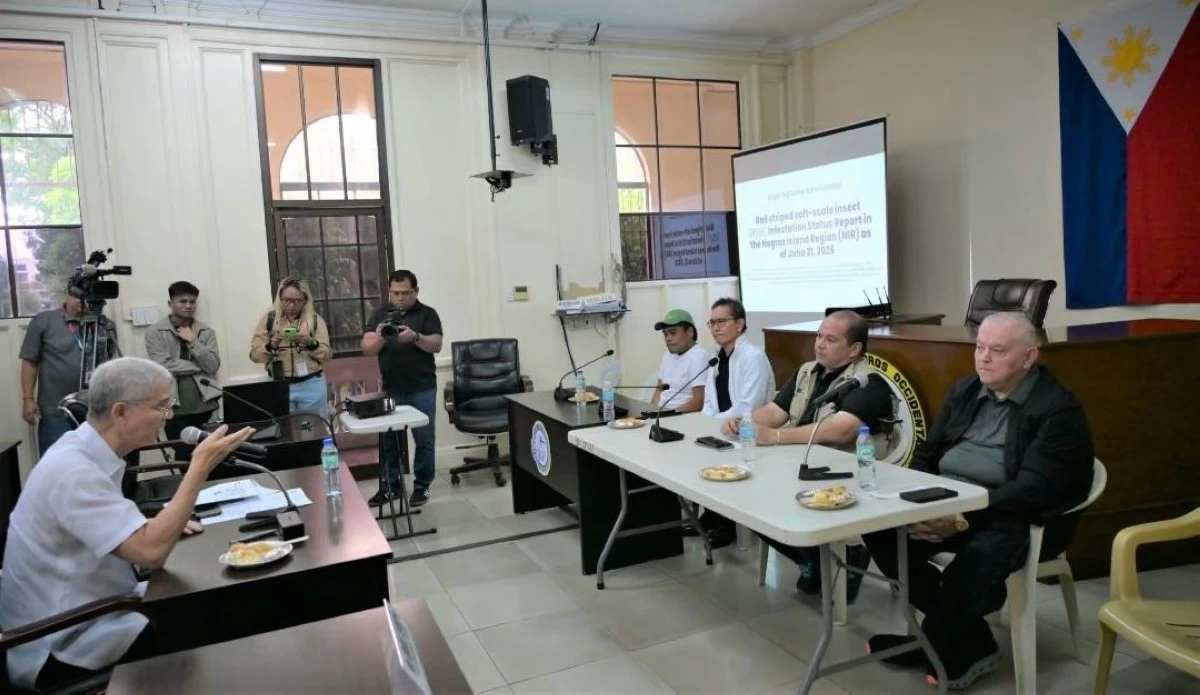
NEGROS Occidental Gov. Eugenio Jose Lacson and Sugar Regulatory Administration Administrator Pablo Luiz Azcona discuss the extent of the Red-Striped Soft Scale Insect (RSSI) infestation and possible interventions for affected sugarcane plantations in the province. (Capitol PIO)
BACOLOD CITY – The Sugar Regulatory Administration (SRA) on Wednesday welcomed the decisive actions of the top leaders in Negros Island to fight the increasing red-striped soft scale insect (RSSI) infestation.
In a statement, SRA Administrator Pablo Luis Azcona thanked Governors Eugenio Jose Lacson of Negros Occidental and Manuel “Chaco” Sagarbarria of Negros Oriental for supporting the agency’s initiatives in addressing the threat posed by the invasive sugarcane pest.
“We are thankful to both governors and glad for their support. This will strengthen collaboration to ensure a cohesive and concerted action island-wide,” he added.
Negros produces more than 60 percent of the country’s sugar output, and studies cited by the SRA indicated that RSSI may potentially reduce the sugar content of infested canes by up to 50 percent.
SRA-Visayas’ validated data as of June 26 showed Negros Island Region is the worst-hit. Negros Occidental recorded 14,447.83 hectares of affected sugarcane farms while Negros Oriental logged 1,571.33.
In Negros Occidental, the provincial board passed a resolution Tuesday afternoon declaring a state of calamity in the province due to the outbreak and continuing infestation of the invasive sugarcane pest, following the recommendation of the Provincial Disaster Risk Reduction and Management Council (PDRRMC) chaired by Lacson.
“That is serious. Our crop production will go down, on top of low (millgate) prices,” Lacson said in an interview on Wednesday.
The declaration of a state of calamity will allow the provincial government to provide the available funds necessary for the implementation of emergency response, containment, rehabilitation, and recovery measures against RSSI.
In its resolution, the PDRRMC cited the SRA status report and the Office of the Provincial Agriculturist situational report as of June 23, indicating that of the 190,314 hectares total sugarcane area planted, 61,242 hectares or 32.18 percent have been reported to be affected by the RSSI.
“This is posing a serious threat to the province's sugar industry, agricultural economy, and the livelihood of thousands of sugarcane farmers, farm workers, and other stakeholders,” it added.
The PDRRMC further said that “if left unchecked, it may result in severe economic losses, disruption of agricultural activities, reduction in farmers' income, and adverse effects on the local economy.”
Sagarbarria said on Tuesday that two of the most-affected local government units, Bais City and Mabinay, are also expected to declare a state of calamity.
Sagarbarria pledged to create an anti-RSSI task force and approve the release of P15 million for the province’s immediate response. (With PNA)

Related Tags

Negros Occidental SRA State of calamity RSSI
ADVERTISEMENT
.most-popular .layout-ratio{ padding-bottom: 79.13%; } @media (min-width: 768px) and (max-width: 1024px) { .widget-title { font-size: 15px !important; } }

{{ articles_filter_1561_widget.title }}

.most-popular .layout-ratio{ padding-bottom: 79.13%; } @media (min-width: 768px) and (max-width: 1024px) { .widget-title { font-size: 15px !important; } }

{{ static_articles_1562_widget.title }}

.most-popular .layout-ratio{ padding-bottom: 79.13%; } @media (min-width: 768px) and (max-width: 1024px) { .widget-title { font-size: 15px !important; } }

{{ articles_filter_1563_widget.title }}

{{ articles_filter_1564_widget.title }}

.mb-article-details { position: relative; } .mb-article-details .article-body-preview, .mb-article-details .article-body-summary{ font-size: 17px; line-height: 30px; font-family: "Libre Caslon Text", serif; color: #000; } .mb-article-details .article-body-preview iframe , .mb-article-details .article-body-summary iframe{ width: 100%; margin: auto; } .read-more-background { background: linear-gradient(180deg, color(display-p3 1.000 1.000 1.000 / 0) 13.75%, color(display-p3 1.000 1.000 1.000 / 0.8) 30.79%, color(display-p3 1.000 1.000 1.000) 72.5%); position: absolute; height: 200px; width: 100%; bottom: 0; display: flex; justify-content: center; align-items: center; padding: 0; } .read-more-background a{ color: #000; } .read-more-btn { padding: 17px 45px; font-family: Inter; font-weight: 700; font-size: 18px; line-height: 16px; text-align: center; vertical-align: middle; border: 1px solid black; background-color: white; } .hidden { display: none; }
function initializeAllSwipers() { // Get all hidden inputs with cms_article_id document.querySelectorAll('[id^="cms_article_id_"]').forEach(function (input) { const cmsArticleId = input.value; const articleSelector = '#article-' + cmsArticleId + ' .body_images'; const swiperElement = document.querySelector(articleSelector); if (swiperElement && !swiperElement.classList.contains('swiper-initialized')) { new Swiper(articleSelector, { loop: true, pagination: false, navigation: { nextEl: '#article-' + cmsArticleId + ' .swiper-button-next', prevEl: '#article-' + cmsArticleId + ' .swiper-button-prev', }, }); } }); } setTimeout(initializeAllSwipers, 3000); const intersectionObserver = new IntersectionObserver( (entries) => { entries.forEach((entry) => { if (entry.isIntersecting) { const newUrl = entry.target.getAttribute("data-url"); if (newUrl) { history.pushState(null, null, newUrl); let article = entry.target; // Extract metadata const author = article.querySelector('.author-section').textContent.replace('By', '').trim(); const section = article.querySelector('.section-info ').textContent.replace(' ', ' '); const title = article.querySelector('.article-title h1').textContent; // Parse URL for Chartbeat path format const parsedUrl = new URL(newUrl, window.location.origin); const cleanUrl = parsedUrl.host + parsedUrl.pathname; // Update Chartbeat configuration if (typeof window._sf_async_config !== 'undefined') { window._sf_async_config.path = cleanUrl; window._sf_async_config.sections = section; window._sf_async_config.authors = author; } // Track virtual page view with Chartbeat if (typeof pSUPERFLY !== 'undefined' && typeof pSUPERFLY.virtualPage === 'function') { try { pSUPERFLY.virtualPage({ path: cleanUrl, title: title, sections: section, authors: author }); } catch (error) { console.error('ping error', error); } } // Optional: Update document title if (title && title !== document.title) { document.title = title; } } } }); }, { threshold: 0.1 } ); function showArticleBody(button) { const article = button.closest("article"); const summary = article.querySelector(".article-body-summary"); const body = article.querySelector(".article-body-preview"); const readMoreSection = article.querySelector(".read-more-background"); // Hide summary and read-more section summary.style.display = "none"; readMoreSection.style.display = "none"; // Show the full article body body.classList.remove("hidden"); } document.addEventListener("DOMContentLoaded", () => { let loadCount = 0; // Track how many times articles are loaded const offset = [1, 2, 3, 4, 5, 6, 7, 8, 9, 10]; // Offset values const currentUrl = window.location.pathname.substring(1); let isLoading = false; // Prevent multiple calls if (!currentUrl) { console.log("Current URL is invalid."); return; } const sentinel = document.getElementById("load-more-sentinel"); if (!sentinel) { console.log("Sentinel element not found."); return; } function isSentinelVisible() { const rect = sentinel.getBoundingClientRect(); return ( rect.top < window.innerHeight && rect.bottom >= 0 ); } function onScroll() { if (isLoading) return; if (isSentinelVisible()) { if (loadCount >= offset.length) { console.log("Maximum load attempts reached."); window.removeEventListener("scroll", onScroll); return; } isLoading = true; const currentOffset = offset[loadCount]; window.loadMoreItems().then(() => { let article = document.querySelector('#widget_1690 > div:nth-last-of-type(2) article'); intersectionObserver.observe(article) loadCount++; }).catch(error => { console.error("Error loading more items:", error); }).finally(() => { isLoading = false; }); } } window.addEventListener("scroll", onScroll); });

Sign up by email to receive news.