ADVERTISEMENT

AFP chief credits SOLCOM's peace strategy with weakening insurgents in Southern Luzon

Published Jun 29, 2026 04:24 pm
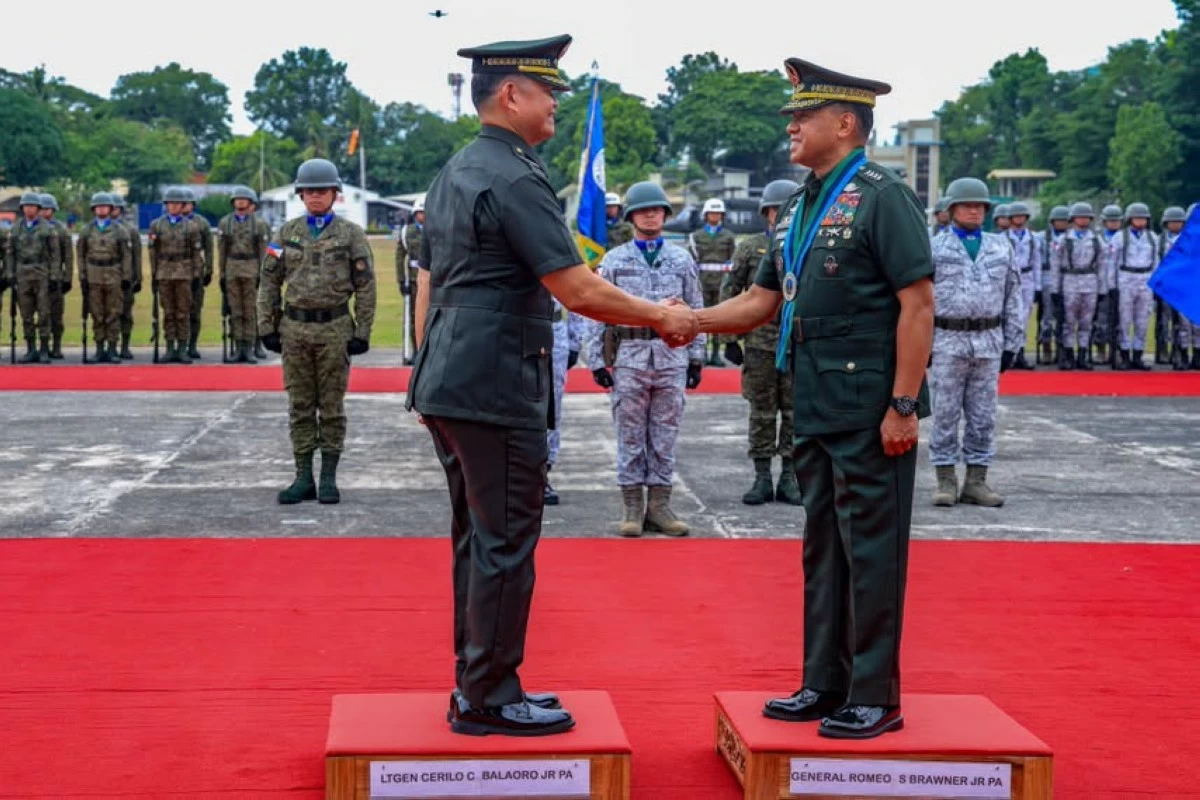
Armed Forces of the Philippines (AFP) Chief of Staff General Romeo S. Brawner Jr. (right) shakes hands with Lt. Gen. Cerilo C. Balaoro Jr., commander of Southern Luzon Command) during arrival honors for the command’s 39th founding anniversary at Camp Guillermo Nakar in Lucena City, Quezon on June 26, 2026. (Photo: AFP)
Armed Forces of the Philippines (AFP) Chief of Staff General Romeo S. Brawner Jr. commended the Southern Luzon Command (SOLCOM) for helping weaken communist insurgents in the region through its “Road to Peace in Southern Luzon” campaign.
The Road to Peace in Southern Luzon is SOLCOM's internal security operations exit strategy, which combines military operations with community development and reintegration efforts.
In a statement on Monday, June 29, the AFP said Brawner urged troops to protect the gains achieved in internal security in Southern Luzon through years of cooperation among the military, government agencies, local government units, and communities.
“These gains were made possible through the whole-of-nation approach and strong partnerships with government agencies, local government units, and communities,” he said.
Over the weekend, Brawner led the celebration of SOLCOM's 39th founding anniversary at Camp Guillermo Nakar in Lucena City, Quezon. He conferred awards on outstanding military personnel and inspected firearms recovered during military operations.
He also urged soldiers to remain committed to protecting the people and preserving the peace achieved across Southern Luzon.
Lt. Gen. Cerilo C. Balaoro Jr., commander of SOLCOM, said the Road to Peace in Southern Luzon campaign helped pave the way for the declaration of Calabarzon (Region 4A), which covers Cavite, Laguna, Batangas, Rizal, and Quezon, as a Stable Internal Peace and Security (SIPS) Region.
SIPS status is a designation given by the national government to a province or region that has achieved a stable security environment after significantly reducing or eliminating the local communist insurgency.
The command said two provinces in Mimaropa (Region 4B) have also attained SIPS status, while Catanduanes remains the only SIPS province in the Bicol Region (Region 5). Security operations and development programs continue in the remaining provinces.
SOLCOM said sustained operations dismantled six sub-regional committees and one horizontal platoon of communist groups, reducing their organizational structure and operational capability in Southern Luzon.
SOLCOM also reported that 1,673 former rebels were reintegrated through the Enhanced Comprehensive Local Integration Program (E-CLIP).
The command said military operations resulted in 83 armed encounters, the neutralization of 56 communist group members, the recovery of 482 firearms, the surrender of 224 New People's Army (NPA) regulars and militia members, and the withdrawal of support from 553 members and supporters of underground mass organizations.
“Our greatest legacy is not measured solely by the operations we have conducted, but by the communities that have regained hope, the lives that have been transformed, and the enduring peace we have built together,” Balaoro said.
“Through the Road to Peace in Southern Luzon, we will continue to strengthen partnerships, empower communities, and preserve the gains of peace for future generations,” he added.
The AFP has been shifting its focus from internal security operations against communist insurgents and local terrorist groups to external defense in response to evolving security challenges, particularly those involving the country's territorial and maritime interests.

Related Tags

AFP General Romeo Brawner Jr. Southern Luzon Command CPP-NPA-NDF communist insurgency
ADVERTISEMENT
.most-popular .layout-ratio{ padding-bottom: 79.13%; } @media (min-width: 768px) and (max-width: 1024px) { .widget-title { font-size: 15px !important; } }

{{ articles_filter_1561_widget.title }}

.most-popular .layout-ratio{ padding-bottom: 79.13%; } @media (min-width: 768px) and (max-width: 1024px) { .widget-title { font-size: 15px !important; } }

{{ static_articles_1562_widget.title }}

.most-popular .layout-ratio{ padding-bottom: 79.13%; } @media (min-width: 768px) and (max-width: 1024px) { .widget-title { font-size: 15px !important; } }

{{ articles_filter_1563_widget.title }}

{{ articles_filter_1564_widget.title }}

.mb-article-details { position: relative; } .mb-article-details .article-body-preview, .mb-article-details .article-body-summary{ font-size: 17px; line-height: 30px; font-family: "Libre Caslon Text", serif; color: #000; } .mb-article-details .article-body-preview iframe , .mb-article-details .article-body-summary iframe{ width: 100%; margin: auto; } .read-more-background { background: linear-gradient(180deg, color(display-p3 1.000 1.000 1.000 / 0) 13.75%, color(display-p3 1.000 1.000 1.000 / 0.8) 30.79%, color(display-p3 1.000 1.000 1.000) 72.5%); position: absolute; height: 200px; width: 100%; bottom: 0; display: flex; justify-content: center; align-items: center; padding: 0; } .read-more-background a{ color: #000; } .read-more-btn { padding: 17px 45px; font-family: Inter; font-weight: 700; font-size: 18px; line-height: 16px; text-align: center; vertical-align: middle; border: 1px solid black; background-color: white; } .hidden { display: none; }
function initializeAllSwipers() { // Get all hidden inputs with cms_article_id document.querySelectorAll('[id^="cms_article_id_"]').forEach(function (input) { const cmsArticleId = input.value; const articleSelector = '#article-' + cmsArticleId + ' .body_images'; const swiperElement = document.querySelector(articleSelector); if (swiperElement && !swiperElement.classList.contains('swiper-initialized')) { new Swiper(articleSelector, { loop: true, pagination: false, navigation: { nextEl: '#article-' + cmsArticleId + ' .swiper-button-next', prevEl: '#article-' + cmsArticleId + ' .swiper-button-prev', }, }); } }); } setTimeout(initializeAllSwipers, 3000); const intersectionObserver = new IntersectionObserver( (entries) => { entries.forEach((entry) => { if (entry.isIntersecting) { const newUrl = entry.target.getAttribute("data-url"); if (newUrl) { history.pushState(null, null, newUrl); let article = entry.target; // Extract metadata const author = article.querySelector('.author-section').textContent.replace('By', '').trim(); const section = article.querySelector('.section-info ').textContent.replace(' ', ' '); const title = article.querySelector('.article-title h1').textContent; // Parse URL for Chartbeat path format const parsedUrl = new URL(newUrl, window.location.origin); const cleanUrl = parsedUrl.host + parsedUrl.pathname; // Update Chartbeat configuration if (typeof window._sf_async_config !== 'undefined') { window._sf_async_config.path = cleanUrl; window._sf_async_config.sections = section; window._sf_async_config.authors = author; } // Track virtual page view with Chartbeat if (typeof pSUPERFLY !== 'undefined' && typeof pSUPERFLY.virtualPage === 'function') { try { pSUPERFLY.virtualPage({ path: cleanUrl, title: title, sections: section, authors: author }); } catch (error) { console.error('ping error', error); } } // Optional: Update document title if (title && title !== document.title) { document.title = title; } } } }); }, { threshold: 0.1 } ); function showArticleBody(button) { const article = button.closest("article"); const summary = article.querySelector(".article-body-summary"); const body = article.querySelector(".article-body-preview"); const readMoreSection = article.querySelector(".read-more-background"); // Hide summary and read-more section summary.style.display = "none"; readMoreSection.style.display = "none"; // Show the full article body body.classList.remove("hidden"); } document.addEventListener("DOMContentLoaded", () => { let loadCount = 0; // Track how many times articles are loaded const offset = [1, 2, 3, 4, 5, 6, 7, 8, 9, 10]; // Offset values const currentUrl = window.location.pathname.substring(1); let isLoading = false; // Prevent multiple calls if (!currentUrl) { console.log("Current URL is invalid."); return; } const sentinel = document.getElementById("load-more-sentinel"); if (!sentinel) { console.log("Sentinel element not found."); return; } function isSentinelVisible() { const rect = sentinel.getBoundingClientRect(); return ( rect.top < window.innerHeight && rect.bottom >= 0 ); } function onScroll() { if (isLoading) return; if (isSentinelVisible()) { if (loadCount >= offset.length) { console.log("Maximum load attempts reached."); window.removeEventListener("scroll", onScroll); return; } isLoading = true; const currentOffset = offset[loadCount]; window.loadMoreItems().then(() => { let article = document.querySelector('#widget_1690 > div:nth-last-of-type(2) article'); intersectionObserver.observe(article) loadCount++; }).catch(error => { console.error("Error loading more items:", error); }).finally(() => { isLoading = false; }); } } window.addEventListener("scroll", onScroll); });

Sign up by email to receive news.