ADVERTISEMENT

A long-awaited Australia-Vanuatu pact blocks China from building a military base

Published Jun 29, 2026 10:08 pm
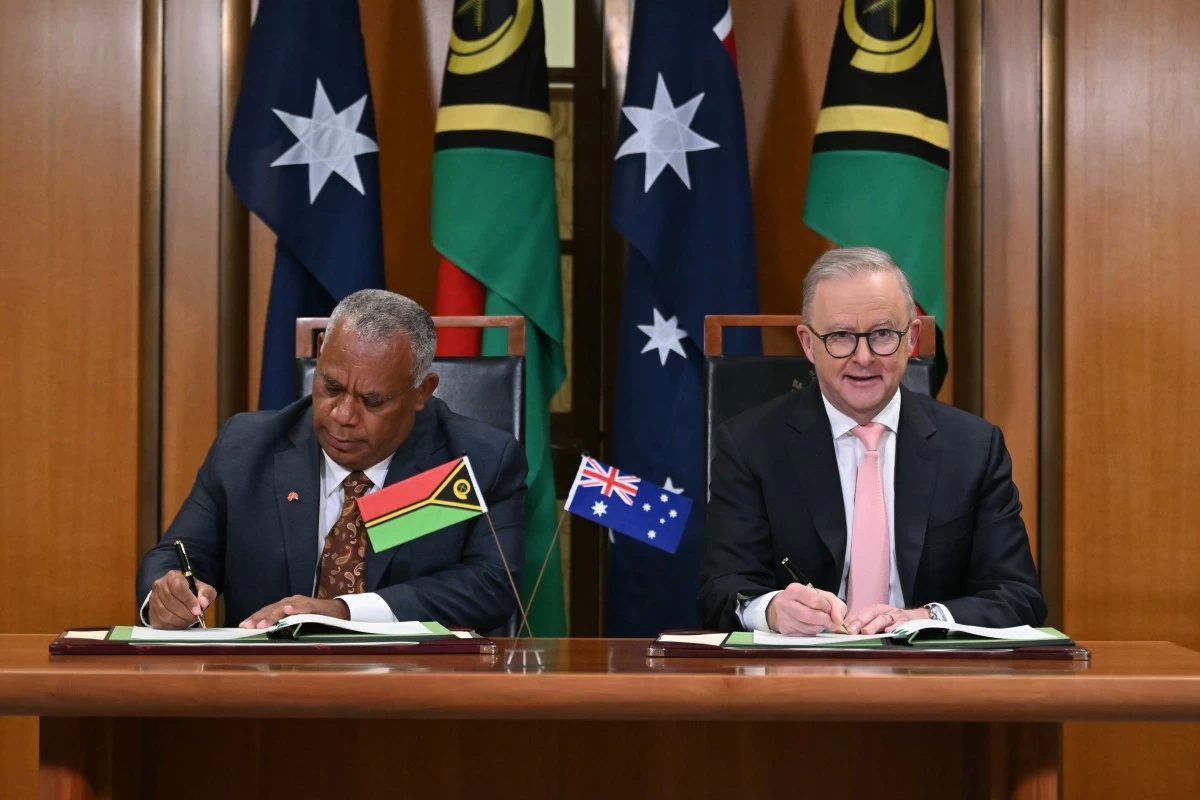
Prime Minister of Vanuatu Jotham Napat, left, and Australian Prime Minister Anthony Albanese sign the Nakamal agreement at Parliament House in Canberra, Monday, June 29, 2026. (Lukas Coch/AAP Image via AP)
MELBOURNE, Australia (AP) — Australia and Vanuatu signed a long-awaited bilateral security and economic treaty Monday that prevents China creating a military base on the South Pacific island nation.
Australian Prime Minister Anthony Albanese signed the so-called Nakamal Agreement with his Vanuatu counterpart, Jotham Napat, in the Australian capital nine months after the Vanuatuan government rejected an earlier draft. Vanuatu had feared the deal would limit its ability to attract infrastructure investment.
“Our agreement reflects and confirms Australia’s role as Vanuatu’s largest and most comprehensive economic, security and development partner, a responsibility that we take seriously,” Albanese told reporters.
Natap said the pact “reaffirms our shared commitment to continuing and strengthening the comprehensive partnership between our two countries, founded on mutual respect, trust and our common vision for a peaceful, stable and prosperous Pacific.”
Under the agreement, Vanuatu will not allow any foreign military base or infrastructure in its territory and will keep its critical infrastructure free from militarization, foreign interference or unauthorized access, a government statement said.
The agreement is one of several Australia has struck or is negotiating with regional neighbors to prevent China from gaining security influence in the region.
Vanuatu will consult with Australia when it considers third-party engagement in its critical infrastructure, but there is no power of veto as originally proposed.
China expressed concern that the agreement may be targeted at it.
“We hope that cooperation between relevant countries and Pacific Island countries will contribute to the development and stability of the island region, not target any third party or be used as a tool for geopolitical rivalry,” said Guo Jiakun, a spokesperson for China’s Ministry of Foreign Affairs.
Vanuatu committed to prioritize policing cooperation with Pacific Islands Forum members, a collection of 18 countries and territories that includes Australia. But the agreement does not exclude Chinese police. China does not have a permanent police presence in Vanuatu, but Chinese police personnel often visit the nation of 350,000 people.
Vanuatu also agrees to come to Australia, New Zealand and France first in response to major natural disasters.
Australia had proposed to provide Vanuatu with 500 million Australian dollars ($344 million) over a decade under the terms of the agreement as originally drafted.
Albanese said the cost of the latest agreement would be made public by December.
Napat said a bilateral agreement Vanuatu is negotiating with China would be made public once the pact had “clearance from Beijing.”
Napat has previously described the so-called Namele Agreement with China as a “comprehensive development cooperation” deal. He said it was not a security pact.
Vanuatu has received large loans and aid from China for buildings, wharves and other infrastructure.
“Currently, it’s not yet signed. We will share the (Namele) agreement. There is nothing to hide. Our government is transparent and I am so grateful that the Prime Minister (Albanese) has also given me the clearance to share with them (China) the Nakamal Agreement,” Napat said. China did not say whether it would reveal the details of the agreement when asked at the Ministry of Foreign Affairs Monday in Beijing.

Related Tags

world news
ADVERTISEMENT
.most-popular .layout-ratio{ padding-bottom: 79.13%; } @media (min-width: 768px) and (max-width: 1024px) { .widget-title { font-size: 15px !important; } }

{{ articles_filter_1561_widget.title }}

.most-popular .layout-ratio{ padding-bottom: 79.13%; } @media (min-width: 768px) and (max-width: 1024px) { .widget-title { font-size: 15px !important; } }

{{ static_articles_1562_widget.title }}

.most-popular .layout-ratio{ padding-bottom: 79.13%; } @media (min-width: 768px) and (max-width: 1024px) { .widget-title { font-size: 15px !important; } }

{{ articles_filter_1563_widget.title }}

{{ articles_filter_1564_widget.title }}

.mb-article-details { position: relative; } .mb-article-details .article-body-preview, .mb-article-details .article-body-summary{ font-size: 17px; line-height: 30px; font-family: "Libre Caslon Text", serif; color: #000; } .mb-article-details .article-body-preview iframe , .mb-article-details .article-body-summary iframe{ width: 100%; margin: auto; } .read-more-background { background: linear-gradient(180deg, color(display-p3 1.000 1.000 1.000 / 0) 13.75%, color(display-p3 1.000 1.000 1.000 / 0.8) 30.79%, color(display-p3 1.000 1.000 1.000) 72.5%); position: absolute; height: 200px; width: 100%; bottom: 0; display: flex; justify-content: center; align-items: center; padding: 0; } .read-more-background a{ color: #000; } .read-more-btn { padding: 17px 45px; font-family: Inter; font-weight: 700; font-size: 18px; line-height: 16px; text-align: center; vertical-align: middle; border: 1px solid black; background-color: white; } .hidden { display: none; }
function initializeAllSwipers() { // Get all hidden inputs with cms_article_id document.querySelectorAll('[id^="cms_article_id_"]').forEach(function (input) { const cmsArticleId = input.value; const articleSelector = '#article-' + cmsArticleId + ' .body_images'; const swiperElement = document.querySelector(articleSelector); if (swiperElement && !swiperElement.classList.contains('swiper-initialized')) { new Swiper(articleSelector, { loop: true, pagination: false, navigation: { nextEl: '#article-' + cmsArticleId + ' .swiper-button-next', prevEl: '#article-' + cmsArticleId + ' .swiper-button-prev', }, }); } }); } setTimeout(initializeAllSwipers, 3000); const intersectionObserver = new IntersectionObserver( (entries) => { entries.forEach((entry) => { if (entry.isIntersecting) { const newUrl = entry.target.getAttribute("data-url"); if (newUrl) { history.pushState(null, null, newUrl); let article = entry.target; // Extract metadata const author = article.querySelector('.author-section').textContent.replace('By', '').trim(); const section = article.querySelector('.section-info ').textContent.replace(' ', ' '); const title = article.querySelector('.article-title h1').textContent; // Parse URL for Chartbeat path format const parsedUrl = new URL(newUrl, window.location.origin); const cleanUrl = parsedUrl.host + parsedUrl.pathname; // Update Chartbeat configuration if (typeof window._sf_async_config !== 'undefined') { window._sf_async_config.path = cleanUrl; window._sf_async_config.sections = section; window._sf_async_config.authors = author; } // Track virtual page view with Chartbeat if (typeof pSUPERFLY !== 'undefined' && typeof pSUPERFLY.virtualPage === 'function') { try { pSUPERFLY.virtualPage({ path: cleanUrl, title: title, sections: section, authors: author }); } catch (error) { console.error('ping error', error); } } // Optional: Update document title if (title && title !== document.title) { document.title = title; } } } }); }, { threshold: 0.1 } ); function showArticleBody(button) { const article = button.closest("article"); const summary = article.querySelector(".article-body-summary"); const body = article.querySelector(".article-body-preview"); const readMoreSection = article.querySelector(".read-more-background"); // Hide summary and read-more section summary.style.display = "none"; readMoreSection.style.display = "none"; // Show the full article body body.classList.remove("hidden"); } document.addEventListener("DOMContentLoaded", () => { let loadCount = 0; // Track how many times articles are loaded const offset = [1, 2, 3, 4, 5, 6, 7, 8, 9, 10]; // Offset values const currentUrl = window.location.pathname.substring(1); let isLoading = false; // Prevent multiple calls if (!currentUrl) { console.log("Current URL is invalid."); return; } const sentinel = document.getElementById("load-more-sentinel"); if (!sentinel) { console.log("Sentinel element not found."); return; } function isSentinelVisible() { const rect = sentinel.getBoundingClientRect(); return ( rect.top < window.innerHeight && rect.bottom >= 0 ); } function onScroll() { if (isLoading) return; if (isSentinelVisible()) { if (loadCount >= offset.length) { console.log("Maximum load attempts reached."); window.removeEventListener("scroll", onScroll); return; } isLoading = true; const currentOffset = offset[loadCount]; window.loadMoreItems().then(() => { let article = document.querySelector('#widget_1690 > div:nth-last-of-type(2) article'); intersectionObserver.observe(article) loadCount++; }).catch(error => { console.error("Error loading more items:", error); }).finally(() => { isLoading = false; }); } } window.addEventListener("scroll", onScroll); });

Sign up by email to receive news.