






Manila Bulletin
 Property and Living
The rise of data centers: An emerging niche in the Philippine property market
Property and Living
The rise of data centers: An emerging niche in the Philippine property market
Property and Living
The rise of data centers: An emerging niche in the Philippine property market
The rise of data centers: An emerging niche in the Philippine property market
Published Jun 28, 2026 03:10 pm



Data centers are expected to develop more in the Philippines. (Image: APAC Knight Frank)
By Rick Santos, chairman and CEO, Santos Knight Frank
The Philippines has long positioned itself as a digital economy contender in Southeast Asia — and the numbers back it up. Of its 117 million people, over 98 million are active internet users spending an average of 54 hours a week on digital media, the second-highest globally. But all of that activity — every stream, transaction, cloud upload, and AI query — has to live somewhere. That somewhere is a data center. And this is where the Philippines faces a defining question: will it build the infrastructure to host its own digital economy, or continue to export that demand elsewhere?
The answer is complicated by real constraints. The challenges are defined by power gaps, weak data security, and limited hyperscaler presence – with Digital Edge Philippines and Equinix Philippines among the few operators in-country. The Philippines remains underleveraged relative to its regional peers.
Yet these very gaps point to where the opportunity lies.

Rick Santos, Chairman and CEO, Santos Knight Frank (Photo: Santos Knight Frank)
The opportunity
Land availability — particularly outside Metro Manila — is one of the country’s most underappreciated advantages. Unlike land-constrained Singapore, the Philippines has room to grow, with special economic zones and former military bases offering large parcels at competitive prices. Construction costs average $6.5 to $7.5 million per megawatt — lower than Thailand, Indonesia, and Singapore.
Policy reforms reinforce the case. Republic Act 12252, signed in August 2025, extended the maximum land lease period for foreign investors from 50 to 99 years — putting the Philippines on par with its ASEAN neighbors. Paired with the CREATE MORE Act’s tax holidays and duty exemptions, these measures significantly lower the barrier to entry for capital-intensive projects like data centers.
The Luzon Economic Corridor and Pax Silica
The most consequential development may be one that has received little attention in property circles: the Luzon Economic Corridor. Announced in April 2024 as the first Partnership for Global Infrastructure and Investment corridor in the Indo-Pacific, the LEC connects Subic Bay, Clark, Manila, and Batangas — accounting for roughly 50 percent of Philippine GDP — through investments in transport, clean energy, and digital connectivity. That digital backbone is already taking shape: HGC has deployed 1,000 kilometers of fiber optic network across Luzon, while the Energy Secure Philippines program targets grid upgrades along the corridor, directly addressing the power reliability challenge that has long held the market back.
In April 2026, the Philippines became the 13th member of Pax Silica — a U.S.-led framework for secure supply chains in semiconductors, AI, and critical minerals — coinciding with the announcement of a 4,000-acre industrial hub in New Clark City, Tarlac, designated as the network’s first “AI-native investment acceleration hub.” For data center developers, it represents a compelling frontier: large land parcels, improving connectivity, and distance from Metro Manila’s congestion and power constraints.
A niche whose time is coming
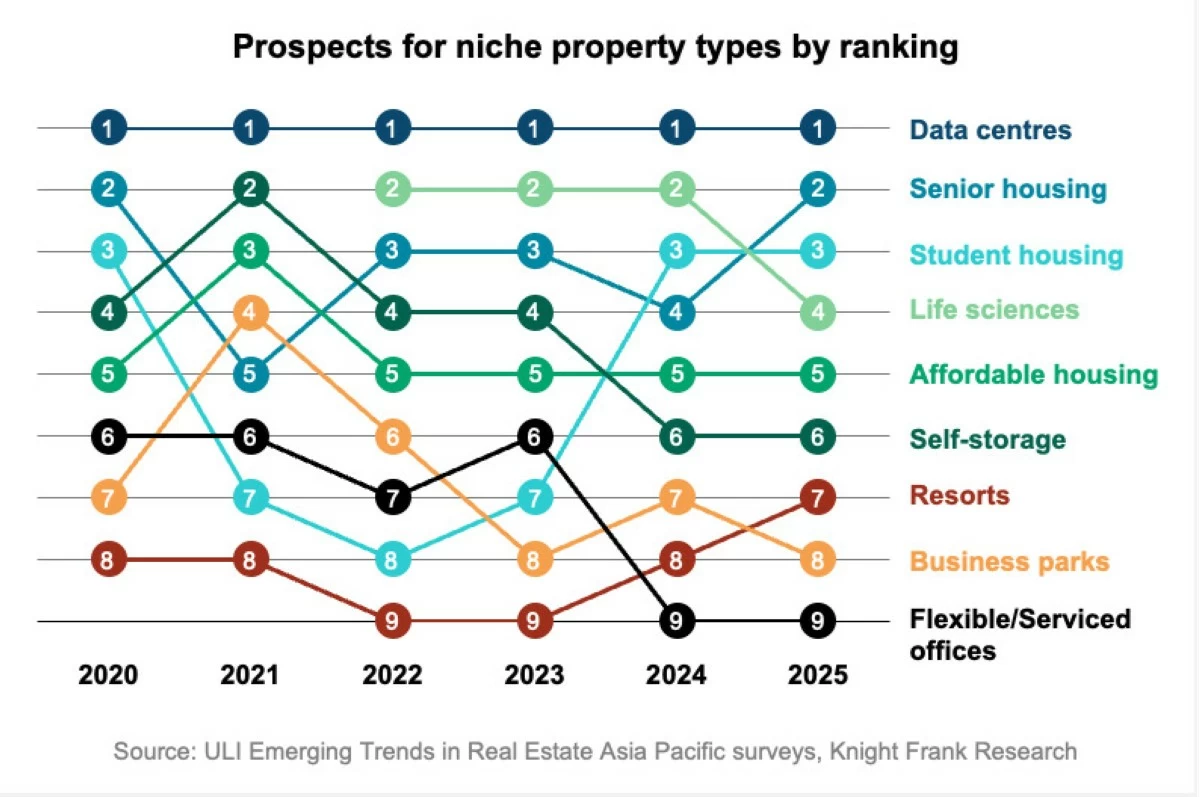
The Philippine data center market, valued at USD 735 million in 2025, is projected to reach USD 2.48 billion by 2031 — a 22.5 percent annual growth rate among the fastest in Southeast Asia. The challenges are real, but actively being addressed through legislation, multilateral investment, and infrastructure development along the LEC.
For developers, investors, and policymakers, the message is clear: data centers are no longer back-office infrastructure. They are the new real estate — mission-critical, income-generating, and strategically positioned at the intersection of digital demand and physical space. In the Philippines, that intersection runs straight through Luzon.