






Manila Bulletin
 Property and Living
Pino Perspectives: Multimodal transportation: Building cities that move better
Property and Living
Pino Perspectives: Multimodal transportation: Building cities that move better
Property and Living
Pino Perspectives: Multimodal transportation: Building cities that move better
Pino Perspectives: Multimodal transportation: Building cities that move better
By Nicholai Go
Published Jun 28, 2026 03:14 pm


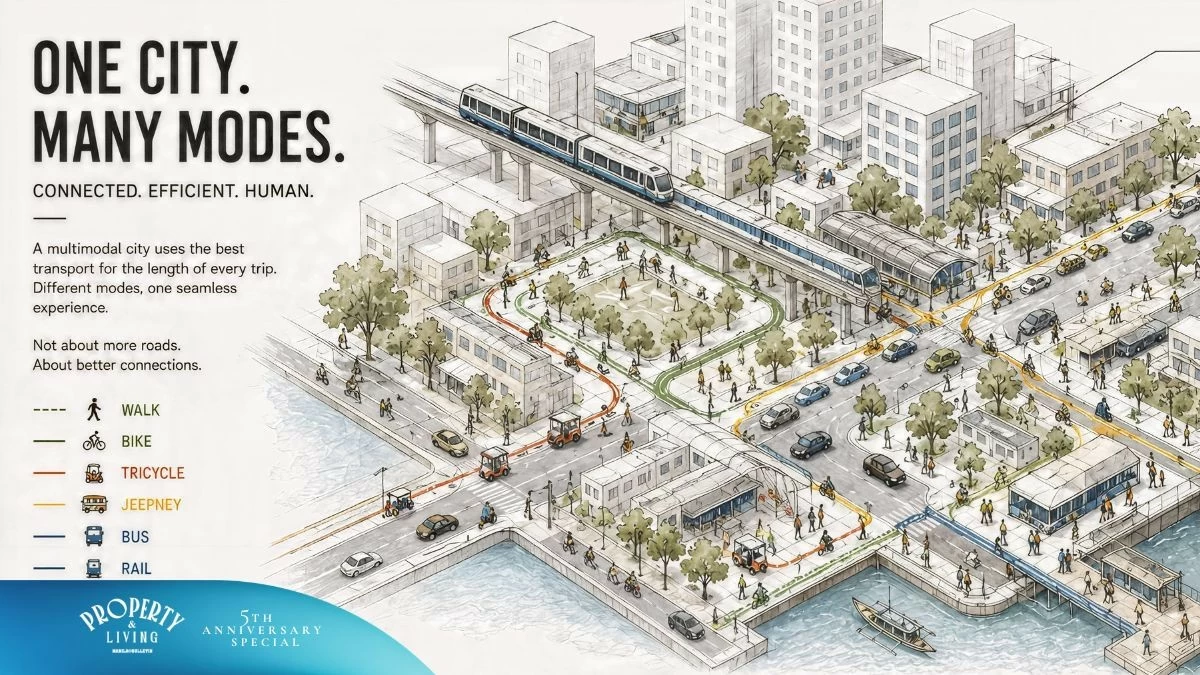
A multimodal city matches every trip with the best way to travel. Different modes, one seamless journey (Artist's perspective: Nicholai Go)
The success of a city is not measured by the height of its skyline or the width of its roads. It is measured by how easily people can move through it. Every commute to work, every trip to school, every delivery, and every visit to family depends on a transportation system that is safe, reliable, and efficient. When movement becomes difficult, the city itself becomes less productive, less accessible, and ultimately less livable. Transportation is the circulatory system of a city. When it fails, the city suffers cardiac arrest.
As our cities continue to grow, transportation must evolve alongside them. Around the world, urban centers have developed systems that reflect their own geography and culture. Tokyo has built one of the world's most efficient rail networks. Copenhagen has transformed cycling into a primary mode of transportation. Bogota has demonstrated the effectiveness of Bus Rapid Transit in moving large numbers of people efficiently. These cities did not succeed because they found a single perfect solution. They succeeded because they developed transportation systems that responded to their unique needs. The Philippines has the opportunity to do the same.
Our cities already possess a remarkable diversity of transportation. We have jeepneys, tricycles, buses, ferries, motorcycles, bicycles, and even the bangka serving coastal communities. These are more than modes of transportation. They are part of our identity and have evolved to meet the country's varied geography and everyday realities. Yet instead of operating as one coordinated network, these systems often function independently, forcing commuters to navigate disconnected and inefficient journeys.

(Artist's perspective: Nicholai Go)
The traditional response to traffic has been to build wider roads and add more lanes for private vehicles. However, cities around the world have shown that expanding road capacity alone rarely solves congestion over the long term. Likewise, while the expansion of rail and subway systems is necessary, mass transit alone cannot address every transportation challenge. No single mode of transport can meet the needs of every journey.
This is where the concept of multimodal transportation becomes essential. Rather than relying on one dominant form of transportation, multimodal planning recognizes that every mode has a specific role to play. Walking is ideal for short neighborhood trips. Bicycles provide an efficient option for nearby destinations. Tricycles offer valuable first and last mile connections. Jeepneys remain highly effective in distributing passengers across local streets. Buses and rail systems serve longer, higher capacity journeys, while ferries and bangka can utilize waterways that often remain underused.
The goal is not to replace these modes, but to connect them into one seamless transportation network where each complements the others. A commuter should be able to walk safely to a transport stop, ride a jeepney to a rail station, travel efficiently across the city by train, and complete the final stretch by bicycle or shuttle. Every mode should perform the task it is best suited for.
Building our future city will require more than infrastructure investment. It will require a shift in how we think about mobility. Success should not be measured by how many kilometers of roads we build, but by how easily people can reach jobs, schools, parks, healthcare, and opportunities. Transportation should be designed around people rather than vehicles.
The future of Philippine cities does not lie in abandoning the transportation systems that make us unique. Instead, it lies in embracing them, improving them, and integrating them into a connected multimodal network. By choosing the right mode of transportation for the right journey, we can create cities that are more efficient, more sustainable, and ultimately more livable for every Filipino.