







Phivolcs monitoring earthquake swarm off Pangasinan coast
Published Jun 26, 2026 01:36 pm


At A Glance
- Phivolcs explained that an earthquake swarm is a series of earthquakes closely clustered in space and time without a clearly defined mainshock-aftershock pattern.
Philippine Institute of Volcanology and Seismology (Phivolcs)
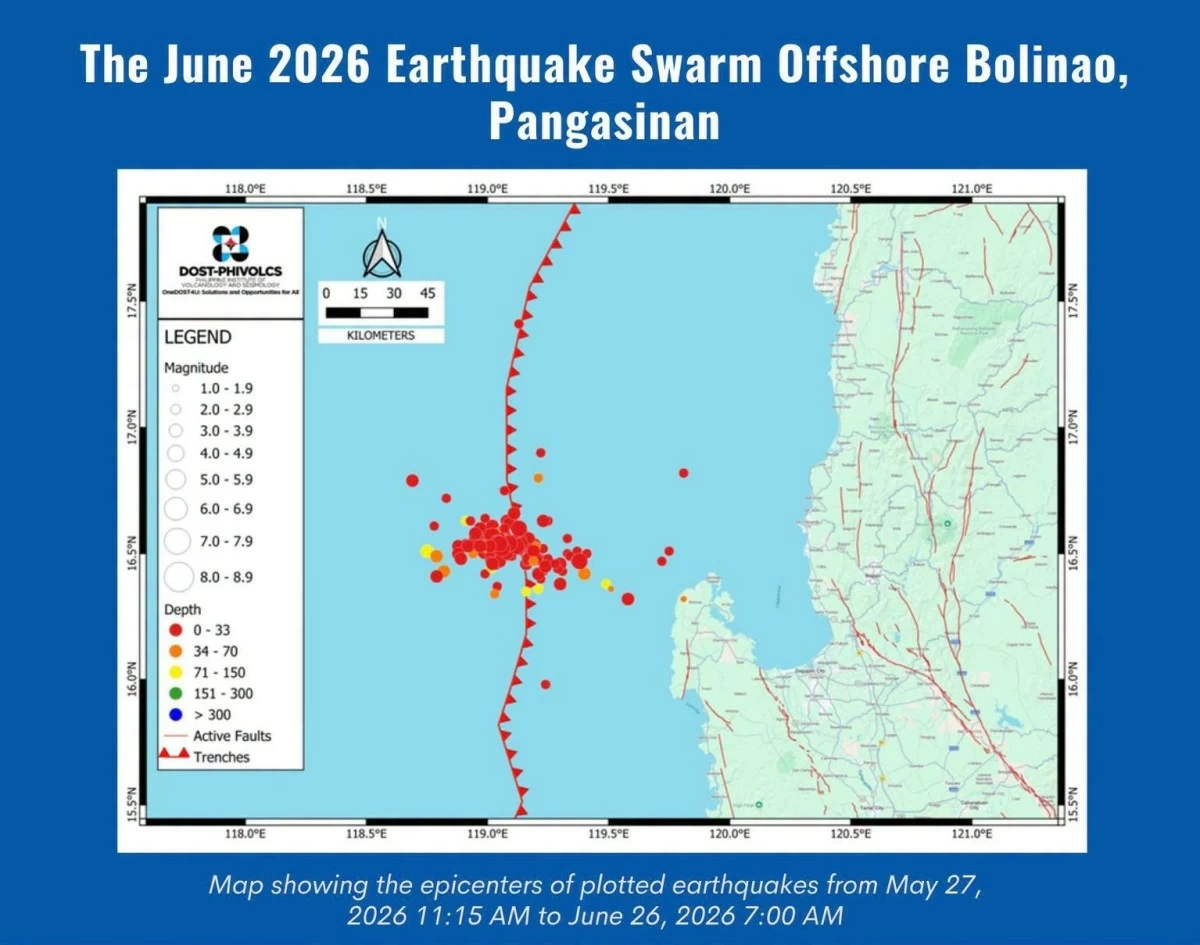
The earthquake swarm being monitored offshore of Bolinao, Pangasinan has generated over 200 tremors since it began on May 27, the Philippine Institute of Volcanology and Seismology (Phivolcs) said on Friday, June 26.
In an advisory, Phivolcs said the earthquake swarm started at 11:15 a.m. on May 27.
As of 7 a.m. on June 26, the agency's seismic network had recorded a total of 287 earthquakes.
Of the recorded earthquakes, only one was felt, with reported Intensity II shaking.
The earthquakes ranged in magnitude from 1.8 to 5.1 and occurred at depths of between 2 and 47 kilometers.
Phivolcs explained that an earthquake swarm is a series of earthquakes closely clustered in space and time without a clearly defined mainshock-aftershock pattern.
Such swarms may last for days, weeks, or even longer, and may or may not lead to stronger earthquakes.
Phivolcs said it continues to closely monitor the seismic activity offshore of Bolinao and will issue updates as necessary.
The agency advised the public to remain vigilant and practice earthquake preparedness, including identifying the safest and fastest evacuation routes, preparing emergency supply kits, and observing the “duck, cover, and hold”procedure during earthquakes.
For coastal communities, Phivolcs also reminded residents to watch for the natural warning signs of a possible local tsunami: strong and long-lasting ground shaking, unusual sea behavior, and a loud roaring sound from the ocean.
Those who observe any of these signs were urged to immediately move to higher ground and follow instructions from local government units and official advisories from Phivolcs.