

ADVERTISEMENT

How a Filipino designer created Eva Noblezada's Tribeca Festival dress

Fashion designer Odile Pauline Roxas shares the story behind the custom gown worn by Broadway star Eva Noblezada, from Hadestown-inspired symbolism to hand-sewn details made in the Philippines

Published Jun 26, 2026 10:06 am
For many designers, dressing a Broadway star for an international event would be a career-defining moment. For fashion designer Odile Pauline Roxas, that moment happened this month when Eva Noblezada stepped out in one of her custom creations at the 2026 Tribeca Festival.
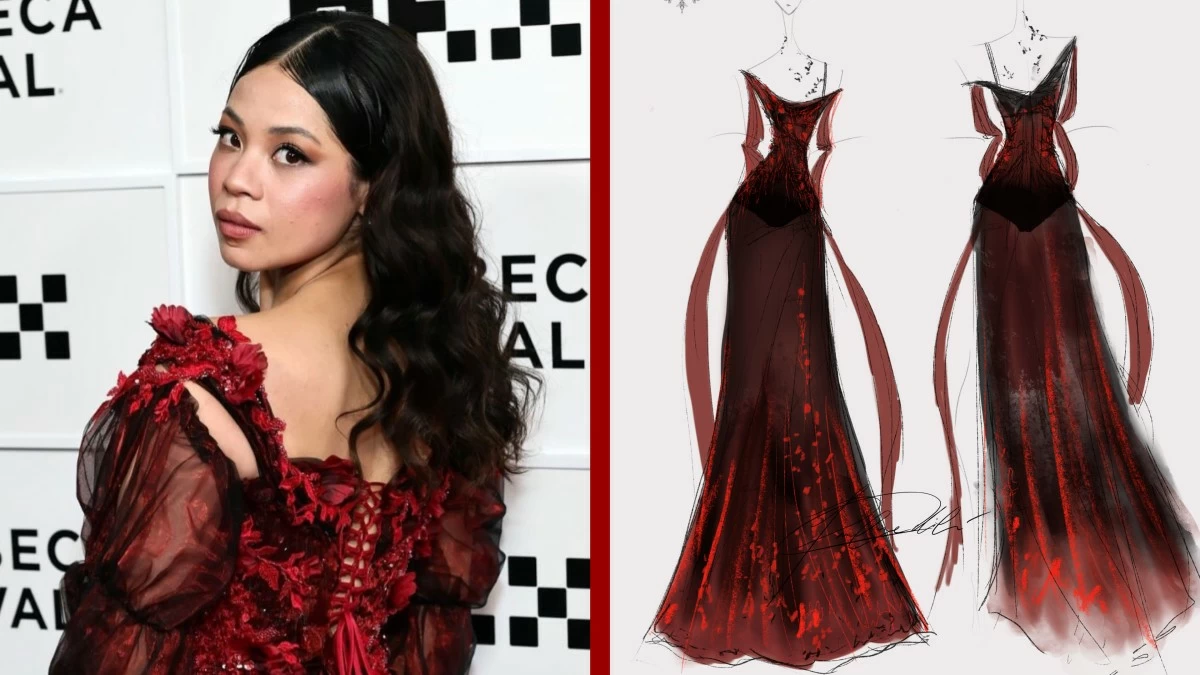
Eva had posted online about wanting to connect with an artist. A mutual acquaintance reached out to recommend Odile's work and encouraged her to send a message as well. "Nothing really came of it for a week, when suddenly I got a response from Eva,” she tells Manila Bulletin Lifestyle. "It was all history from there. Pure luck and chance."
The opportunity was particularly meaningful for Odile, a self-described theater nerd who grew up watching musical bootlegs and taking theater classes. Rather than creating a traditional red-carpet gown, Odile approached the project through storytelling. "It started with 'Hadestown,' a never-ending story of hunger and romance, and what it meant to Eva to play Eurydice," Odile explains.
The concept of red strings and destiny guided the narrative of the dress. References to Orpheus and Eurydice's enduring connection appeared throughout the design, while the color palette paid homage to the musical's recurring imagery of the red flower, a symbol that represents both love and death.
To achieve the ethereal effect she envisioned, Odile selected translucent organzas and lace fabrics that shifted and revealed themselves under light. "I wanted something ghostly," she says.

Working alongside two seamstresses, Odile completed the piece in less than a month while simultaneously managing other commissions, developing her bridal collection, and preparing the outfit that would later earn her Best Dressed honors at a Laufey concert.
Many of the dress' most intricate details were completed by hand. "I'm proud to say that this piece was hand-beaded by yours truly and made with local materials by local hands.”
Even the beaded flower petals carried a distinctly Filipino touch. Odile sourced prop flowers from Divisoria, carefully dismantling and transforming them into embellishments for the gown.
Among her favorite details were strategically placed green beads representing spring, a symbol of hope woven into Hadestown's famously tragic narrative.
"When that story doesn't have a happy ending, do we stop telling it? No, we keep moving forward, because one day that ending might change."
While the Broadway star shared her preferences and practical requirements, she trusted Odile to lead the artistic direction of the piece. "Eva is such a dear to collaborate with," she says. "She is an artist's favorite kind of client—a true muse. Her kindness, trust, and very generous compliments throughout the process made me more motivated to create a masterpiece of a dress."
According to Odile, Eva told her that the gown created "an angelic artistic shield" during her performance.
For the designer, the experience marked a significant milestone for Odile. She sees moments like this as opportunities not only for herself but for Filipino fashion as a whole. "I hope my journey motivates my fellow artists to keep creating, to push beyond boundaries and distance and stigmas, and to fight for our deserved time in the spotlight."
For Odile, the experience also challenges a common belief among aspiring creatives—that success requires leaving the Philippines. "My work and my story prove that one doesn't necessarily need to leave home to be recognized internationally," she says.
It is a message she hopes will resonate with young Filipino designers and artists pursuing their own dreams. "Putting faith in my future, and refusing to look back—to try and try again despite it all—is what brought me here today."

Related Tags

fashion and beauty Odile Pauline Roxas Eva Noblezada Eva Noblezada
ADVERTISEMENT
.most-popular .layout-ratio{ padding-bottom: 79.13%; } @media (min-width: 768px) and (max-width: 1024px) { .widget-title { font-size: 15px !important; } }

{{ articles_filter_1561_widget.title }}

.most-popular .layout-ratio{ padding-bottom: 79.13%; } @media (min-width: 768px) and (max-width: 1024px) { .widget-title { font-size: 15px !important; } }

{{ static_articles_1562_widget.title }}

.most-popular .layout-ratio{ padding-bottom: 79.13%; } @media (min-width: 768px) and (max-width: 1024px) { .widget-title { font-size: 15px !important; } }

{{ articles_filter_1563_widget.title }}

{{ articles_filter_1564_widget.title }}

.mb-article-details { position: relative; } .mb-article-details .article-body-preview, .mb-article-details .article-body-summary{ font-size: 17px; line-height: 30px; font-family: "Libre Caslon Text", serif; color: #000; } .mb-article-details .article-body-preview iframe , .mb-article-details .article-body-summary iframe{ width: 100%; margin: auto; } .read-more-background { background: linear-gradient(180deg, color(display-p3 1.000 1.000 1.000 / 0) 13.75%, color(display-p3 1.000 1.000 1.000 / 0.8) 30.79%, color(display-p3 1.000 1.000 1.000) 72.5%); position: absolute; height: 200px; width: 100%; bottom: 0; display: flex; justify-content: center; align-items: center; padding: 0; } .read-more-background a{ color: #000; } .read-more-btn { padding: 17px 45px; font-family: Inter; font-weight: 700; font-size: 18px; line-height: 16px; text-align: center; vertical-align: middle; border: 1px solid black; background-color: white; } .hidden { display: none; }
function initializeAllSwipers() { // Get all hidden inputs with cms_article_id document.querySelectorAll('[id^="cms_article_id_"]').forEach(function (input) { const cmsArticleId = input.value; const articleSelector = '#article-' + cmsArticleId + ' .body_images'; const swiperElement = document.querySelector(articleSelector); if (swiperElement && !swiperElement.classList.contains('swiper-initialized')) { new Swiper(articleSelector, { loop: true, pagination: false, navigation: { nextEl: '#article-' + cmsArticleId + ' .swiper-button-next', prevEl: '#article-' + cmsArticleId + ' .swiper-button-prev', }, }); } }); } setTimeout(initializeAllSwipers, 3000); const intersectionObserver = new IntersectionObserver( (entries) => { entries.forEach((entry) => { if (entry.isIntersecting) { const newUrl = entry.target.getAttribute("data-url"); if (newUrl) { history.pushState(null, null, newUrl); let article = entry.target; // Extract metadata const author = article.querySelector('.author-section').textContent.replace('By', '').trim(); const section = article.querySelector('.section-info ').textContent.replace(' ', ' '); const title = article.querySelector('.article-title h1').textContent; // Parse URL for Chartbeat path format const parsedUrl = new URL(newUrl, window.location.origin); const cleanUrl = parsedUrl.host + parsedUrl.pathname; // Update Chartbeat configuration if (typeof window._sf_async_config !== 'undefined') { window._sf_async_config.path = cleanUrl; window._sf_async_config.sections = section; window._sf_async_config.authors = author; } // Track virtual page view with Chartbeat if (typeof pSUPERFLY !== 'undefined' && typeof pSUPERFLY.virtualPage === 'function') { try { pSUPERFLY.virtualPage({ path: cleanUrl, title: title, sections: section, authors: author }); } catch (error) { console.error('ping error', error); } } // Optional: Update document title if (title && title !== document.title) { document.title = title; } } } }); }, { threshold: 0.1 } ); function showArticleBody(button) { const article = button.closest("article"); const summary = article.querySelector(".article-body-summary"); const body = article.querySelector(".article-body-preview"); const readMoreSection = article.querySelector(".read-more-background"); // Hide summary and read-more section summary.style.display = "none"; readMoreSection.style.display = "none"; // Show the full article body body.classList.remove("hidden"); } document.addEventListener("DOMContentLoaded", () => { let loadCount = 0; // Track how many times articles are loaded const offset = [1, 2, 3, 4, 5, 6, 7, 8, 9, 10]; // Offset values const currentUrl = window.location.pathname.substring(1); let isLoading = false; // Prevent multiple calls if (!currentUrl) { console.log("Current URL is invalid."); return; } const sentinel = document.getElementById("load-more-sentinel"); if (!sentinel) { console.log("Sentinel element not found."); return; } function isSentinelVisible() { const rect = sentinel.getBoundingClientRect(); return ( rect.top < window.innerHeight && rect.bottom >= 0 ); } function onScroll() { if (isLoading) return; if (isSentinelVisible()) { if (loadCount >= offset.length) { console.log("Maximum load attempts reached."); window.removeEventListener("scroll", onScroll); return; } isLoading = true; const currentOffset = offset[loadCount]; window.loadMoreItems().then(() => { let article = document.querySelector('#widget_1690 > div:nth-last-of-type(2) article'); intersectionObserver.observe(article) loadCount++; }).catch(error => { console.error("Error loading more items:", error); }).finally(() => { isLoading = false; }); } } window.addEventListener("scroll", onScroll); });

Sign up by email to receive news.