







Discovering the many secrets of Rome
Hidden travel itineraries worth seeking out
Published Jun 25, 2026 12:21 pm


It has been said that Rome is like lasagna. This means that it has many layers waiting to be discovered.
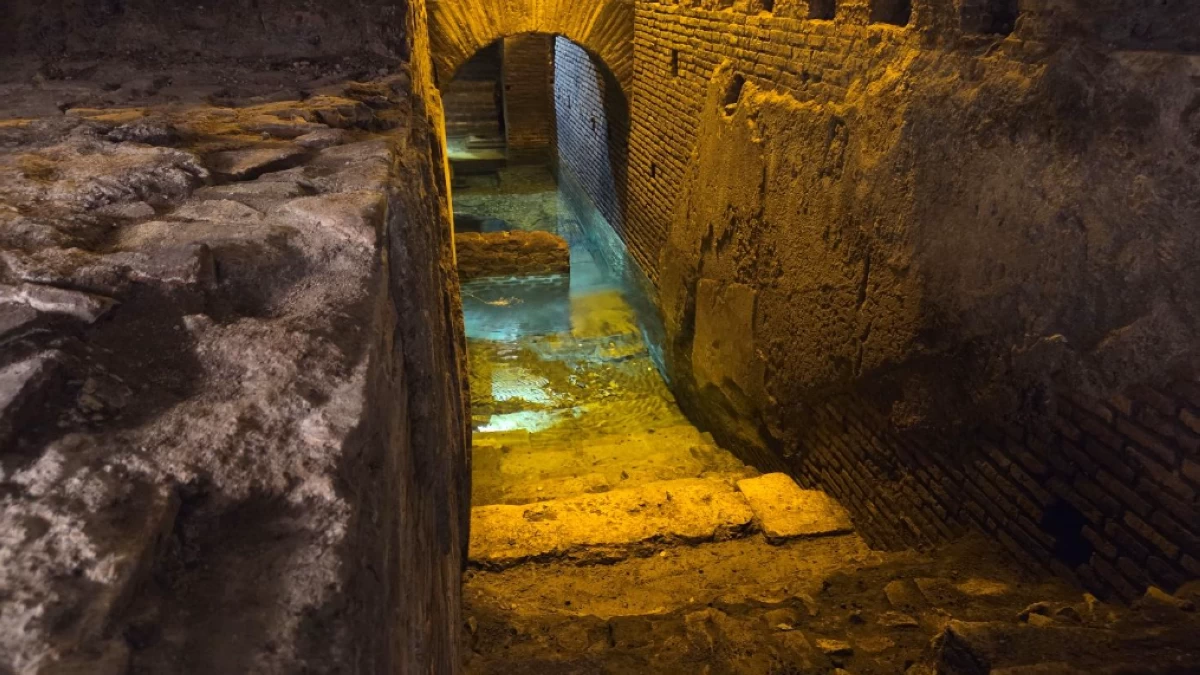
The Colosseo underground
This is certainly true for many of the archaeological sites, which, over the centuries, have piled one on top of the other. A single visit to Rome does not do it justice, and there are always more things to be discovered, even in the most popular attractions.
Like a Dan Brown novel, a lot of hidden structures and sites can be found if one knows what one is looking for. We visited a few of these treasures on our recent trip.
The Colosseo or Colosseum is one of the most recognizable landmarks in Rome. That isn’t even its official name. Officially known as the Flavian Amphitheatre, it was constructed on an artificial lake next to a colossal statue of the Emperor Nero, which no longer exists, but nevertheless gave the stadium its more popular name.
The Colosseum was the site of numerous gladiator battles, which could be elaborate to the extent that they sometimes flooded the arena to have ships do naval battles. More often, the floor was covered with sand to soak up the blood from the warriors and animals that participated in the games.
The Colosseum was the site of numerous gladiator battles, which could be elaborate to the extent that they sometimes flooded the arena to have ships do naval battles. More often, the floor was covered with sand to soak up the blood from the warriors and animals that participated in the games.
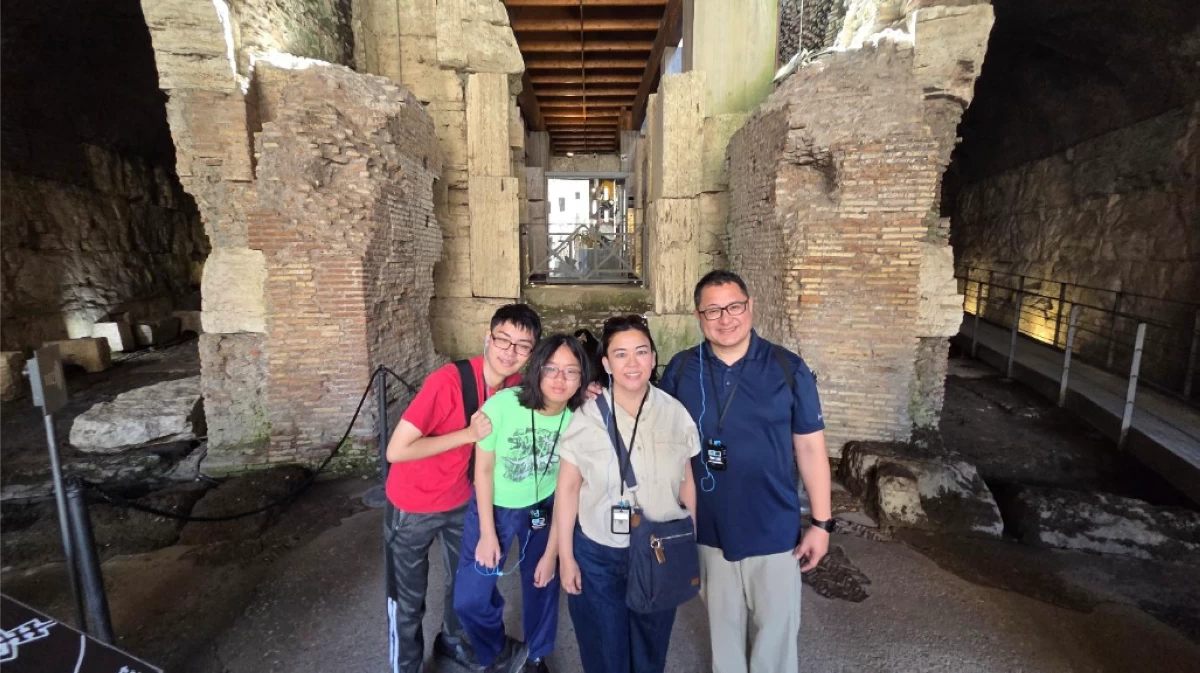
The author and his family
In recent years, limited access for the public has been granted to the arena floor where the gladiatorial contests were held. Even more limited access has been given to the underground level where the gladiators entered and were lifted to the arena floor with elaborate elevators and other contraptions.
We were able to get access to the underground level and the arena with a private guide after booking the tour months ahead of time. It was an eye-opening experience.
We saw the corridors connecting the adjacent training building to the structures under the arena floor where the gladiators got ready for their contests, complete with a video reenactment of the journey projected on the wall of one of the tunnels.
There was an exhibit on the different paraphernalia they used, including the tridents, nets, and swords. Gladiators themselves are named after the “gladius,” which is a type of sword favored by these warriors. There were also animal storage areas, which housed lions, tigers, and even elephants for the games.
Still intact are at least two flood corridors where the ships used for the naval battles were prepared and stored. There is a display showing everyday items found in the arena, from souvenirs and ancient figurines to the food that the spectators ate, complete with chicken bones.
We left the underground and proceeded to the arena floor, where our guide further explained how the games were conducted. Contrary to popular belief, it was rare that gladiators were killed since they represented a significant investment for the owners and managers of the games. Successful gladiators were treated as celebrities, and the oil from their bodies after a massage was scraped and collected for use as an aphrodisiac. Gladiators could be slaves or free men, but they were treated equally regardless of class since it was important for them to be in their peak condition for the games.
Another secret area we were able to visit was the remnants of the Aqua Virgo, an aqueduct that was built in ancient Rome in 19 B.C. and which eventually supplied the Trevi fountain. The Trevi fountain is perhaps the most famous fountain in the world, and we stopped by many times during our trip. It features Oceanus, the titan of the sea, flanked by different mythological figures in an impressive display of marble and travertine.
The modern-day fountain is supplied by the reconstructed Acqua Vergine, which still utilizes some of the original Roman aqueducts, including the Aqua Virgo. However, unlike in the past, when the water continuously flowed through the Trevi fountain, the supply is now supplemented and recycled using water pumps.
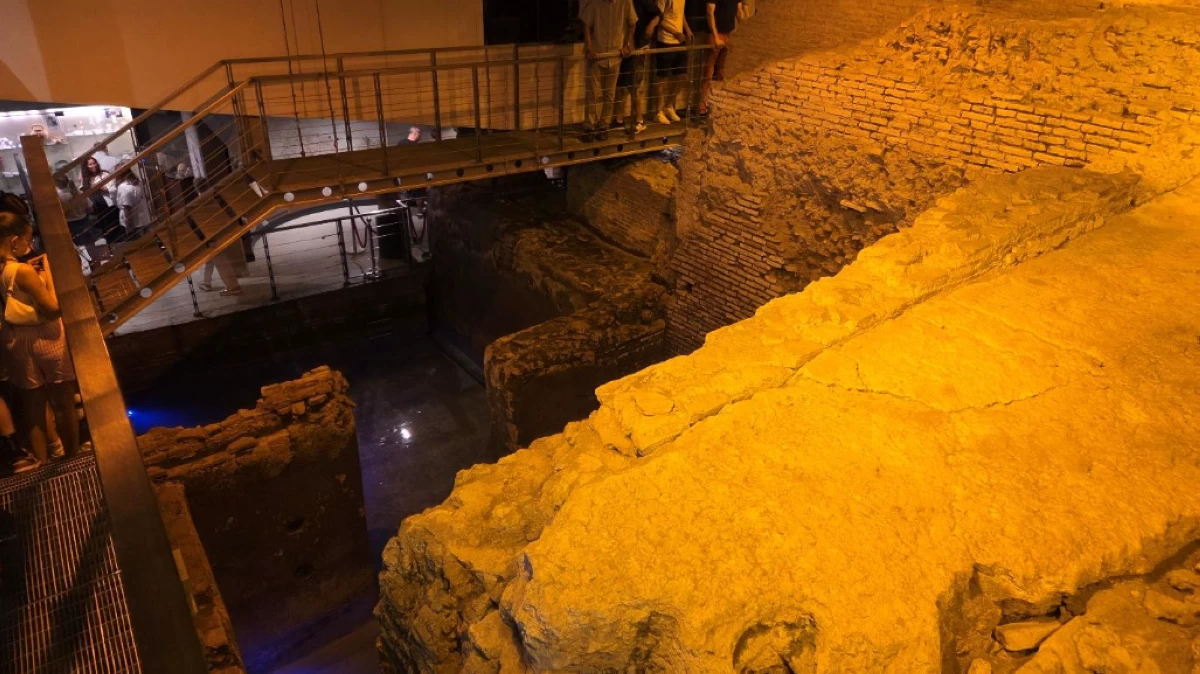
Underneath the Trevi fountain are the remnants of the Aqua Virgo.
The ancient Aqua Virgo distribution tank is still used as an overflow mechanism for the Trevi fountain, which we were able to see in the Vicus Caprarius, an underground excavation nearby under a hotel and bar. Within those same ruins was found the back of a Roman senator’s house, which had the luxury of flowing water even in ancient times.
Another part of the aqueduct system was discovered during excavations to expand the Rinascente Via del Tritone luxury shopping mall. They incorporated the archaeological site into the basement of the mall, complete with a video presentation that reconstructs and overlays the original plan on the water delivery structures.
Seeing the expertise of the ancient Romans in hydrology and realizing that we have been drinking untreated pure water from the same sources since ancient times is a testament to how advanced their engineering knowledge was at that time.
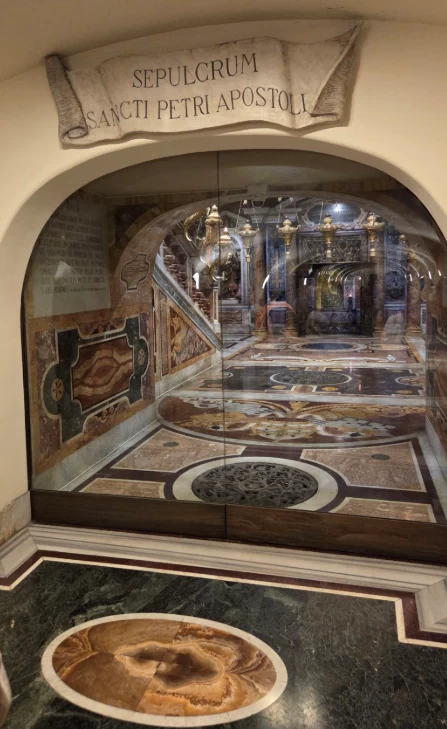
St. Peter’s tomb under the main altar of St. Peter’s Basilica
One not-so-secret area of St. Peter’s Basilica in the Vatican City that is easily missed by tourists on a hectic itinerary is the Vatican Grottoes. The Vatican Grottoes are where many of the crypts of the popes are located along with relics and memorabilia of a number of saints.
The Grottoes are open to the public for free. The tomb of St. Peter, which is directly under the Basilica's main altar, is connected to the Grottoes and can be seen through a glass partition, but requires special permission to access directly.
A more ancient Roman cemetery is located further underneath the Grottoes, but also requires special access, which we did not have time to obtain. The Grottoes are accessible through a side entrance near one of the altars on the left side of the Basilica. We nearly missed it had we not seen people exiting through stairs from beneath the ground on the opposite altar.
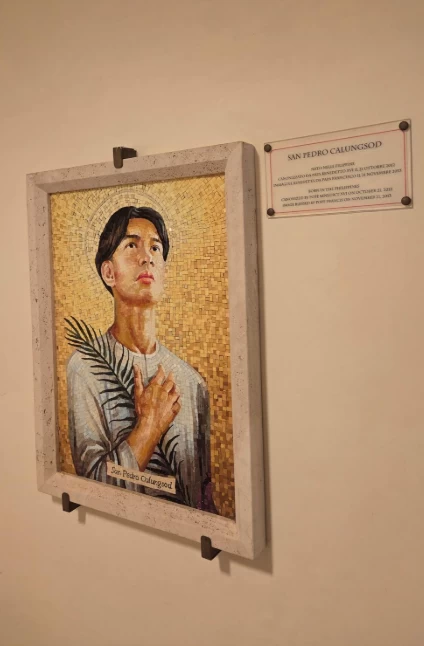
Portrait of Saint Pedro Calungsod in the Vatican Grottoes.
The most recent interment was in 2023 when Pope Emeritus Benedict XVI was laid to rest. His successor, Pope Francis, was not buried in the Grottoes but instead requested to be interred at the Santa Maria Maggiore Basilica upon his death in 2025. One unexpected and interesting detail we saw in the Grottoes was a mosaic painting of St. Pedro Calungsod, which was enshrined by Pope Francis in 2013 with the consecrating mass presided over by Cardinal Luis Antonio Tagle.
These are just three of the many other hidden and fascinating sites located in Rome that we visited during this trip. We also descended into the ossuary of the Capuchin monks, which holds the artfully arranged bones of some 3,000 monks. Along the Appian way, we explored catacombs, which served as meeting places for early Christian communities.
At Castel Gandolfo, we toured the private gardens of the Popes, which were opened to the public by Pope Francis. Rome holds many more secrets, and a lifetime would not be enoughto discover all of them. That just gives us an excuse to keep coming back to this Eternal City.