






Manila Bulletin
 Business
The Stock Market
Stocks plunge below 6,000 as peso slips past 61 per US dollar
Business
The Stock Market
Stocks plunge below 6,000 as peso slips past 61 per US dollar
Business
The Stock Market
Stocks plunge below 6,000 as peso slips past 61 per US dollar
Stocks plunge below 6,000 as peso slips past 61 per US dollar
Published Jun 24, 2026 05:33 pm


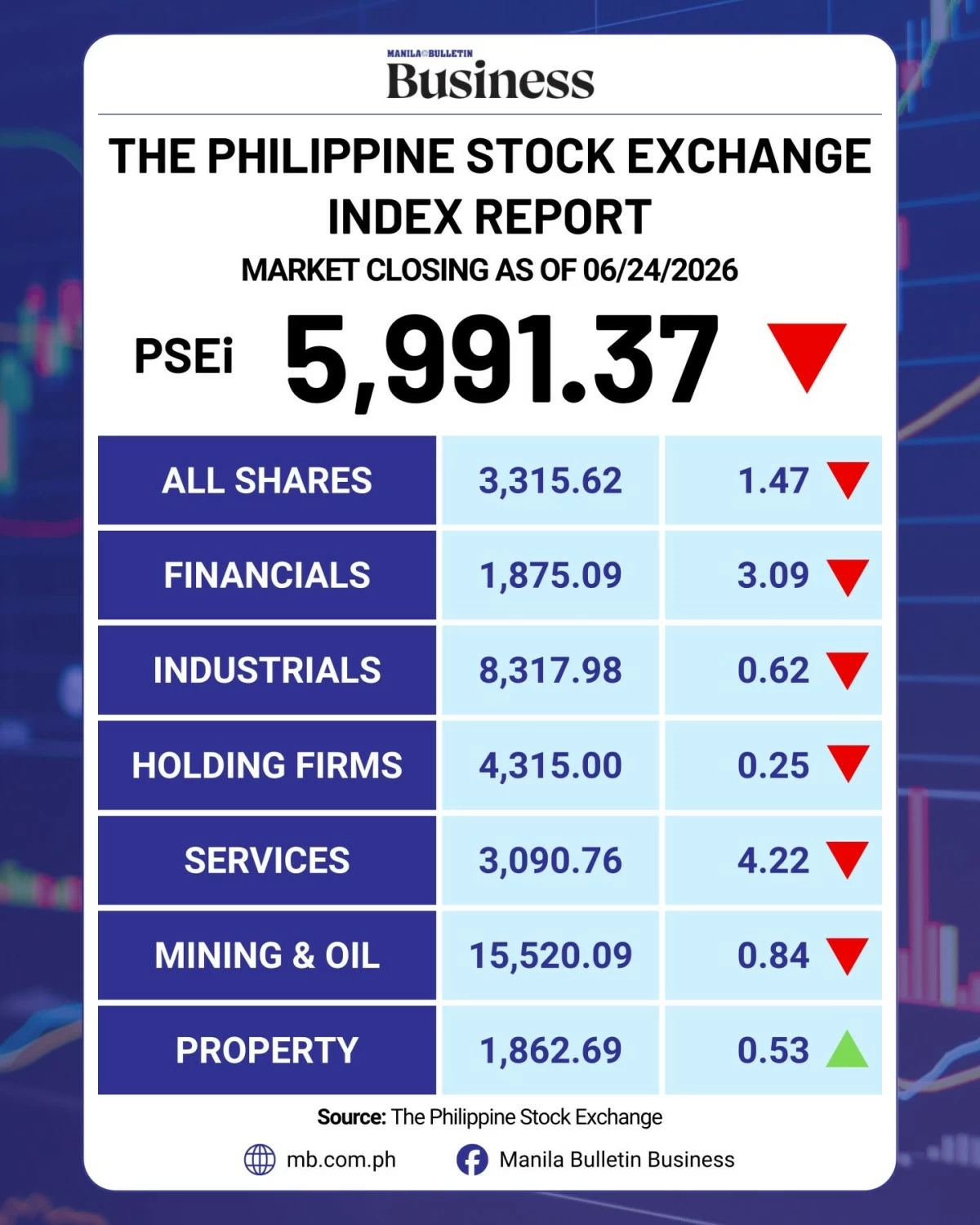
Local equities plunged back below a critical psychological threshold as worsening domestic growth forecasts and a hawkish shift in United States (US) Federal Reserve monetary policy expectations triggered a broad-based selloff.
The Philippine Stock Exchange index (PSEi) slumped 133.85 points, or 2.2 percent, to finish at 5,991.37 on Wednesday, June 24, effectively wiping out the previous session’s brief technical rebound, with the services and banking sectors leading the downturn.
Out of the exchange’s major sub-indices, only the property sector managed to eke out marginal gains.
Trading velocity accelerated as investors rapidly adjusted their portfolios, with 8.7 billion shares valued at ₱10.32 billion changing hands. Decliners handily outpaced advances, with 104 stocks falling against 67 that moved higher, while 63 counters closed unchanged.
The breach of the 6,000 mark comes amid deepening anxieties over the archipelago's macroeconomic trajectory. Market participants reacted sharply to a wave of downgraded growth projections for the Philippines, which have clouded the outlook for corporate earnings and consumer spending.
“The PSEi ended below the 6,000-level as the market reacted negatively to various lowered growth forecasts for the Philippines,” said Luis Limlingan, managing director at Regina Capital Development Corp. “Investor sentiment weakened as concerns over slower economic momentum prompted cautious positioning among market participants.”
Adding to the domestic headwinds was a sharp correction in one of the market's most influential heavyweights. International Container Terminal Services Inc. (ICTSI), the global port operator, plummeted 5.97 percent, severely dragging down the aggregate index.
“The local market was weighed down by the sell-off of its heavyweight International Container Terminal Services Inc.,” said Japhet Tantiangco, research manager at Philstocks Financial Inc., noting that widespread selling pressure was observed across key sectors as institutional investors reassessed their growth outlooks.
Simultaneously, severe foreign-exchange pressures exacerbated the equity rout.
The Philippine weakened past the 61-per-dollar mark, marking its sixth consecutive day of depreciation. A softer currency threatens to exacerbate imported inflation, potentially forcing the Bangko Sentral ng Pilipinas to maintain an aggressive policy stance. This currency weakness intensified following renewed signals from U.S. policymakers that another Federal Reserve rate hike remains a distinct possibility.
“The PSEi dropped after the exchange rate went up for the sixth straight trading day after more hawkish Fed signals on a possible Fed rate hike,” said Michael Ricafort, chief economist at Rizal Commercial Banking Corp.
He noted that the dual threat of currency depreciation and sticky inflation expectations continues to suppress local equity valuations.