






Manila Bulletin
 Business
The Stock Market
Stocks jump 1.5% as US-Iran oil deal triggers bargain hunting
Business
The Stock Market
Stocks jump 1.5% as US-Iran oil deal triggers bargain hunting
Business
The Stock Market
Stocks jump 1.5% as US-Iran oil deal triggers bargain hunting
Stocks jump 1.5% as US-Iran oil deal triggers bargain hunting
Published Jun 23, 2026 05:09 pm


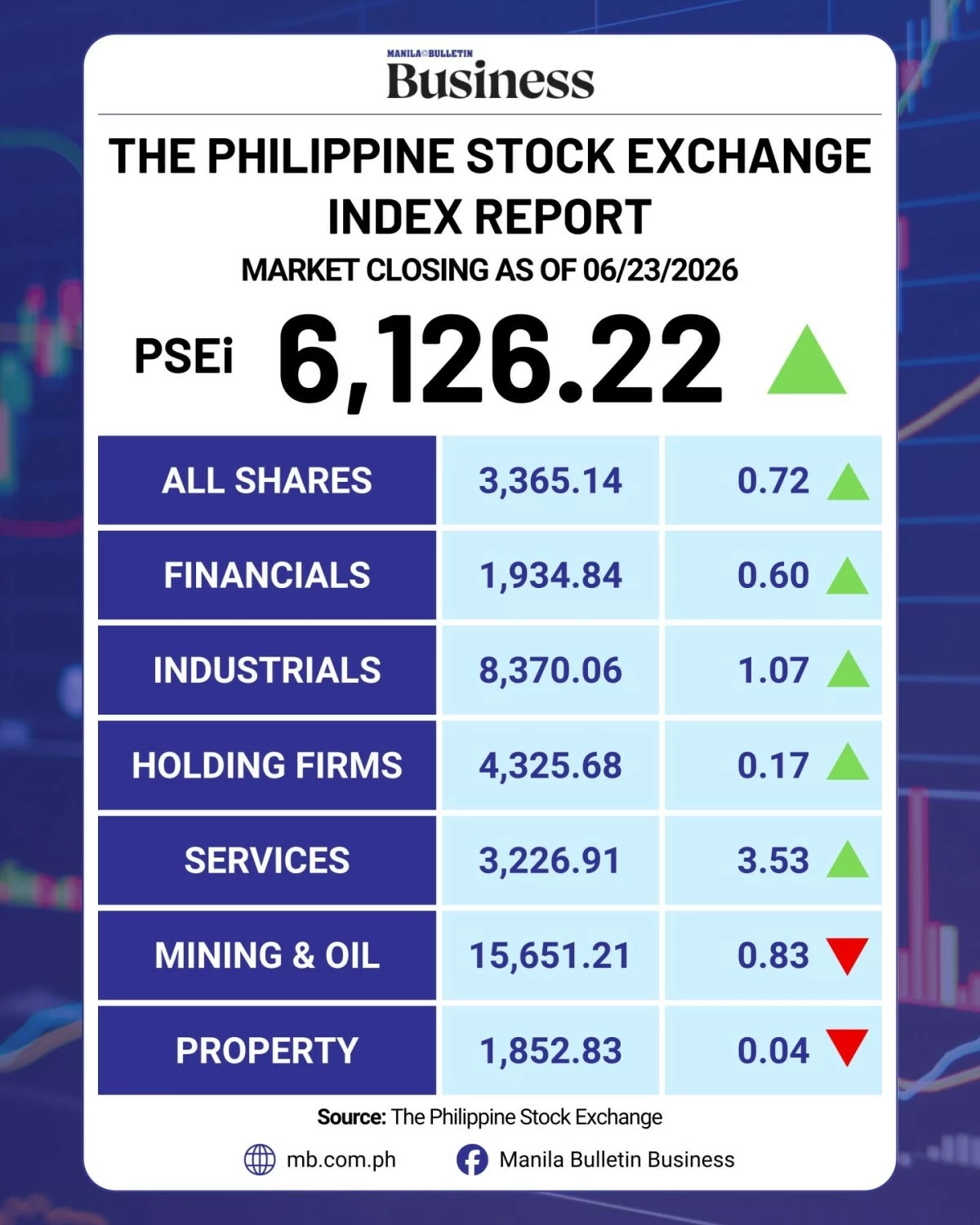
Domestic equities snapped a two-day decline, rallying as investors capitalized on lower valuations after the United States (US) issued an interim waiver on Iranian energy exports, dragging global crude prices to a three-month low.
The Philippine Stock Exchange index (PSEi) advanced 1.51 percent, or 91.2 points, to close at 6,126.22 on Tuesday, June 23. The rebound was paced by services companies, which offset lingering weakness among mining and real estate firms.
The advance came despite the broader undertone of caution across Asian markets, where participants continued to weigh local macroeconomic pressures against an easing geopolitical landscape.
Sentiment lifted globally after Washington granted a 60-day license allowing Tehran to resume international oil sales. The move provides a crucial economic lifeline to Iran while diplomatic negotiations for a long-term peace agreement continue in Switzerland. The prospect of revived supply from the Persian Gulf sent New York mercantile crude down to $73 per barrel, its lowest level since March 3.
“The local market bounced back as investors hunted for bargains following two straight days of losses,” said Japhet Tantiangco, research manager at Philstocks Financial.
However, he noted that trading remained relatively muted as many market participants stayed on the sidelines to monitor both the Middle East diplomatic discussions and domestic headwinds. “Risks remain, primarily those pertaining to the US-Iran situation and the Philippines' own growth and inflation outlook.”
Market activity reflected this underlying hesitation. Total volume decreased to 706 million shares, with transactions valued at ₱6.83 billion. Advancers barely edged out decliners 85 to 83, while 66 stocks remained unchanged.
The temporary oil waiver has temporarily eased global energy supply anxieties, offering relief to import-dependent economies like the Philippines, which has been grappling with sticky inflation. Michael Ricafort, chief economist at Rizal Commercial Banking Corp., noted that the 60-day window provides vital breathing room for international markets as negotiators seek a permanent peace settlement.
Even with the daily gain, investment managers cautioned that local equities face structural hurdles. Attractive domestic valuations are currently being balanced against ongoing global uncertainties and tight central bank monetary policy.
Luis Limlingan, managing director at Regina Capital Development Corp., remarked that while investors actively engaged in bargain hunting to reverse the prior sessions' steep losses, regional market caution capped broader enthusiasm.