ADVERTISEMENT

AFP to intensify patrols near Bajo de Masinloc despite Chinese presence

Published Jun 23, 2026 02:37 pm
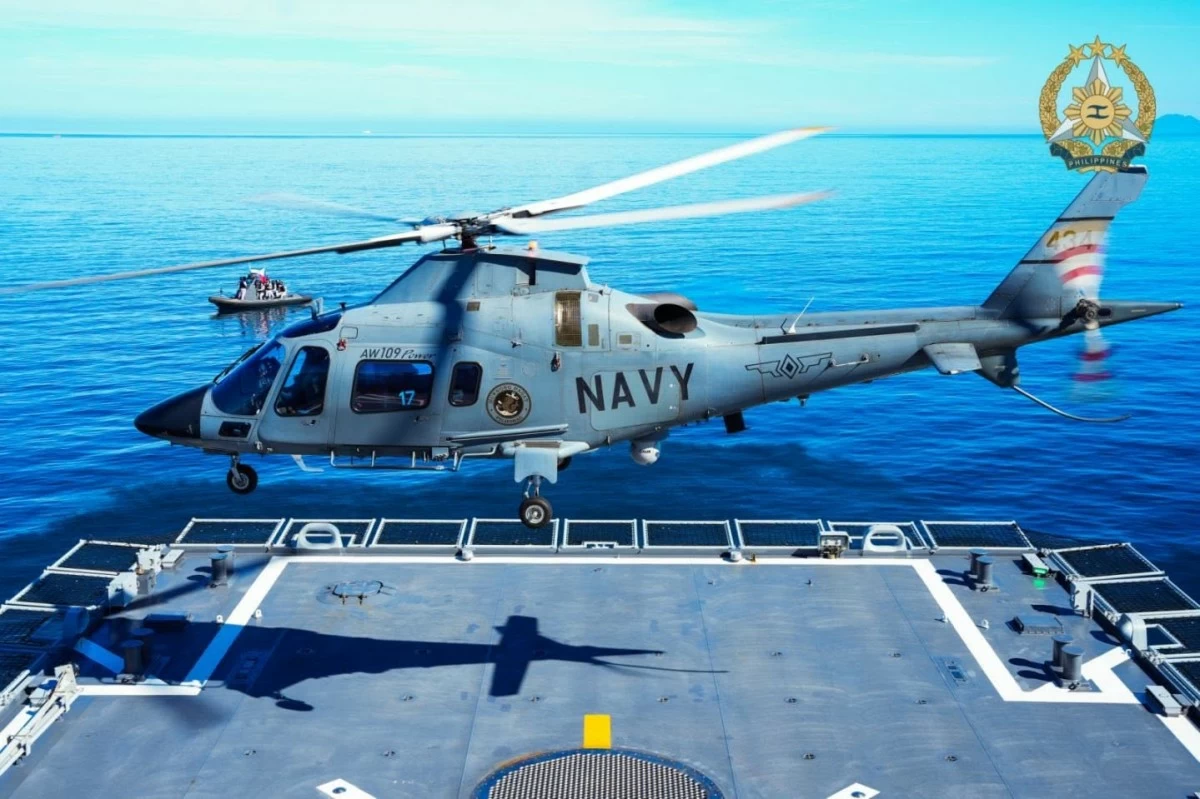
An AW109 helicopter launches from the flight deck of BRP Diego Silang (FFG7) to support Visit, Board, Search, and Seizure (VBSS) drills during the PH-US bilateral Maritime Cooperative Activity in the West Philippine Sea held from June 14 to 19, 2026. (Photo: Armed Forces of the Philippines)
More unilateral, bilateral, and multilateral patrols will be conducted near Bajo de Masinloc (Scarborough or Panatag Shoal) in the West Philippine Sea (WPS) in the coming months, the Armed Forces of the Philippines (AFP) vowed on Tuesday, June 23, following the detection of a movable floating platform used for scientific research and a flotilla of Chinese vessels.
Retired admiral Roy Vincent Trinidad, AFP spokesperson for WPS, made the statement after BRP Diego Silang (FFG-7), an offshore patrol vessel of the Philippine Navy (PN), successfully carried out a unilateral patrol near Bajo de Masinloc last week despite the presence of Chinese naval vessels.
“Recently, BRP Diego Silang conducted a unilateral patrol close to Bajo de Masinloc. She was armed with the arbitral tribunal ruling of 2016. She was met by four PLA [People’s Liberation Army] Navy warships that were armed with a non-existent claim,” Trinidad said.
The 2016 arbitral ruling invalidated China's expansive claims in the South China Sea but Beijing continues to reject the decision.
“The patrol was successfully conducted in a legal and professional manner. You can expect more unilateral patrols and bilateral and multilateral activities close to Bajo de Masinloc in the coming months,” Trinidad added.
On June 19, the BRP Diego Silang conducted a maritime sovereignty patrol near Bajo de Masinloc as part of the week-long bilateral Maritime Cooperative Activity (MCA) by the AFP with the United States, where Philippine Navy personnel encountered the presence of Chinese naval and coast guard assets.
Despite being outnumbered by the presence of two Jiangkai-class frigates with bow numbers “554” and “555,” a Jiangdao-class corvette, an auxiliary tanker, and a maritime patrol aircraft from the Chinese side, BRP Diego Silang continued its mission.
Trinidad said there was no indication that the Chinese warships activated weapons-related systems against BRP Diego Silang during the patrol.
“There was no monitored activity that would point to activation of sensors or fire control systems. Nevertheless, BRP Diego Silang challenged their presence and reminded them that based on the Arbitral Tribunal ruling and domestic law, they have no right to be in Philippine waters,” he explained.
Meanwhile, the AFP continues to monitor the Chinese research vessel “Tongji,” which was spotted near Bajo de Masinloc shortly after the removal of a floating platform from the area. While the Chinese embassy in Manila claimed the vessel was conducting marine scientific research, the AFP dismissed these assertions as a familiar deception.
Tongji, described as an intelligent oceanographic comprehensive research vessel, was monitored outside the shoal during a maritime domain awareness flight over the weekend.
"In 1995, the Philippines and the world were fooled by similar statements about Panganiban or Mischief Reef. Today, Mischief is a fully functional military base. Today, the country and the world will not allow itself to be fooled the second time around on Bajo de Masinloc or Scarborough Shoal," Trinidad warned, referring to the reclamation works done by China on Panganiban Reef, which was initially said to be just a fisherman's shelter.
The military emphasized that any marine scientific research conducted within the Philippines’ exclusive economic zone without coordination with the coastal state is illegal.
For its latest monitoring from June 16 to 22, the AFP said it spotted 17 China Coast Guard (CCG) and PLA-Navy vessels in three key features in the WPS.
Majority of the Chinese depployment was in Bajo de Masinloc with four CCG vessels and five PLA-Navy ships.
In Ayungin (Second Thomas) Shoal, there were four CCG vessels, while in Pag-asa (Thitu) Island, there were three PLA-Navy ships and one CCG vessel.
In Escoda Shoal, the AFP did not monitor any presence of Chinese vessels.

Related Tags

AFP West Philippine Sea Bajo de Masinloc China
ADVERTISEMENT
.most-popular .layout-ratio{ padding-bottom: 79.13%; } @media (min-width: 768px) and (max-width: 1024px) { .widget-title { font-size: 15px !important; } }

{{ articles_filter_1561_widget.title }}

.most-popular .layout-ratio{ padding-bottom: 79.13%; } @media (min-width: 768px) and (max-width: 1024px) { .widget-title { font-size: 15px !important; } }

{{ static_articles_1562_widget.title }}

.most-popular .layout-ratio{ padding-bottom: 79.13%; } @media (min-width: 768px) and (max-width: 1024px) { .widget-title { font-size: 15px !important; } }

{{ articles_filter_1563_widget.title }}

{{ articles_filter_1564_widget.title }}

.mb-article-details { position: relative; } .mb-article-details .article-body-preview, .mb-article-details .article-body-summary{ font-size: 17px; line-height: 30px; font-family: "Libre Caslon Text", serif; color: #000; } .mb-article-details .article-body-preview iframe , .mb-article-details .article-body-summary iframe{ width: 100%; margin: auto; } .read-more-background { background: linear-gradient(180deg, color(display-p3 1.000 1.000 1.000 / 0) 13.75%, color(display-p3 1.000 1.000 1.000 / 0.8) 30.79%, color(display-p3 1.000 1.000 1.000) 72.5%); position: absolute; height: 200px; width: 100%; bottom: 0; display: flex; justify-content: center; align-items: center; padding: 0; } .read-more-background a{ color: #000; } .read-more-btn { padding: 17px 45px; font-family: Inter; font-weight: 700; font-size: 18px; line-height: 16px; text-align: center; vertical-align: middle; border: 1px solid black; background-color: white; } .hidden { display: none; }
function initializeAllSwipers() { // Get all hidden inputs with cms_article_id document.querySelectorAll('[id^="cms_article_id_"]').forEach(function (input) { const cmsArticleId = input.value; const articleSelector = '#article-' + cmsArticleId + ' .body_images'; const swiperElement = document.querySelector(articleSelector); if (swiperElement && !swiperElement.classList.contains('swiper-initialized')) { new Swiper(articleSelector, { loop: true, pagination: false, navigation: { nextEl: '#article-' + cmsArticleId + ' .swiper-button-next', prevEl: '#article-' + cmsArticleId + ' .swiper-button-prev', }, }); } }); } setTimeout(initializeAllSwipers, 3000); const intersectionObserver = new IntersectionObserver( (entries) => { entries.forEach((entry) => { if (entry.isIntersecting) { const newUrl = entry.target.getAttribute("data-url"); if (newUrl) { history.pushState(null, null, newUrl); let article = entry.target; // Extract metadata const author = article.querySelector('.author-section').textContent.replace('By', '').trim(); const section = article.querySelector('.section-info ').textContent.replace(' ', ' '); const title = article.querySelector('.article-title h1').textContent; // Parse URL for Chartbeat path format const parsedUrl = new URL(newUrl, window.location.origin); const cleanUrl = parsedUrl.host + parsedUrl.pathname; // Update Chartbeat configuration if (typeof window._sf_async_config !== 'undefined') { window._sf_async_config.path = cleanUrl; window._sf_async_config.sections = section; window._sf_async_config.authors = author; } // Track virtual page view with Chartbeat if (typeof pSUPERFLY !== 'undefined' && typeof pSUPERFLY.virtualPage === 'function') { try { pSUPERFLY.virtualPage({ path: cleanUrl, title: title, sections: section, authors: author }); } catch (error) { console.error('ping error', error); } } // Optional: Update document title if (title && title !== document.title) { document.title = title; } } } }); }, { threshold: 0.1 } ); function showArticleBody(button) { const article = button.closest("article"); const summary = article.querySelector(".article-body-summary"); const body = article.querySelector(".article-body-preview"); const readMoreSection = article.querySelector(".read-more-background"); // Hide summary and read-more section summary.style.display = "none"; readMoreSection.style.display = "none"; // Show the full article body body.classList.remove("hidden"); } document.addEventListener("DOMContentLoaded", () => { let loadCount = 0; // Track how many times articles are loaded const offset = [1, 2, 3, 4, 5, 6, 7, 8, 9, 10]; // Offset values const currentUrl = window.location.pathname.substring(1); let isLoading = false; // Prevent multiple calls if (!currentUrl) { console.log("Current URL is invalid."); return; } const sentinel = document.getElementById("load-more-sentinel"); if (!sentinel) { console.log("Sentinel element not found."); return; } function isSentinelVisible() { const rect = sentinel.getBoundingClientRect(); return ( rect.top < window.innerHeight && rect.bottom >= 0 ); } function onScroll() { if (isLoading) return; if (isSentinelVisible()) { if (loadCount >= offset.length) { console.log("Maximum load attempts reached."); window.removeEventListener("scroll", onScroll); return; } isLoading = true; const currentOffset = offset[loadCount]; window.loadMoreItems().then(() => { let article = document.querySelector('#widget_1690 > div:nth-last-of-type(2) article'); intersectionObserver.observe(article) loadCount++; }).catch(error => { console.error("Error loading more items:", error); }).finally(() => { isLoading = false; }); } } window.addEventListener("scroll", onScroll); });

Sign up by email to receive news.