







PCG challenges Chinese vessel loitering near Luzon coast
Published Jun 22, 2026 01:55 pm


At A Glance
- The Philippine Coast Guard (PCG) deployed BRP Malabrigo (MRRV-4402) to confront a China Coast Guard (CCG) vessel, CCG-5304, which has been loitering within the Philippine Exclusive Economic Zone off the coast of Luzon since June 16.
- Despite numerous radio challenges issued by the BRP Malabrigo since June 20, the Chinese vessel has remained silent and failed to respond to the PCG's repeated attempts at communication.
- The PCG noted that the Chinese vessel was patrolling routes that align with Beijing's illegal ten-dash line claims, which were previously invalidated by the 2016 Permanent Court of Arbitration ruling.
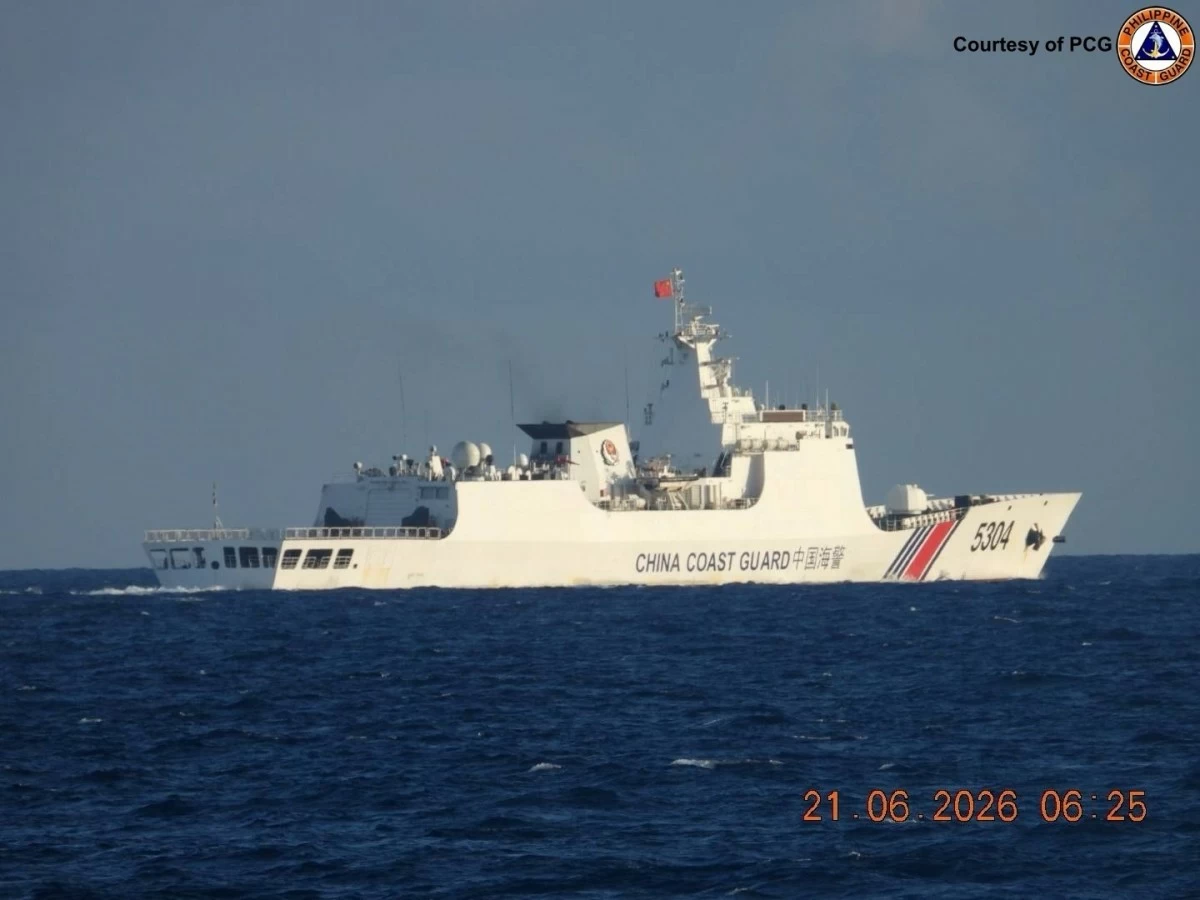
The Philippine Coast Guard (PCG) monitors China Coast Guard (CCG) vessel "5394" operating within the country’s exclusive economic zone (EEZ) off the coast of Luzon on June 21, 2026. (Photo: PCG)
The Philippine Coast Guard (PCG) deployed one of its 44-meter multi-role response vessels to confront a China Coast Guard (CCG) ship operating within the country’s exclusive economic zone (EEZ) off the coast of Luzon.
Rear Admiral Jay Tarriela, PCG spokesperson for West Philippine Sea (WPS), said BRP Malabrigo (MRRV-4402) has been deployed since June 20 to challenge the CCG ship with bow number “5304”.
“BRP Malabrigo has radio-challenged CCG-5304 numerous times but [the] CCG vessel did not respond to any of these challenges,” Tarriela said.
According to monitoring data, CCG-5304 has been present in the area since June 16.
A PCG Britten-Norman Islander aircraft (PCG-251) conducted a maritime domain awareness flight on Sunday, June 21, to track the ship. The PCG aircraft spotted the vessel approximately 45.5 nautical miles west of Iba, Zambales.
According to Tarriela, the movement of the CCG vessel has been irregular and provocative. Its northernmost track reached 27.29 nautical miles off Burgos, Ilocos Sur while its southernmost track took it to 30 nautical miles off Capones Island in San Antonio, Zambales.
As of Sunday evening, the vessel was observed 43 nautical miles west of Cabangan, Zambales.
“It is worth noting that the movement pattern indicates that CCG-5304 is likely patrolling along the limits of China’s unlawfully claimed sea areas in the West Philippine Sea, as demarcated by its illegal nine- or ten-dash line—claims that were invalidated by the 2016 Arbitral Award,” Tarriela said.
The nine-dash line is a U-shaped demarcation that appears on Chinese maps to delineate what Beijing terms its "historic rights" in the region. It covers approximately 90 percent of the South China Sea, encroaching upon the EEZs of several neighbors, including the Philippines, Vietnam, Malaysia, and Brunei.
In recent years, Beijing has supplemented this with a "ten-dash line," which adds a tenth dash to the east of Taiwan, further extending its sweeping claims.
In 2013, the Philippine government challenged China's claims before the Permanent Court of Arbitration (PCA) in The Hague under the United Nations Convention on the Law of the Sea (UNCLOS). Three years later, on July 12, 2016, the tribunal delivered a unanimous ruling that dismantled the legal foundation of China's expansive maritime claims.
Despite the lack of communication from the Chinese side, the PCG maintained that it will not back down from its mission to protect Philippine maritime interests.
“The PCG remains steadfast in upholding the Philippines’ sovereign rights and jurisdiction within its maritime zones,” Tarriela said.
“We will continue to maintain our presence and conduct lawful patrols to ensure the safety of our maritime domain and protect the rights of our Filipino fisherfolk,” he added.