

ADVERTISEMENT

Sweet success: Guimaras mangoes make historic first journey to Europe

Published Jun 21, 2026 07:16 am

At A Glance

  • Fresh Guimaras mangoes have arrived in Europe for the first time through a pioneering 100-kilogram test shipment.
  • The shipment marks the first European export by woman-led enterprise Guimaras Wonder Farms and aims to test logistics, shelf life, and market opportunities.
  • The mangoes have reached Madrid, Spain, after traveling through Brussels and other major European cities.
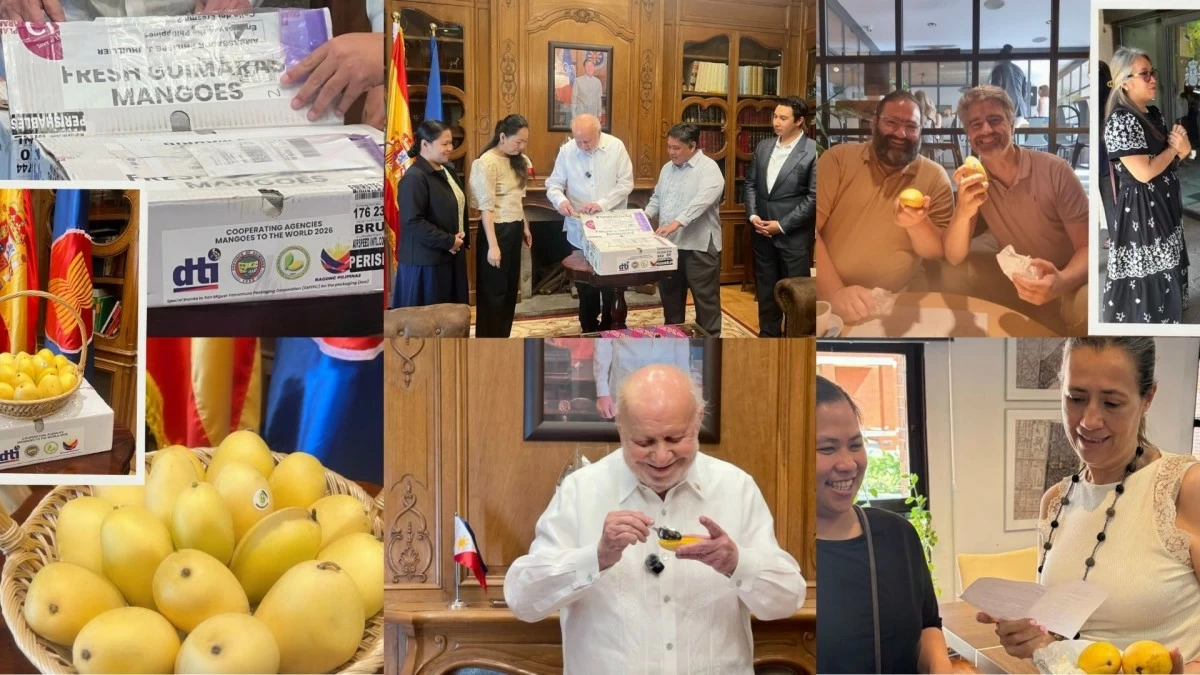
A TASTE OF THE PHILIPPINES ARRIVES IN SPAIN — The Philippine Embassy in Spain presents fresh Guimaras Mangoes as part of a pioneering 100-kilogram test shipment to Europe. The Guimaras Mangoes were received by officials from the Prado Museum, Ministry of Labor, and Councillor Yolanda Estrada of the District of Chamartín, among many others. (Philippine Embassy in Spain/Facebook)

One of the Philippines' sweetest treasures has officially arrived in Europe.

The Philippine Embassy in Spain announced that fresh Guimaras mangoes have made their historic first journey to the continent through a pioneering 100-kilogram test shipment aimed at introducing one of the country's most celebrated agricultural products to European consumers and trade partners.

The shipment, which has now reached Madrid, Spain, marks an important milestone for Philippine agriculture and exports, as it seeks to open new markets for high-value Filipino produce.

The European journey began in Brussels, Belgium, considered the symbolic first entry point "from the heart of the Philippines to the heart of Europe," before continuing to key cities including The Hague, Paris, Berlin, and Madrid.

More than just mangoes

The embassy said on June 19 that the shipment represents several firsts.

Aside from being the first time fresh Guimaras mangoes have been exported to Europe, it is also the first European export undertaken by a woman-led enterprise, Guimaras Wonder Farms.

The initiative is also serving as a test shipment that will generate valuable insights on logistics, shelf life, and premium market opportunities in Europe.

Philippine Ambassador to Spain Philippe J. Lhuillier said the initiative could create opportunities not only for exporters but also for Filipino farmers, entrepreneurs, and local communities.

"Introducing premium Philippine products to European markets creates opportunities not only for our exporters, but also for our farmers, entrepreneurs, and local communities," Lhuillier said.

"We hope this initiative will open doors for future partnerships and strengthen appreciation for the quality and diversity of Philippine agricultural products," he added.

A taste of Guimaras

The embassy noted that Guimaras mangoes hold a special distinction as the first registered Geographical Indication (GI) product of the Philippines.

A geographical indication identifies products whose qualities and reputation are closely linked to their place of origin.

Cultivated in the island province of Guimaras, the mangoes are renowned for their sweetness, aroma, and flavor—qualities shaped by the province's soil, climate, and generations of farming expertise.

Often referred to as among the world's sweetest mangoes, Guimaras mangoes have become one of the country's iconic agricultural products and a major source of livelihood for thousands of farmers in the province.

Connecting Filipino farmers to the world

The shipment was made possible through the collaboration of the Department of Trade and Industry's Supply Chain and Logistics Group, DTI-Guimaras, the Provincial Government of Guimaras, Guimaras Wonder Farms, logistics partners, and Philippine embassies and trade offices across Europe.

At the heart of the initiative is a shared goal: connecting Philippine farmers and small and medium enterprises directly with international markets and creating new export pathways for high-value agricultural products.

As the mangoes arrived in Madrid, the embassy said it was delighted to share "a taste of the Philippines" with Europe and showcase a product that embodies Filipino excellence, heritage, and the dedication of local farmers.

For now, the journey of the 100 kilograms of mangoes may be a small shipment by volume—but for Philippine agriculture, it represents a giant leap toward putting one of the country's sweetest exports on European tables.

Related Tags

Guimaras Mango Europe Spain Guimaras Mangoes Philippine Mangoes
ADVERTISEMENT
.most-popular .layout-ratio{ padding-bottom: 79.13%; } @media (min-width: 768px) and (max-width: 1024px) { .widget-title { font-size: 15px !important; } }

{{ articles_filter_1561_widget.title }}

.most-popular .layout-ratio{ padding-bottom: 79.13%; } @media (min-width: 768px) and (max-width: 1024px) { .widget-title { font-size: 15px !important; } }

{{ static_articles_1562_widget.title }}

.most-popular .layout-ratio{ padding-bottom: 79.13%; } @media (min-width: 768px) and (max-width: 1024px) { .widget-title { font-size: 15px !important; } }

{{ articles_filter_1563_widget.title }}

{{ articles_filter_1564_widget.title }}

.mb-article-details { position: relative; } .mb-article-details .article-body-preview, .mb-article-details .article-body-summary{ font-size: 17px; line-height: 30px; font-family: "Libre Caslon Text", serif; color: #000; } .mb-article-details .article-body-preview iframe , .mb-article-details .article-body-summary iframe{ width: 100%; margin: auto; } .read-more-background { background: linear-gradient(180deg, color(display-p3 1.000 1.000 1.000 / 0) 13.75%, color(display-p3 1.000 1.000 1.000 / 0.8) 30.79%, color(display-p3 1.000 1.000 1.000) 72.5%); position: absolute; height: 200px; width: 100%; bottom: 0; display: flex; justify-content: center; align-items: center; padding: 0; } .read-more-background a{ color: #000; } .read-more-btn { padding: 17px 45px; font-family: Inter; font-weight: 700; font-size: 18px; line-height: 16px; text-align: center; vertical-align: middle; border: 1px solid black; background-color: white; } .hidden { display: none; }
function initializeAllSwipers() { // Get all hidden inputs with cms_article_id document.querySelectorAll('[id^="cms_article_id_"]').forEach(function (input) { const cmsArticleId = input.value; const articleSelector = '#article-' + cmsArticleId + ' .body_images'; const swiperElement = document.querySelector(articleSelector); if (swiperElement && !swiperElement.classList.contains('swiper-initialized')) { new Swiper(articleSelector, { loop: true, pagination: false, navigation: { nextEl: '#article-' + cmsArticleId + ' .swiper-button-next', prevEl: '#article-' + cmsArticleId + ' .swiper-button-prev', }, }); } }); } setTimeout(initializeAllSwipers, 3000); const intersectionObserver = new IntersectionObserver( (entries) => { entries.forEach((entry) => { if (entry.isIntersecting) { const newUrl = entry.target.getAttribute("data-url"); if (newUrl) { history.pushState(null, null, newUrl); let article = entry.target; // Extract metadata const author = article.querySelector('.author-section').textContent.replace('By', '').trim(); const section = article.querySelector('.section-info ').textContent.replace(' ', ' '); const title = article.querySelector('.article-title h1').textContent; // Parse URL for Chartbeat path format const parsedUrl = new URL(newUrl, window.location.origin); const cleanUrl = parsedUrl.host + parsedUrl.pathname; // Update Chartbeat configuration if (typeof window._sf_async_config !== 'undefined') { window._sf_async_config.path = cleanUrl; window._sf_async_config.sections = section; window._sf_async_config.authors = author; } // Track virtual page view with Chartbeat if (typeof pSUPERFLY !== 'undefined' && typeof pSUPERFLY.virtualPage === 'function') { try { pSUPERFLY.virtualPage({ path: cleanUrl, title: title, sections: section, authors: author }); } catch (error) { console.error('ping error', error); } } // Optional: Update document title if (title && title !== document.title) { document.title = title; } } } }); }, { threshold: 0.1 } ); function showArticleBody(button) { const article = button.closest("article"); const summary = article.querySelector(".article-body-summary"); const body = article.querySelector(".article-body-preview"); const readMoreSection = article.querySelector(".read-more-background"); // Hide summary and read-more section summary.style.display = "none"; readMoreSection.style.display = "none"; // Show the full article body body.classList.remove("hidden"); } document.addEventListener("DOMContentLoaded", () => { let loadCount = 0; // Track how many times articles are loaded const offset = [1, 2, 3, 4, 5, 6, 7, 8, 9, 10]; // Offset values const currentUrl = window.location.pathname.substring(1); let isLoading = false; // Prevent multiple calls if (!currentUrl) { console.log("Current URL is invalid."); return; } const sentinel = document.getElementById("load-more-sentinel"); if (!sentinel) { console.log("Sentinel element not found."); return; } function isSentinelVisible() { const rect = sentinel.getBoundingClientRect(); return ( rect.top < window.innerHeight && rect.bottom >= 0 ); } function onScroll() { if (isLoading) return; if (isSentinelVisible()) { if (loadCount >= offset.length) { console.log("Maximum load attempts reached."); window.removeEventListener("scroll", onScroll); return; } isLoading = true; const currentOffset = offset[loadCount]; window.loadMoreItems().then(() => { let article = document.querySelector('#widget_1690 > div:nth-last-of-type(2) article'); intersectionObserver.observe(article) loadCount++; }).catch(error => { console.error("Error loading more items:", error); }).finally(() => { isLoading = false; }); } } window.addEventListener("scroll", onScroll); });

Sign up by email to receive news.