







Sarangani extends earthquake emergency protocols
Published Jun 20, 2026 10:07 pm


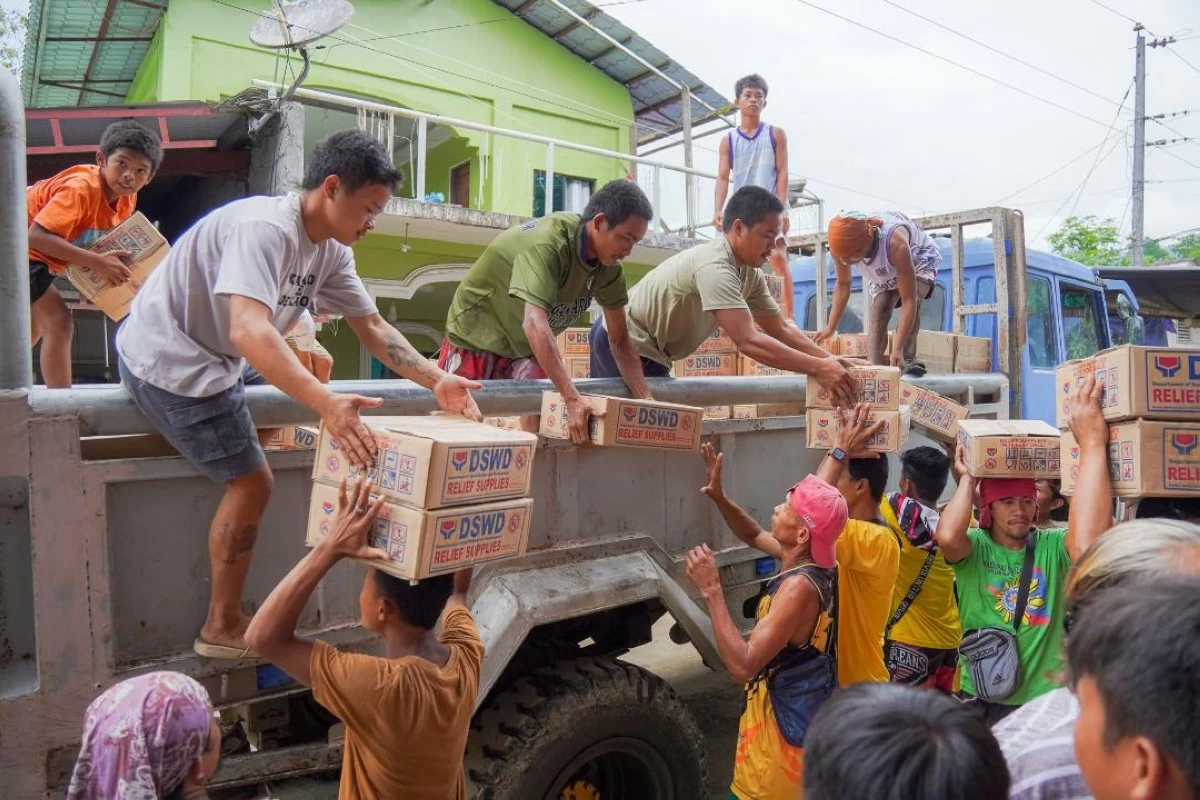
FOOD aid for earthquake victims unloaded in Barangay E. Alegado, Glan, Sarangani province. (OCD-12)
DAVAO CITY – The provincial government of Sarangani has extended the implementation of emergency protocols as recovery and rehabilitation efforts continue following the magnitude-7.8 earthquake that devastated several towns in the province recently.
Through Executive Order No. 36, Gov. Rogelio Pacquiao extended the imposition of emergency protocols until the end of the month to allow sufficient time for structural validation and continuing recovery and rehabilitation efforts.
The provincial government initially imposed emergency protocols from June 8 to June 17.
While the emergency protocols are in place, the provincial government imposed alternative work arrangements and suspended face-face classes in the entire province.
Pacquiao directed concerned agencies to conduct mandatory monitoring of landslides and seismic hazards following the powerful tremor that affected all seven municipalities of the provinces.
Among the severely-affected towns are Glan, Malapatan, and Alabel, where hundreds of houses were totally destroyed and several landslides were reported.
Pacquiao ordered the continuation of province-wide safety sweep and Rapid Damage Assessment and Needs Analysis (RDANA).
“All local chief executives are strictly directed to maintain intensified comprehensive sweeps of all private and public structures, public roads, bridges, educational facilities, health institutions, and government,” Pacquiao said.
The Provincial Disaster Risk Reduction and Management Office (PDRRMO) reported that the earthquake killed 32 persons and 16 are still missing as of 6 p.m. June 18.
Twenty-three of the fatalities were from Glan, the most affected town in the province due to its proximity to the offshore epicenter.
Nearly 500,000 persons have been affected and about 32,000 houses have been damaged, the PDRRMO said. At least 6,000 were totally damaged.
Pacquiao directed public and private schools to implement alternative learning modalities such as modular distance learning, online distance learning, or blended learning.
“All school heads are hereby directed to coordinate with the duly authorized engineers from the Department of Education, Office of the Building Official, and their municipal engineering offices to conduct the rapid, thorough structural assessment,” he said.
The Department of Education Schools Division of Sarangani reported that 258 out of 327 schools in the province were affected by the earthquake, with 617 classrooms totally and 1,127 partially damaged.
DepEd-Sarangani serves the towns of Alabel, Glan, Kiamba, Maasim, Maitum, Malapatan, and Malungon.
DepEd-Sarangani said the coastal town of Glan has the most number of damaged schools with 29 and 206 and 317 classrooms sustaining major and minor damage. Twenty-seven schools sustained major damage in Malapatan. At least 100 classrooms sustained major damage and 165 had minor damage.
DepEd-Sarangani chief Dr. Ruth Estacio said the earthquake has affected around 140,000 learners and about 7,000 teaching and non-teaching personnel.
With the extension of emergency protocols, Estacio said they have directed all school heads and teachers in the province to shift to modular and online modalities.
With the vast number of damaged schools and continuing aftershocks, only modular and online modalities are feasible, she added.
Estacio said the DepEd-Sarangani is providing psychological first aid (PFA) and mental health and psychosocial support services (MHPSS) for personnel and learners.
“We will prioritize PFA and MHPSS before fully resuming academic activities which are critical for healing after the earthquake,” the DepEd-Sarangani chief said. “Let’s take care of each other. Our learners’ and teachers’ well-being come first. This will help our children and colleagues recover.”