






Manila Bulletin
 Business
The Stock Market
Stocks slump as BSP rate hike, abrupt US-Iran delay rattle investors
Business
The Stock Market
Stocks slump as BSP rate hike, abrupt US-Iran delay rattle investors
Business
The Stock Market
Stocks slump as BSP rate hike, abrupt US-Iran delay rattle investors
Stocks slump as BSP rate hike, abrupt US-Iran delay rattle investors
Published Jun 19, 2026 04:35 pm


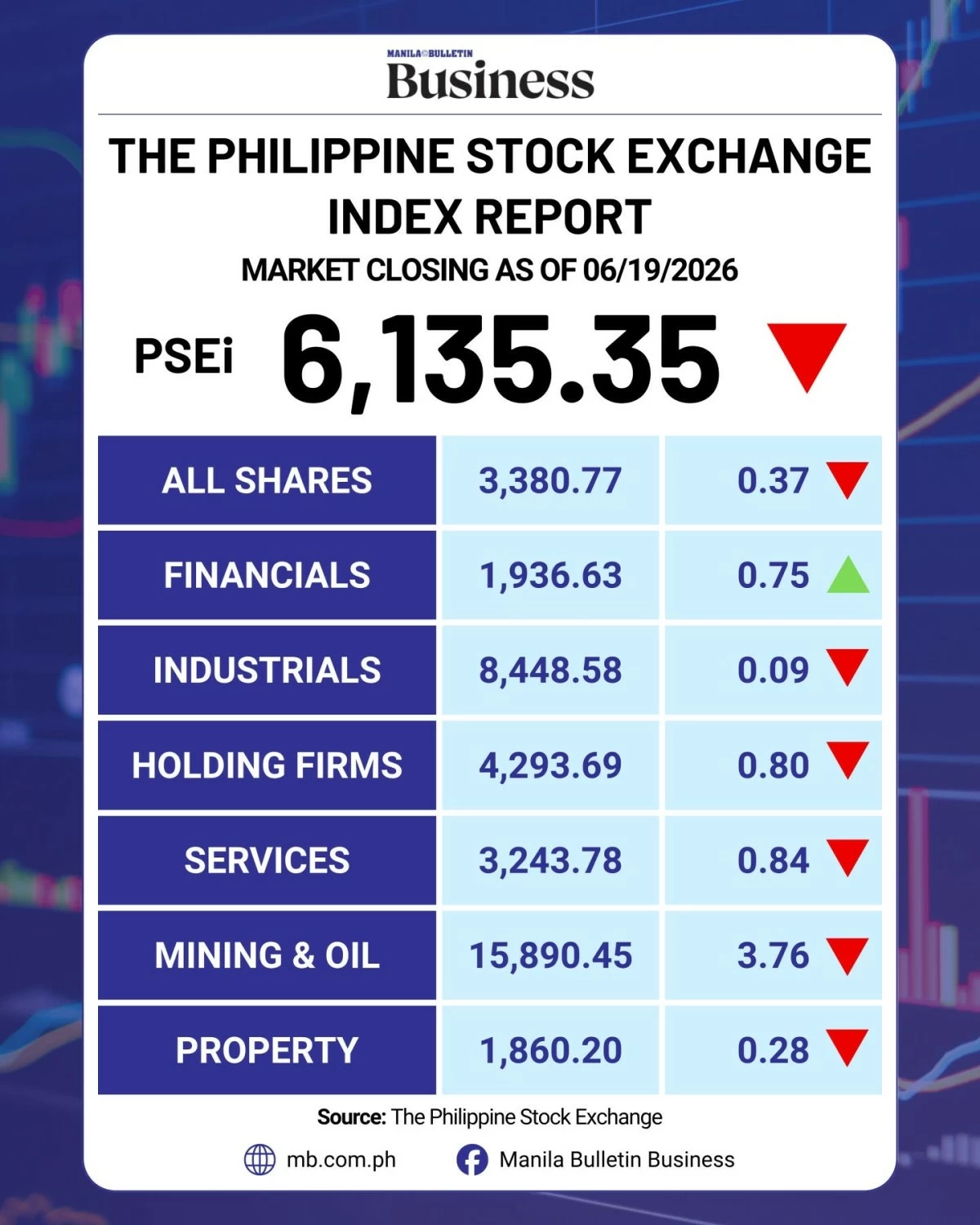
Local equities market retreated at the end of the week as investors pared back risk following the central bank's hawkish policy stance and the sudden disruption to geopolitical diplomatic efforts in Europe.
The Philippine Stock Exchange index (PSEi) slipped 18.31 points, or 0.3 percent, to close at 6,135.35 on Friday, June 19. Market breadth was firmly negative, with declining shares outnumbering gainers 111 to 81, while 48 issues remained unchanged.
Trading activity surged significantly, with volume climbing to a hefty 1.32 billion shares valued at ₱11.18 billion, driven partly by selective selling associated with the rebalancing of the FTSE Global Equity Index.
Investor sentiment was weighed down primarily by domestic monetary tightening after the Bangko Sentral ng Pilipinas (BSP) raised its key policy interest rate by 25 basis points to 4.75 percent on Thursday.
The central bank also elevated its headline inflation forecasts to 6.4 percent for 2026 and 4.5 percent for 2027, signalling that price pressures from global commodity shocks remain deeply entrenched.
“The local bourse ended lower following the BSP’s 25-basis-point rate hike, as expectations of higher fixed-income yields reduced the appeal of equities,” said Luis Limlingan, managing director at Regina Capital Development Corp.
The macro outlook added fresh anxieties on the trading floor, with market participants anticipating an extended cycle of restrictive monetary policy.
Japhet Tantiangco, research manager at Philstocks Financial, noted that fears of subsequent interest rate hikes dampened buy-side momentum, particularly given the revised projections for persistent consumer price increases.
Geopolitical headwinds further exacerbated the risk-off mood. Preliminary implementation talks regarding the “Islamabad Memorandum of Understanding” between the United States and Iran, which were scheduled to begin Friday in the Swiss village of Obbürgen, were abruptly postponed. The postponement followed intense overnight military clashes between Israel and Iran-backed Hezbollah militants in Lebanon.
“Concerns that the US-Iran memorandum of understanding is fragile and carries downside risks of reversing weighed heavily on the market,” Tantiangco added.
Michael L. Ricafort, chief economist at Rizal Commercial Banking Corp., stated that the delayed negotiations regarding Iran's nuclear program and the broader security arrangement directly restricted regional market optimism, especially since Iran had previously positioned a Lebanese truce as a key condition for the preliminary deal.
Sector performance across the local exchange was mixed. Mining companies led the declines as global gold prices softened, while financial institutions bucked the broader downward trend.
Large-cap commercial lenders drew support from institutional inflows on widespread expectations that widening net interest margins will boost profitability in a higher interest rate environment.