






Manila Bulletin
 Business
The Economy
Philippines seeks Singapore, Hong Kong tax treaties to boost FDI
Business
The Economy
Philippines seeks Singapore, Hong Kong tax treaties to boost FDI
Business
The Economy
Philippines seeks Singapore, Hong Kong tax treaties to boost FDI
Philippines seeks Singapore, Hong Kong tax treaties to boost FDI
8 more DTAs eyed
By Derco Rosal
Published Jun 17, 2026 09:00 pm
|
Updated Jun 17, 2026 01:40 pm


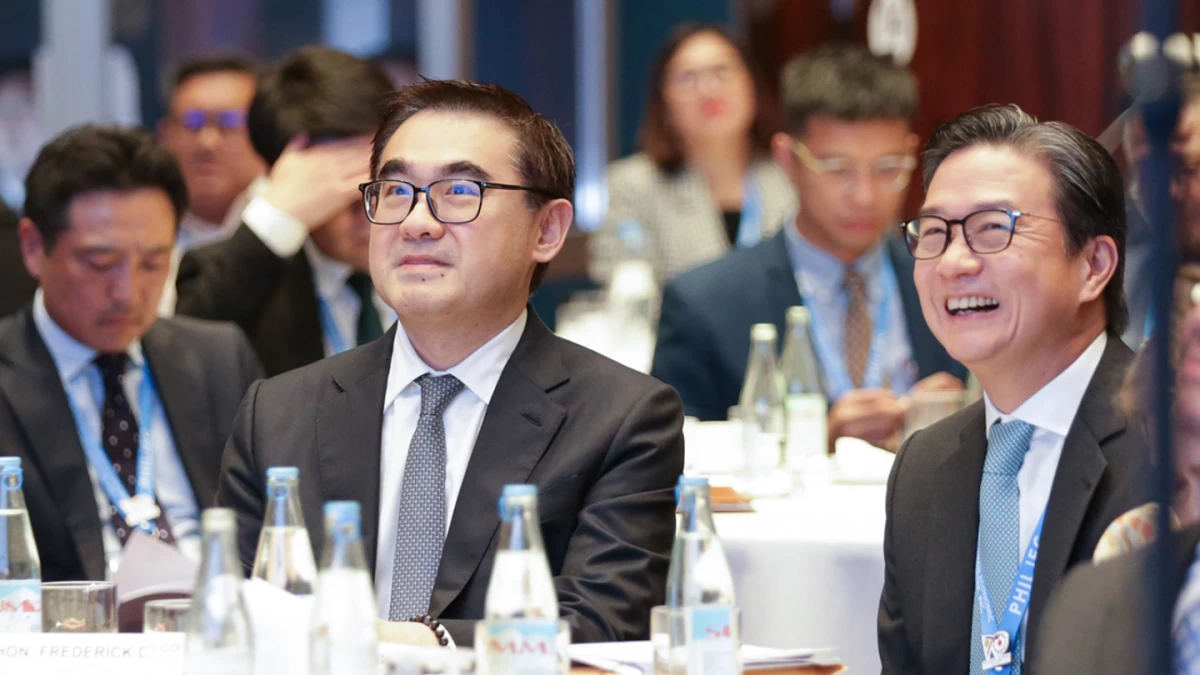
Finance Secretary Frederick D. Go (left) shares a moment with Toyota Motor Philippines (TMP) Chairman Alfred V. Ty during the 42nd Annual Joint Meeting of the Philippine and Japan Economic Cooperation Committees on Feb. 19, 2026. In his keynote address, Go highlighted the 70th anniversary of diplomatic ties between the two nations, citing seven decades of “trust, cooperation, and shared progress” that have solidified Japan as one of the Philippines' most vital strategic partners. (DOF photo)
Apart from Japan, the Philippine government is currently in talks with Singapore and Hong Kong to update existing double taxation agreements (DTAs) in a bid to attract more foreign direct investments (FDIs).
During a roundtable discussion on June 16, Department of Finance (DOF) Secretary Frederick D. Go noted that the Philippines is pursuing three double tax treaties under its renegotiation category: Japan, Singapore, and Hong Kong. He emphasized that the current administration’s primary goal is to generate more jobs for Filipinos, which “requires attracting larger foreign investments into the country.”
“While the Philippines has a strong base of domestic investors, we have not been up to speed because we lack FDIs," Go said. "That is why DTAs are an essential tool, as they help make the Philippines a more attractive destination for foreign investors and, ultimately, contribute to job creation.”
Last month, the Philippine and Japanese governments signed a renegotiated DTA, replacing a decades-old framework originally established in 1980. The DOF stated that the updated deal is expected to establish clearer and more predictable rules on the taxation of cross-border income.
“By providing clear and predictable rules on the taxation of cross-border income, the agreement is also expected to benefit more than 245,000 overseas Filipino workers (OFWs) in Japan,” the DOF added.
These changes are strategically designed to incentivize the flow of Japanese technology and capital into the Philippine economy, specifically targeting high-growth sectors such as advanced manufacturing, infrastructure, and digital innovation.
“We sign DTAs with other countries to ensure that taxes paid by investors in the Philippines can be credited against their tax obligations in their home countries,” Go explained.
Beyond updating existing treaties, the Philippines is aggressively expanding its fiscal reach through a series of entirely new DTAs. These agreements are moving through various stages of the diplomatic and legal pipeline, ranging from active negotiation to final processing for signing.
According to Go, the new targets include a mix of European and Southeast Asian nations. Specifically, the Philippines is pursuing four new DTAs with Liechtenstein, Cambodia, Laos, and Ireland, which are currently at various stages of development.
Additionally, the government has identified a third tier of agreements that are still in their infancy, including partnerships with Malaysia, Luxembourg, and South Korea. For these nations, the DOF is navigating the preliminary internal hurdles required to begin formal talks.
Go noted that while the total pipeline consists of approximately 10 agreements, the timeline for completion is often measured in years rather than months. “All these agreements take years to conclude. Without a very strong push, the process can take a long time,” he said.
Currently, the Philippines has active DTAs with Australia, Austria, Bahrain, Bangladesh, Belgium, Brazil, Brunei Darussalam, Canada, China, the Czech Republic, Denmark, Finland, France, Germany, Hungary, India, Indonesia, Israel, Italy, Japan, Kuwait, Malaysia, Mexico, the Netherlands, New Zealand, Nigeria, Norway, Pakistan, Poland, Qatar, Romania, Russia, Singapore, South Korea, Spain, Sri Lanka, Sweden, Switzerland, Thailand, Turkey, the United Arab Emirates (UAE), the United Kingdom (UK), the United States (US), and Vietnam.
Global top-up tax pushed in 2026
Go expressed hope that the qualified domestic minimum top-up tax (QDMTT) law will pass this year, allowing the Philippines to onboard the program next year and catch up with the 2028 schedule for initial collections.
“I definitely want to pass the law this year so that we can join the program in 2027,” Go told reporters. “But I have to warn you, the first collection of taxes is actually in 2028 because of the way the rules are crafted.” The bill currently remains under congressional review.
To avoid causing unnecessary alarm within the local business community, Go clarified that the DOF is branding the measure as the “multinational minimum tax.” He explained that while it is technically the QDMTT under the Organization for Economic Co-operation and Development’s (OECD) Pillar 2 framework, this alternative name was chosen to ensure clarity and avoid causing undue concern among domestic companies.
For its part, the Bureau of Internal Revenue (BIR) is preparing for the potential implementation of the proposed tax measure. This preparation comes as large multinational enterprises (MNEs) have expressed a preference to settle the 15 percent minimum levy in the Philippines rather than comply with unfamiliar tax rules abroad.
This specific tax requires very large MNEs—those earning at least €750 million (roughly ₱50 billion) in two of the past four years—to pay a minimum global tax rate of 15 percent, a threshold that leaves smaller investors untouched.
Because the Philippines has yet to implement this tax measure, the country continues to lose potential tax revenues to other jurisdictions. Go described the current opportunity loss of around ₱50 billion annually as "too low." Given that the global program includes major economic partners like the US, Japan, and South Korea, Go believes the country's potential revenue intake should be significantly higher.