







PH, US marines Launch 'KAMANDAG' Exercise
Published Jun 16, 2026 04:22 pm


At A Glance
- The 10th iteration of 'KAMANDAG' Exercise was launched in Taguig City on June 15, evolving from a bilateral Philippines-United States marine drill into a premier multinational platform featuring participants from Japan and South Korea, plus observers from eight other nations.
- Training activities across Northern Luzon, Palawan, and Tawi-Tawi are designed to directly support the Armed Forces of the Philippines' Comprehensive Archipelagic Defense Concept (CADC) through high-end, complex maritime operations.
- Exercise Director BGen. Bob R. Apostol and USMC Col. George Flynn emphasized that this year's drills prioritize territorial and coastal defense, highlighting interoperability as a critical necessity for maintaining regional peace and stability.
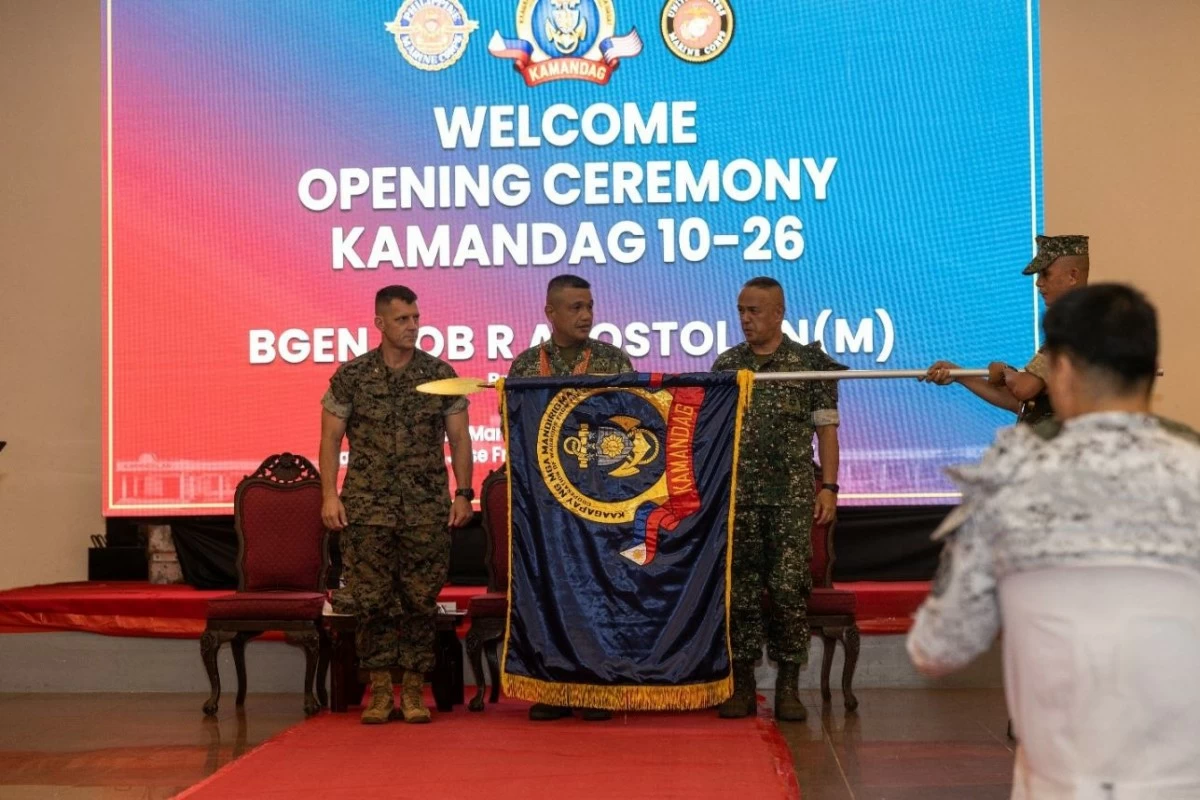
(L-R) United States Marine Corps Col. George J. Flynn, commanding officer of Marine Rotational Force – Darwin, I Marine Expeditionary Force; Philippine Marine Corps Brig. Gen. Bob R. Apostol, director of Exercise Directorate Headquarters (EDH); and PMC Col. Edwin Jospeh H. Olaer, assistant director of EDH, unfurl the flag for the 10th iteration of KAMANDAG Exercise during its opening ceremony at Fort Bonifacio in Taguig City on June 15, 2026. KAMANDAG 10-2026 is a multi-domain, joint, and combined exercise between the Armed Forces of the Philippines and the United States military focused on enhancing maritime security, interoperability, contested logistics, and combined readiness throughout the Philippine archipelago. (US Marine Corps photo by Cpl. Ryan Ramsammy)
The Philippine Marine Corps (PMC) and the United States Marine Corps (USMC) officially launched the 10th iteration of the "Kaagapay ng mga Mandirigma Mula sa Dagat" (KAMANDAG) Exercise, a multi-domain, joint, and combined exercise between the Armed Forces of the Philippines (AFP) and the United States military focused on enhancing maritime security, interoperability, contested logistics, and combined readiness throughout the Philippine archipelago, at Fort Bonifacio in Taguig City on Monday, June 15.
This year’s iteration of the exercise include participants from the Japan Ground Self-Defense Force and the Republic of Korea Marine Corps. Observers from eight nations—Australia, Bahrain, Canada, France, Germany, the Netherlands, Spain, and Thailand—are also attending, according to the PMC.
Brigadier General Bob R. Apostol, the exercise director, framed the milestone as a turning point for regional defense, noting that the expanded participation of allied nations underscored the strategic importance of the Mutual Defense Board–Security Engagement Board (MDB-SEB) activities for 2026.
The training spans critical geographic zones including Northern Luzon, Central Luzon, Palawan, Tawi-Tawi, Manila, and Cavite.
“Exercise KAMANDAG marks its 10th iteration, evolving from bilateral engagement into a premier multinational platform built on trust, cooperation, and collective resolve,” Apostol said.
“This exercise advances shared goals by strengthening capabilities, deepening relationships, and reaffirming a unified commitment to peace, stability, and collective security,” he added.
Apostol also underscored the tactical shift required by the current security environment.
The exercise began in 2016 as a bilateral training activity between the Philippine and US Marines. Over the years, it expanded to include more allied and partner nations as the AFP increased its focus on territorial defense and maritime security.
“Readiness is not merely an option; it is a responsibility. Cooperation is not a convenience; it is a necessity. And interoperability is not an aspiration; it is an operational imperative,” Apostol added.
The AFP has operationalized the Comprehensive Archipelagic Defense Concept (CADC), a new doctrine which emphasizes securing the country's vast maritime borders and projecting power from its islands.
US Marine Corps Colonel George Flynn, commanding officer of Marine Rotational Force - Darwin 26, noted how the current drills align with these strategic goals.
“Operating collectively alongside our Philippine Marine Corps brothers and sisters, we are here to directly support the Armed Forces of the Philippines’ and its Comprehensive Archipelagic Defense Concept,” Flynn said.
The training curriculum is designed for high-end, complex operations and participating forces will conduct maritime key terrain security operations, maritime strike, counterlanding, airfield seizure/defense, and island seizure/defense.
Additional modules include seaborne maneuver, amphibious raid, boat raid and seizure, military free fall, and close air support.
"Over the coming weeks, across dispersed nodes from Northern Luzon down to Palawan and Tawi-Tawi, we will focus our combined readiness on what matters most: territorial defense, coastal defense operations, and seamless interoperability," Flynn added.