







Local stocks reverse gains as traders lock in profits
Published Jun 16, 2026 04:48 pm


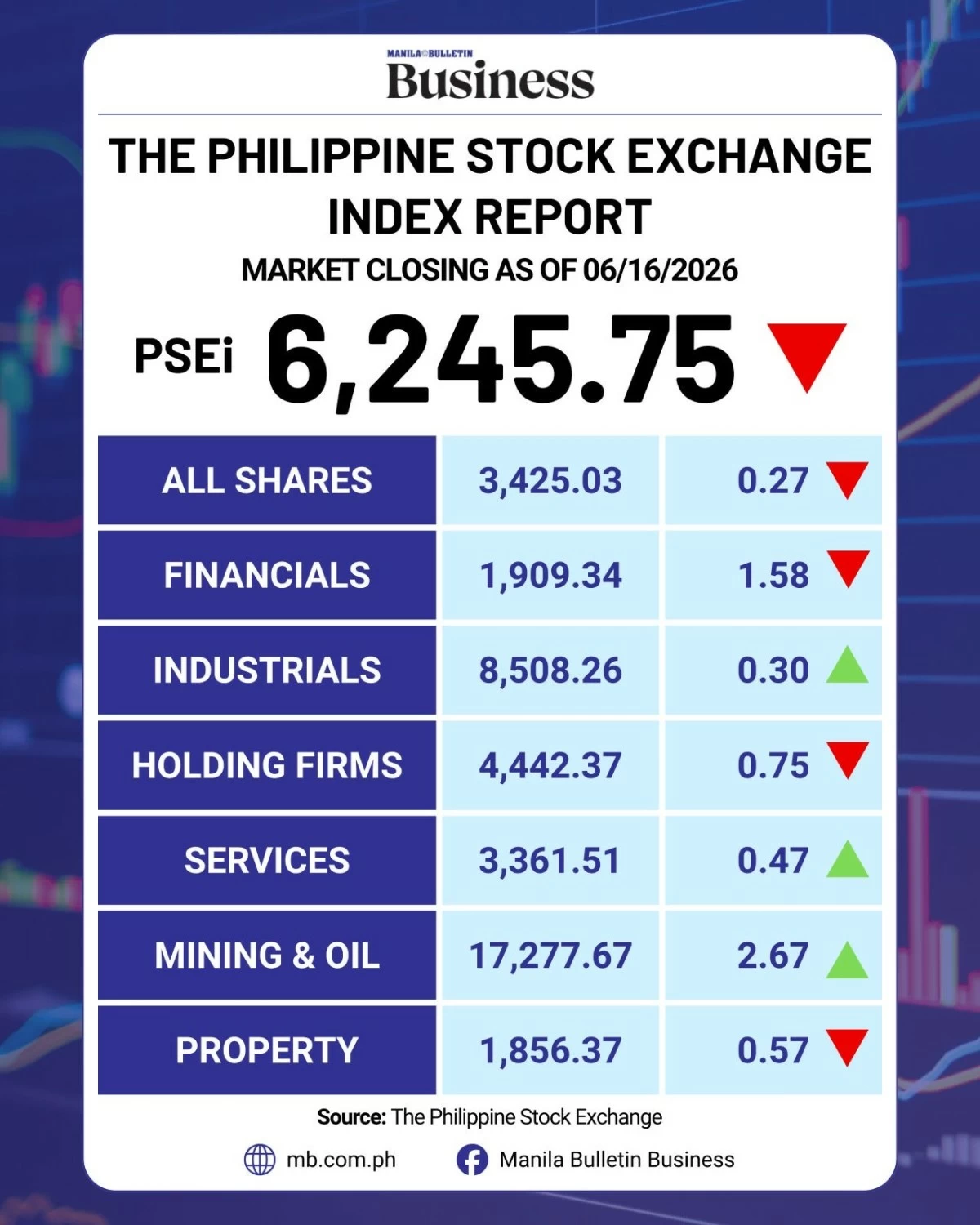
Local stocks declined as an afternoon wave of profit-taking erased morning gains, cutting short a rally that had pushed the benchmark index to its highest intraday level in recent sessions.
The Philippine Stock Exchange index (PSEi) decreased 27.13 points, or 0.43 percent, to close at 6,245.75 on Tuesday, June 16. The market had initially extended its recent momentum during early trading, with the main gauge climbing as high as 6,396.23 before investors moved to lock in profits. Sectoral indices finished evenly split between gainers and losers.
Trading volume remained robust, with 862 million shares changing hands valued at ₱11.8 billion. Decliners outnumbered advancers 92 to 84, while 64 stocks remained unchanged.
Luis Limlingan, managing director at Regina Capital Development Corp., indicated that the afternoon selling pressure intensified precisely because the recent multi-day rally had left stocks vulnerable to profit-taking.
According to Limlingan, investors opted to lock in gains despite lingering optimism over the US-Iran diplomatic progress, which many hope will eventually translate to more stable global oil prices and easing domestic inflationary pressures.
Japhet Tantiangco, research manager at Philstocks Financial, observed that while the last-minute selling dragged the main index lower, the market's ability to hold its ground above the 6,150 support line remains a positive technical indicator.
The intra-day push toward the 6,400 psychological threshold demonstrated strong early demand, but institutional and retail traders ultimately viewed the peak as an ideal window to book profits.
Michael Ricafort, chief economist at Rizal Commercial Banking Corp., highlighted the divergence between local equities and macroeconomic indicators.
Ricafort noted that the PSEi dipped even as a softer crude outlook and a strengthening peso provided a fundamentally favorable environment for Philippine corporate earnings.
The local currency's appreciation against the greenback typically cushions imported inflation, suggesting that the day's equity decline was driven primarily by short-term trading dynamics rather than structural deterioration.