






Manila Bulletin
 Environment and Sustainability
How wind power is transforming the global energy transition
Environment and Sustainability
How wind power is transforming the global energy transition
Environment and Sustainability
How wind power is transforming the global energy transition
How wind power is transforming the global energy transition
Published Jun 15, 2026 02:19 pm


There are non-renewable energy sources, which primarily rely on fossil fuels, and renewable energy sources which are derived from naturally replenished resources. If you are considering which renewable energy sources to explore, you may wish to follow the advice of Nobel Prize-winning singer-songwriter Bob Dylan.
“The answer, my friend,” Dylan crooned, “is blowin’ in the wind. The answer is blowin’ in the wind.”
June 15, the global community commemorates Global Wind Day, an event dedicated to raise awareness of wind energy and its potential to transform energy systems while reducing carbon emissions. This observance is organized by WindEurope and the Global Wind Energy Council through activities and events in countries around the world.
“Across the developing world, countries are beginning to see the way the wind is blowing,” said Klaus Toepfer, former executive director of the United Nations Environment Program (UNEP). “Once it was believed that only one percent of their area was suitable for wind power.”
Not anymore.
“The serious development of wind power in modern times began in 1973 after the oil crisis shook the confidence of the developed world that oil was there for the asking. Today, wind power is one of the fastest-growing energy sources, and the potential is enormous,” noted Dr. Leon Freris, visiting professor of renewable energy at the Centre for Renewable Energy Systems Technology of Loughborough University in England.
Wind power is among the fastest-growing renewable energy sources worldwide. According to the World Wind Energy Association (WWEA), it now generates enough electricity to meet more than 11 percent of global demand.
It is also the world’s third-largest source of carbon-free electricity after hydropower and nuclear energy, making it a major contributor to efforts to mitigate climate change.
Last year marked a milestone for the global wind industry. Preliminary WWEA data showed that 169,014 megawatts (MW) of new wind capacity were installed worldwide, a 35 percent increase from 2024, bringing total global capacity to 1,346,866 MW.
The growth was driven largely by China, which accounted for 77 percent of new installations after adding 130 Gigawatts (GW) in a single year. China now holds more than half of the world’s total installed wind capacity.
Today, more than 138 countries generate electricity from wind power. Aside from China, the leading countries in installed wind capacity are the United States, Germany, India, and Brazil.
In the Philippines, some experts are advocating the development of the country’s wind power resources. At present, the majority of the electricity produced in the country is derived from fossil fuels. Specifically, approximately 70 percent is generated from coal, while a substantial portion is sourced from imported oil-based fuels, both of which are subject to fluctuating prices in the global market.
“With fossil-fuel prices continually rising due to dwindling supplies and soaring demand, the cost of our electricity shall rise even further. The best solution is to use existing renewable energy resources to shield us from the cost volatility of fossil fuels,” said Atty. Angela Consuelo Ibay, climate change head of the World Wide Fund for Nature (WWF) in the Philippines.
The WWF supports the use of clean and renewable energy sources. Among the few competitive advantages the country possesses, given its lack of significant fossil fuel deposits, are geothermal, hydro, wind, and solar energy.
“Wind energy in the Philippines offers a clean, abundant, and economically viable solution for reducing reliance on fossil fuels and driving sustainable development,” wrote Princess Catherine Pabellano for billionbricks.org.
According to Pabellano, the country’s most important geographic advantage for wind energy is its location.
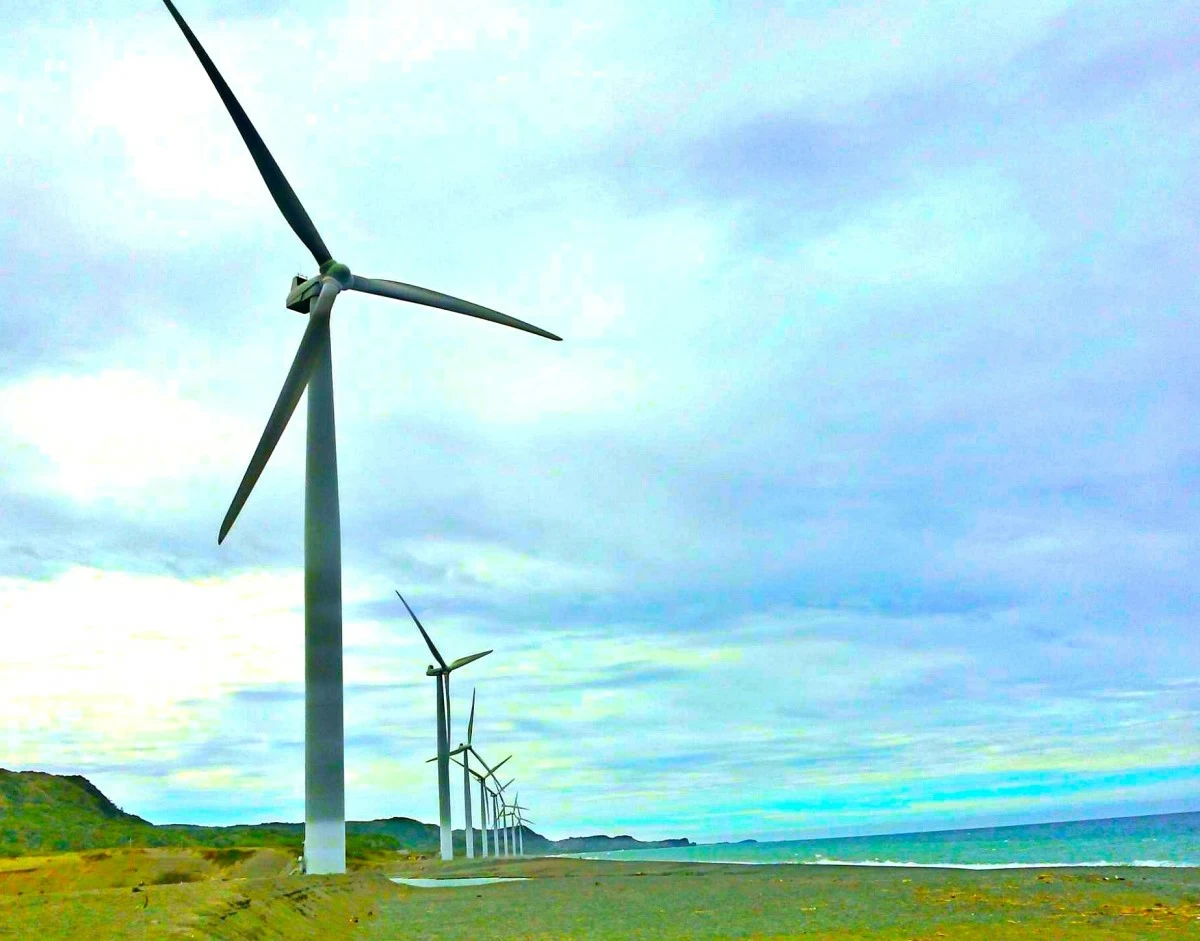
Wind turbines harness the kinetic energy of wind to generate electricity. (Photo courtesy of Benjie S. Palisada)
“The country is located in the western Pacific Ocean, where the prevailing winds are strong and consistent,” she wrote. “This makes the Philippines a prime location for wind turbines, which can generate electricity from the wind’s kinetic energy.”
Another advantage is the country’s terrain.
“The country has a diverse terrain, including mountains, hills, and coastal areas,” she explained. “These different elevations create wind patterns that are ideal for wind energy generation.”
The surrounding waters—the South China Sea, Philippine Sea, and Celebes Sea—also generate strong winds that can be harnessed by wind turbines.
The Philippines consists of over 7,000 islands. Currently, wind power accounts for only a small share of the country's overall energy production.
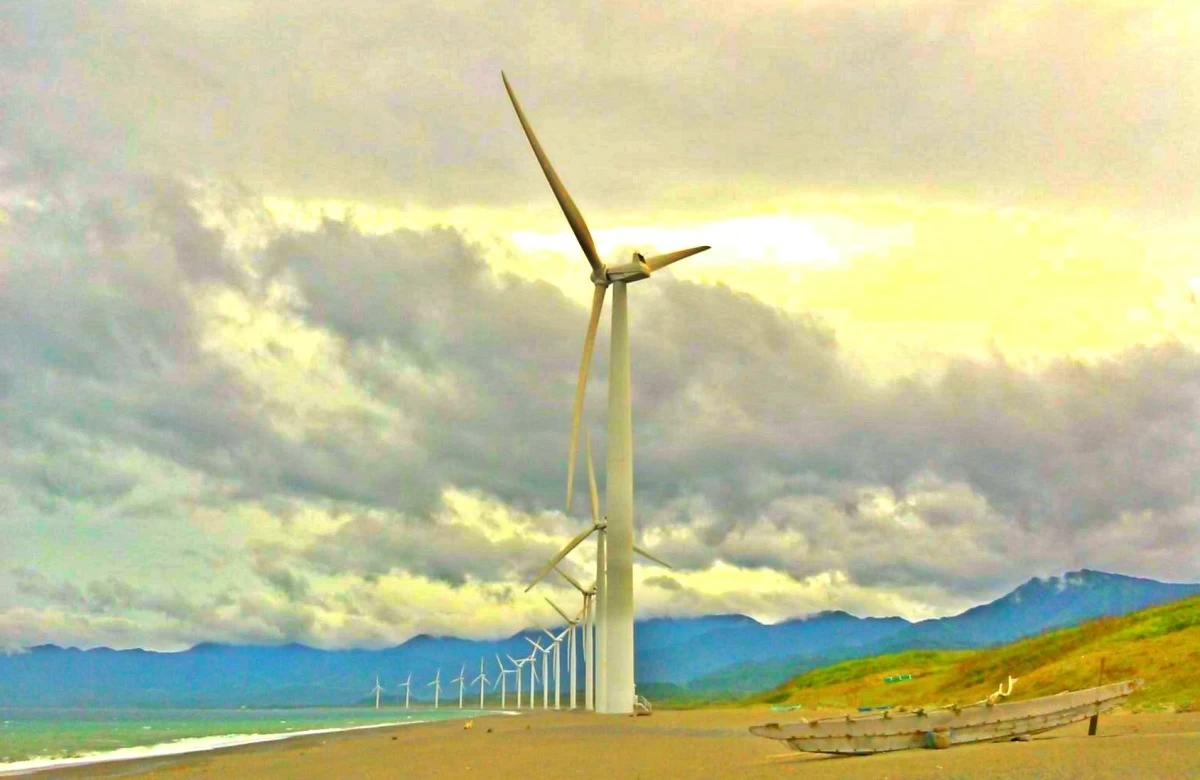
The Bangui Wind Farm, often called the Bangui Windmills, is an onshore wind power facility located in Ilocos Norte. (Photo courtesy of Benjie S. Palisada)
Onshore wind farms include the Burgos Wind Farm located in Ilocos Norte, the Caparispisan Wind Farm in Pagudpod, Ilocos Norte, the Pililla Wind Farm in Rizal, and the San Lorenzo Wind Farm situated in Guimaras.
According to the WWF, there are more than 1,000 wind sites in the northern and central regions of the Philippines, with a potential capacity of at least 7,400 MW—sufficient to supply energy to 19 million households.
“Wind is the movement of air from an area of high pressure to an area of low pressure,” National Geographic explains. “In fact, wind exists because the sun unevenly heats the surface of the Earth. As hot air rises, cooler air moves in to fill the void. As long as the sun shines, the wind will blow. And as long as the wind blows, people will harness it to power their lives.”
Nowadays, many people recognize wind power as “ one of the most promising new energy sources” that can serve as an alternative to electricity generated from fossil fuels.
Wind power involves transforming wind energy into usable energy, such as generating electricity through wind turbines, using windmills for mechanical energy, employing wind pumps for water drainage or pumping, or using sails to propel ships.
The Dutch contributed significantly to the advancement of the windmill, mainly for the purpose of removing excess water from flooded land. The windmill underwent further improvements in the late 19th century in the United States, and several designs from that era remain operational today.
The first large windmill designed to generate electricity was the “American multi-blade design,” built in 1888. Its 12-kilowatt capacity was later surpassed by modern 70– to 100-kilowatt wind turbines.
“Wind turbines for electricity generation are essentially simple devices, though their design requires a deep understanding of the properties of wind, aerodynamics, as well as mechanical and electrical engineering,” explains Dr. Freris.
The kinetic energy in the wind is intercepted by two or three rotating, slender blades. These blades extract energy from the wind by slowing it down. This extracted energy first appears as mechanical energy on the turbine shaft and then as electrical energy from a generator coupled to the shaft through a gearbox.
“The power in the wind is proportional to the cube of the wind speed, hence doubling of the wind speed results in an eight-fold increase in electrical power generated,” Dr. Freris explained. “Wind turbines are designed to stop if the wind speed becomes excessive and do not rotate if the wind speed is too low for useful energy extraction.”
Wind turbines are usually grouped in wind farms consisting of a few to as many as 100 machines. By installing several machines on a site, the costs of connection to the electricity grid, as well as operation and maintenance expenses, are reduced.
Wind energy is environmentally friendly.
“Wind energy can help protect the environment by reducing air pollution and greenhouse gas emissions,” Pabellano wrote.
But of course, wind power should not be the only source of electricity. Generally, hydroelectricity complements wind power very well. When the wind is blowing strongly, nearby hydroelectric plants can temporarily hold back water. When the wind drops, they can rapidly increase production again, providing a more stable power supply.
The answer is not only blowing in the wind; the future may well depend on it. As singer Peter Frampton wrote: “The future’s in the air, I can feel it everywhere; blowing with the wind of change…”