






 Philippines
National
Marcos calls Congress special session on June 17 to fast-track social protection, education bills
Philippines
National
Marcos calls Congress special session on June 17 to fast-track social protection, education bills
Marcos calls Congress special session on June 17 to fast-track social protection, education bills


At A Glance
- President Marcos has called Congress to a special session on June 17 to act on priority social protection and education measures.
- The bills include the Anti-Political Dynasty Law, AICS Act, amendments to free college and school feeding laws, and the creation of a National Center for Geriatric Health.
- The special session will also allow the Commission on Appointments to act on pending appointments in the Cabinet, military, and foreign service.
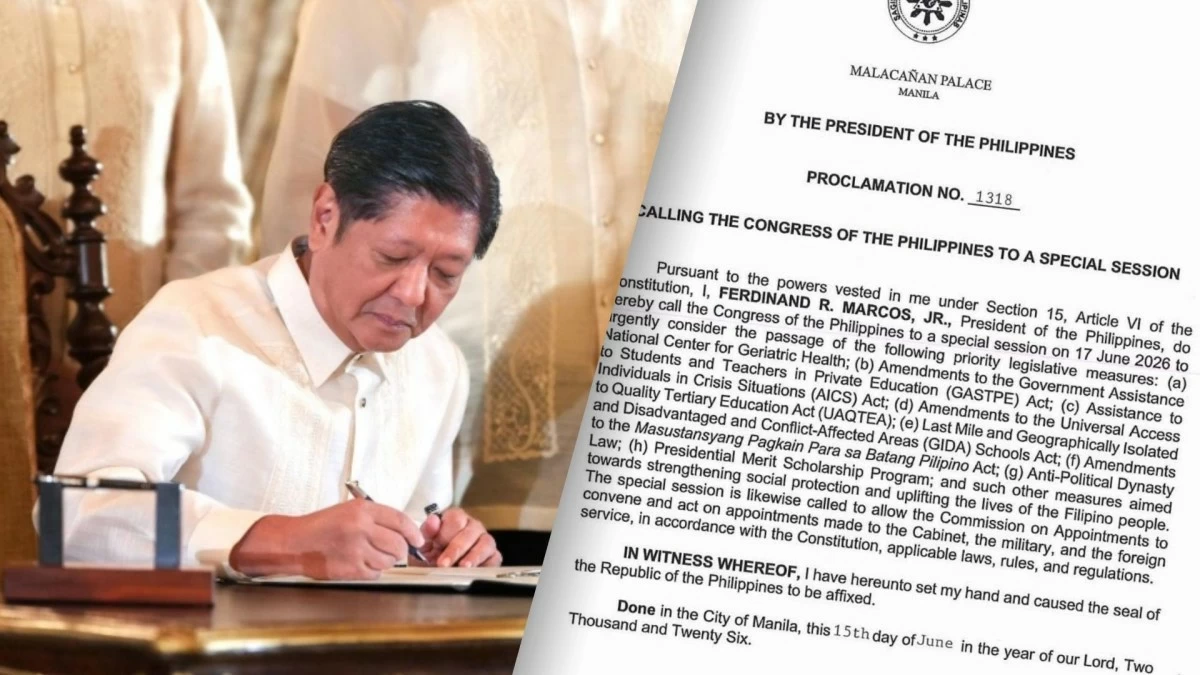
President Marcos has called Congress to a special session on June 17 to urgently act on priority legislative measures aimed at strengthening social protection, expanding access to education and healthcare, and providing greater support to vulnerable Filipinos amid ongoing energy challenges and recent natural disasters.
Under Proclamation No. 1318, signed on June 15, the President directed lawmakers to take up priority bills that remain pending despite having reached advanced stages of legislation.
“The challenges confronting our people demand urgent action. Families affected by the recent earthquake in Mindanao require immediate assistance. Students need continued support to pursue their education. Our senior citizens deserve better healthcare. Our children must have better nutrition, and vulnerable sectors need stronger protection,” Marcos said.
“The needs of the Filipino people do not pause when Congress is not in session. The government must continue to respond, and the welfare of every Filipino must remain our highest priority,” he added.
Priority measures
Among the bills identified for consideration are the proposed creation of a National Center for Geriatric Health, amendments to the Government Assistance to Students and Teachers in Private Education (GASTPE) Act, the proposed Assistance to Individuals in Crisis Situations (AICS) Act, and amendments to the Universal Access to Quality Tertiary Education Act.
Also included are the proposed Last Mile and Geographically Isolated and Disadvantaged and Conflict-Affected Areas (GIDA) Schools Act, amendments to the Masustansyang Pagkain Para sa Batang Pilipino Act, the proposed Anti-Political Dynasty Law, and the Presidential Merit Scholarship Program.
The proclamation likewise provides for the consideration of “such other measures aimed towards strengthening social protection and uplifting the lives of the Filipino people.”
Anti-political dynasty bill
The inclusion of the proposed Anti-Political Dynasty Law comes days after Malacañang reiterated that the measure remains among the President's priorities.
Presidential Communications Office (PCO) Undersecretary Claire Castro earlier said Marcos wants the measure passed during his administration and would review the final version that reaches his desk.
The House of Representatives has approved on third and final reading a bill prohibiting political dynasties involving relatives up to the second degree of consanguinity or affinity from simultaneously or successively holding elective office in the same locality.
Marcos had also personally pushed for the measure during a meeting of the Legislative-Executive Development Advisory Council (LEDAC), according to the Palace.
Education, nutrition measures
The special session will also tackle measures affecting millions of students and teachers, including amendments to the GASTPE Act and the Universal Access to Quality Tertiary Education Act, which currently provides free tuition and other school fees in state universities and colleges.
The proposed Last Mile and GIDA Schools Act seeks to strengthen support for schools in geographically isolated, disadvantaged, and conflict-affected areas, while amendments to the Masustansyang Pagkain Para sa Batang Pilipino Act seek to enhance the government's school feeding program.
Meanwhile, the proposed Presidential Merit Scholarship Program aims to expand educational opportunities for deserving students.
Appointments also on agenda
Aside from legislation, the special session will also allow the Commission on Appointments to act on pending appointments to key positions in the Cabinet, military, and foreign service.
Malacañang said this would help ensure continuity and stability across government institutions.
Under Section 15, Article VI of the 1987 Constitution, the President may call Congress to a special session at any time to address urgent matters requiring immediate legislative action.
The administration expressed confidence that lawmakers would set aside political distractions and focus on measures that would provide timely and meaningful support to the Filipino people.