ADVERTISEMENT

Cebu's Aznar Shipping plans shipyard venture, targets roro rivals

Published Jun 15, 2026 02:47 pm
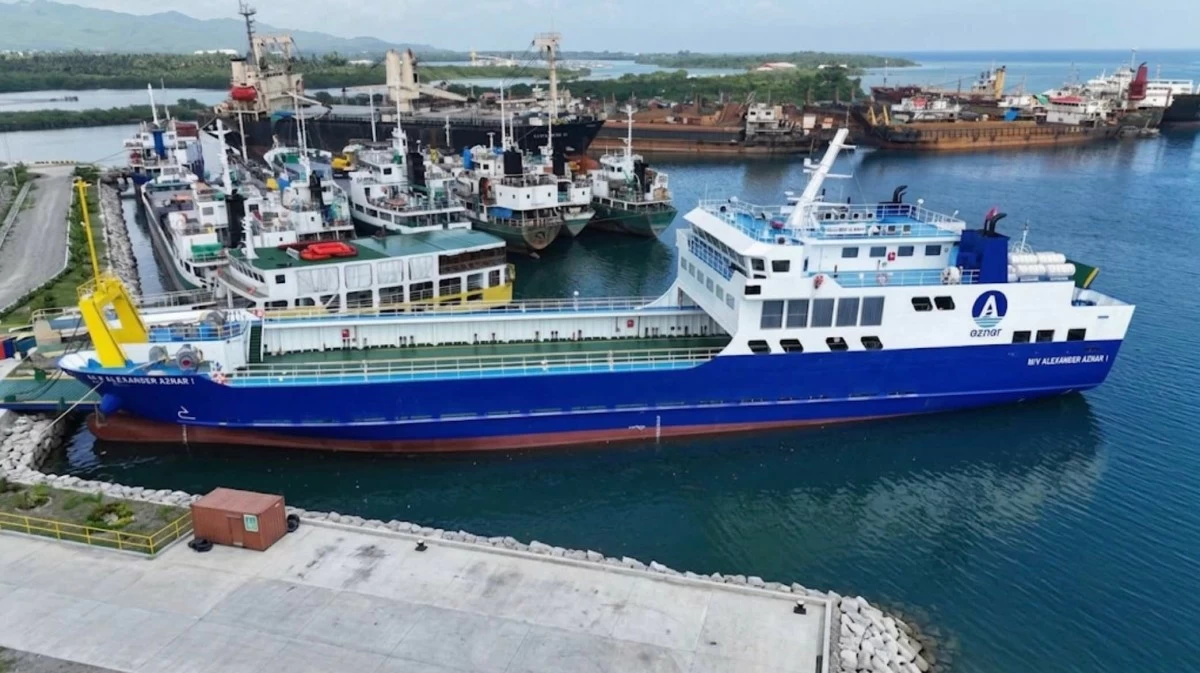
(Aznar Shipping Corp. photo)
Cebu-based Aznar Shipping Corp. is planning to venture into shipyard operations to service its own fleet and potentially external clients as part of its ongoing expansion efforts.
Under its medium-term plan, Aznar Shipping president and chief executive officer (CEO) Kyle Alexander Aznar said the company intends to develop its own shipyard facility to support its growing operations.
He noted that building a dedicated facility is the most cost-efficient move to comply with the government’s mandate requiring vessels to undergo dry-docking every two and a half years.
Currently, the company spends roughly ₱15 million on maintenance for each ship that undergoes dry-docking—an expense that quickly multiplies when up to four vessels are dry-docked around the same time.
“We're looking at that ecosystem,” Aznar told reporters. “Once we grow the fleet to a certain size, we will develop our own shipyard facility. We will become already our own market. For example, when we get the three new vessels, we'll be at 13 ships. [That means], on average, we'll have six ships being dry-docked in a year.”
From its current fleet of 10 vessels, Aznar Shipping plans to add three more within the next five years to meet rising cargo demand in the Visayas.
The new ships, to be manufactured in China, are expected to boost the company’s carrying capacity and enable new routes, including a linkage to Iloilo.
At present, the company operates roll-on/roll-off (RoRo) and landing craft vessels catering to both cargo and passenger demand across 10 ports in Cebu, Leyte, and Negros Occidental.
Aznar expects shipyard development to begin in about five years, shortly after the three additional vessels are acquired. The facility will likely be established in Cebu, where the company is based, or in nearby provinces like Negros Occidental or Leyte.
Once the shipyard achieves peak operational efficiency, Aznar said the company is open to offering its services to rival roro operators.
“We will cater eventually to the outside market. I think they need it, there's really a demand for it,” he said.
Despite higher fuel costs, Aznar Shipping is off to a strong start this year. First-quarter net income doubled to nearly ₱17 million, while revenues rose to ₱81 million compared to the same period last year. This follows a banner year in 2025, when net income reached ₱51 million on the back of ₱225 million in revenues.
Driven largely by sustained demand for cargo services—which account for 70 percent of total revenue—Aznar remains optimistic that the company can sustain its growth trajectory.
Growth this year will be further anchored by the deployment of its newest vessel, MV Alexander Aznar I, which was granted pioneer route status for the Danao, Cebu–Isabel, Leyte route by the Maritime Industry Authority (MARINA).
The pioneer status grants Aznar Shipping six years of route protection. Under this incentive, no competing vessels may be authorized to operate between the same origin and destination ports unless there is a capacity shortage or a pressing economic need.
The MV Alexander Aznar I can carry up to 340 passengers per trip, alongside 14 ten-wheeler wing vans and 24 four-wheel vehicles.

Related Tags

Aznar Shipping Corp.
ADVERTISEMENT
.most-popular .layout-ratio{ padding-bottom: 79.13%; } @media (min-width: 768px) and (max-width: 1024px) { .widget-title { font-size: 15px !important; } }

{{ articles_filter_1561_widget.title }}

.most-popular .layout-ratio{ padding-bottom: 79.13%; } @media (min-width: 768px) and (max-width: 1024px) { .widget-title { font-size: 15px !important; } }

{{ articles_filter_1562_widget.title }}

.most-popular .layout-ratio{ padding-bottom: 79.13%; } @media (min-width: 768px) and (max-width: 1024px) { .widget-title { font-size: 15px !important; } }

{{ articles_filter_1563_widget.title }}

{{ articles_filter_1564_widget.title }}

.mb-article-details { position: relative; } .mb-article-details .article-body-preview, .mb-article-details .article-body-summary{ font-size: 17px; line-height: 30px; font-family: "Libre Caslon Text", serif; color: #000; } .mb-article-details .article-body-preview iframe , .mb-article-details .article-body-summary iframe{ width: 100%; margin: auto; } .read-more-background { background: linear-gradient(180deg, color(display-p3 1.000 1.000 1.000 / 0) 13.75%, color(display-p3 1.000 1.000 1.000 / 0.8) 30.79%, color(display-p3 1.000 1.000 1.000) 72.5%); position: absolute; height: 200px; width: 100%; bottom: 0; display: flex; justify-content: center; align-items: center; padding: 0; } .read-more-background a{ color: #000; } .read-more-btn { padding: 17px 45px; font-family: Inter; font-weight: 700; font-size: 18px; line-height: 16px; text-align: center; vertical-align: middle; border: 1px solid black; background-color: white; } .hidden { display: none; }
function initializeAllSwipers() { // Get all hidden inputs with cms_article_id document.querySelectorAll('[id^="cms_article_id_"]').forEach(function (input) { const cmsArticleId = input.value; const articleSelector = '#article-' + cmsArticleId + ' .body_images'; const swiperElement = document.querySelector(articleSelector); if (swiperElement && !swiperElement.classList.contains('swiper-initialized')) { new Swiper(articleSelector, { loop: true, pagination: false, navigation: { nextEl: '#article-' + cmsArticleId + ' .swiper-button-next', prevEl: '#article-' + cmsArticleId + ' .swiper-button-prev', }, }); } }); } setTimeout(initializeAllSwipers, 3000); const intersectionObserver = new IntersectionObserver( (entries) => { entries.forEach((entry) => { if (entry.isIntersecting) { const newUrl = entry.target.getAttribute("data-url"); if (newUrl) { history.pushState(null, null, newUrl); let article = entry.target; // Extract metadata const author = article.querySelector('.author-section').textContent.replace('By', '').trim(); const section = article.querySelector('.section-info ').textContent.replace(' ', ' '); const title = article.querySelector('.article-title h1').textContent; // Parse URL for Chartbeat path format const parsedUrl = new URL(newUrl, window.location.origin); const cleanUrl = parsedUrl.host + parsedUrl.pathname; // Update Chartbeat configuration if (typeof window._sf_async_config !== 'undefined') { window._sf_async_config.path = cleanUrl; window._sf_async_config.sections = section; window._sf_async_config.authors = author; } // Track virtual page view with Chartbeat if (typeof pSUPERFLY !== 'undefined' && typeof pSUPERFLY.virtualPage === 'function') { try { pSUPERFLY.virtualPage({ path: cleanUrl, title: title, sections: section, authors: author }); } catch (error) { console.error('ping error', error); } } // Optional: Update document title if (title && title !== document.title) { document.title = title; } } } }); }, { threshold: 0.1 } ); function showArticleBody(button) { const article = button.closest("article"); const summary = article.querySelector(".article-body-summary"); const body = article.querySelector(".article-body-preview"); const readMoreSection = article.querySelector(".read-more-background"); // Hide summary and read-more section summary.style.display = "none"; readMoreSection.style.display = "none"; // Show the full article body body.classList.remove("hidden"); } document.addEventListener("DOMContentLoaded", () => { let loadCount = 0; // Track how many times articles are loaded const offset = [1, 2, 3, 4, 5, 6, 7, 8, 9, 10]; // Offset values const currentUrl = window.location.pathname.substring(1); let isLoading = false; // Prevent multiple calls if (!currentUrl) { console.log("Current URL is invalid."); return; } const sentinel = document.getElementById("load-more-sentinel"); if (!sentinel) { console.log("Sentinel element not found."); return; } function isSentinelVisible() { const rect = sentinel.getBoundingClientRect(); return ( rect.top < window.innerHeight && rect.bottom >= 0 ); } function onScroll() { if (isLoading) return; if (isSentinelVisible()) { if (loadCount >= offset.length) { console.log("Maximum load attempts reached."); window.removeEventListener("scroll", onScroll); return; } isLoading = true; const currentOffset = offset[loadCount]; window.loadMoreItems().then(() => { let article = document.querySelector('#widget_1690 > div:nth-last-of-type(2) article'); intersectionObserver.observe(article) loadCount++; }).catch(error => { console.error("Error loading more items:", error); }).finally(() => { isLoading = false; }); } } window.addEventListener("scroll", onScroll); });

Sign up by email to receive news.