






Manila Bulletin
 Business
The Stock Market
PSEi drops as US strikes in Iran ignite new oil, inflation fears
Business
The Stock Market
PSEi drops as US strikes in Iran ignite new oil, inflation fears
Business
The Stock Market
PSEi drops as US strikes in Iran ignite new oil, inflation fears
PSEi drops as US strikes in Iran ignite new oil, inflation fears
Published Jun 11, 2026 05:31 pm


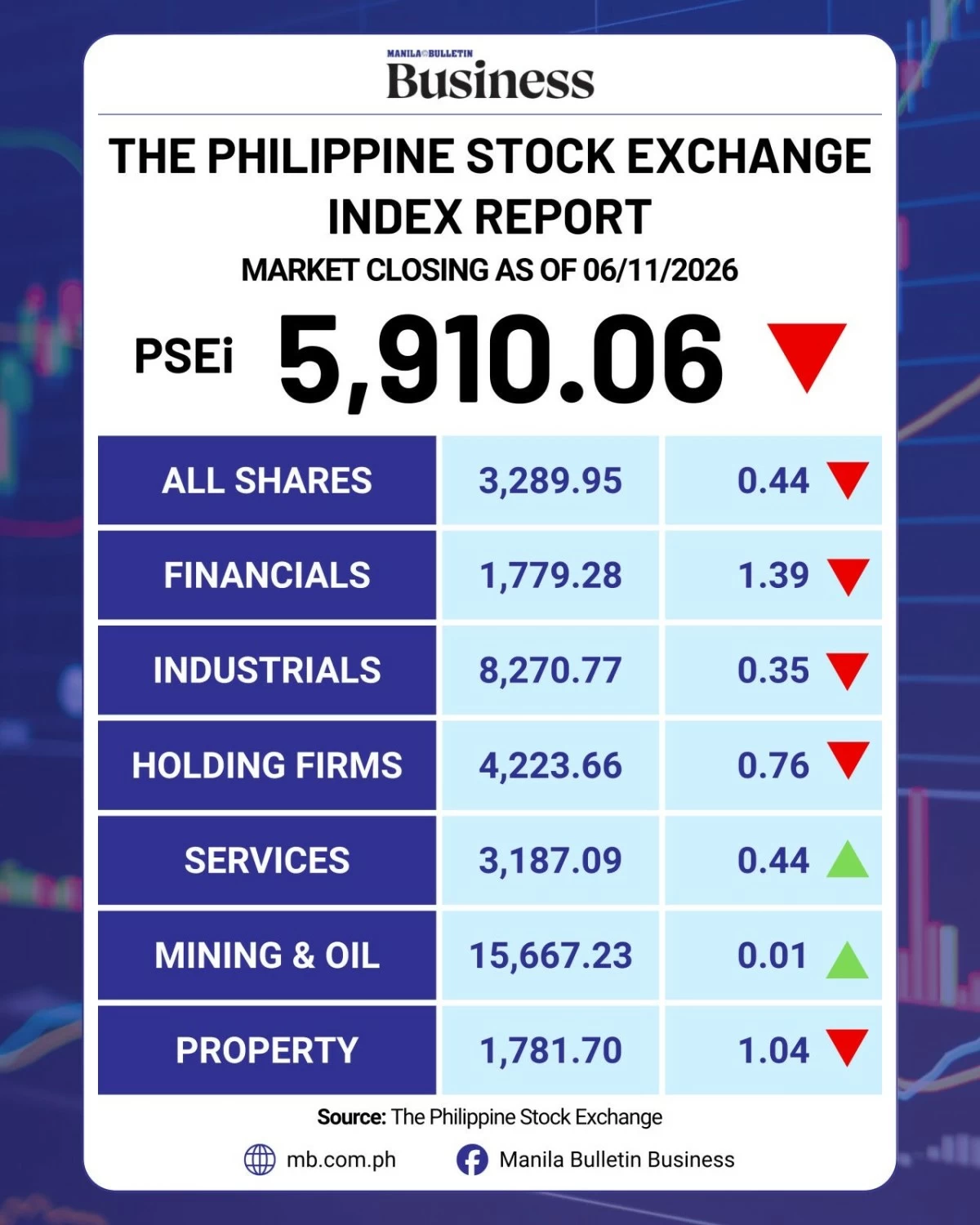
Local stocks fell, ending the week lower as a second day of United States (US) airstrikes in Iran drove oil prices higher, stoking renewed global inflation fears and dimming investor appetite for risk assets.
The Philippine Stock Exchange index (PSEi) slid 31.30 points, or 0.53 percent, to close at 5,910.06 on Thursday, June 11. Financial companies anchored the decline, outweighing gains in consumer and services equities, while mining firms remained unchanged.
Trading volume narrowed from recent sessions, with 585 million shares valued at ₱6.65 billion changing hands. Decliners beat gainers 99 to 75, while 59 stocks closed unchanged.
“The local bourse closed in the red as continued attacks in Iran stoked fear and dampened investor sentiment, dragging the index lower,” said Luis Limlingan, Managing Director at Regina Capital Development Corp.
He added that the sudden premium on global crude raises structural concerns over imported inflation, which in turn sparked worries that the Bangko Sentral ng Pilipinas may be pressured into raising its benchmark interest rate to tame consumer price risks.
Domestic equity markets are also tracking a broader global correction as international fund managers recalibrate their regional exposure. Overlapping macroeconomic pressures from both local monetary fears and shifting capital flows have forced institutional buyers to the sidelines.
The local benchmark index fell for a separate, second consecutive trading day, mirroring minor downward corrections across US equity markets where participants are weighing fluid, mixed signals from the conflict.
At the same time, resilient US macroeconomic data has led market participants to price in a near certainty of a 25-basis-point interest rate increase by the US Federal Reserve by December 2026.
Higher-for-longer US interest rates typically strain emerging market assets by drawing foreign capital back toward dollar-denominated yields and putting pressure on local currencies.
Michael Ricafort, Chief Economist at Rizal Commercial Banking Corp., noted that the combination of international geopolitical shocks and hawkish shifting expectations for the Federal Reserve’s terminal policy rate has created a challenging near-term environment for domestic equity valuations.