






Manila Bulletin
 Philippines
National
Phivolcs marks Pinatubo eruption's 35th anniversary with commemorative marker
Philippines
National
Phivolcs marks Pinatubo eruption's 35th anniversary with commemorative marker
Philippines
National
Phivolcs marks Pinatubo eruption's 35th anniversary with commemorative marker
Phivolcs marks Pinatubo eruption's 35th anniversary with commemorative marker
Published Jun 10, 2026 02:56 pm


At A Glance
- According to Phivolcs, the marker recognizes the contributions of scientists, government agencies, local communities, international partners, and media organizations that helped save lives and lessen the disaster's impacts.
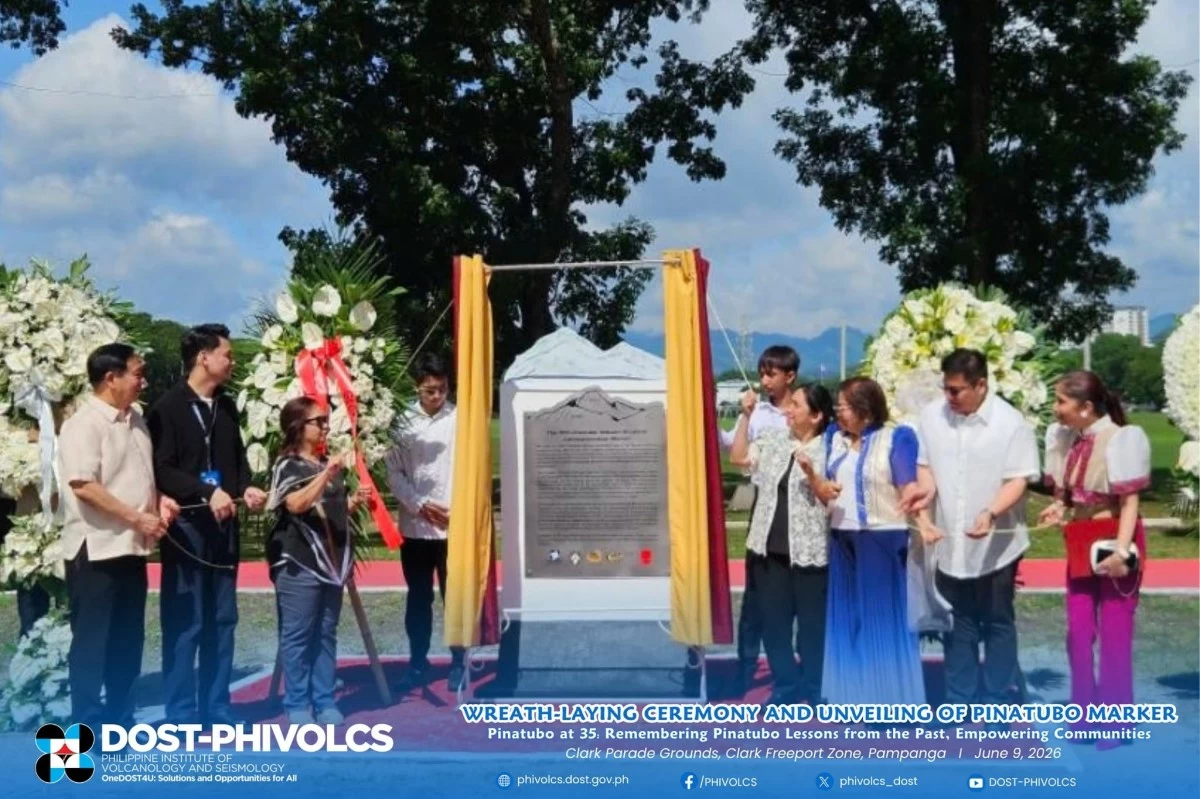
(Phivolcs/Facebook)
A commemorative marker recognizing the historical significance of the 1991 eruption of Mount Pinatubo and the lessons and efforts that helped reduce its impact was unveiled as part of activities marking the eruption’s 35th anniversary.
The marker was unveiled on June 9 during a ceremony at the Clark Development Corporation Parade Grounds in the Clark Freeport Zone, Pampanga, accompanied by a wreath-laying activity led by the Philippine Institute of Volcanology and Seismology (Phivolcs).
According to Phivolcs, the marker recognizes the contributions of scientists, government agencies, local communities, international partners, and media organizations that helped save lives and lessen the disaster’s impacts.
The ceremony formed part of the twin-event program, “Pinatubo at 35: Remembering Pinatubo Lessons from the Past, Empowering Communities,” which highlights lessons from the eruption that continue to guide disaster risk reduction and resilience efforts.
Also held on June 9 was the opening of an international conference at Holy Angel University in Angeles City, which gathered experts and researchers from local and international institutions working on volcanology and disaster risk management.
Technical sessions scheduled on June 11 will focus on volcanic hazards, disaster preparedness, emergency response, advances in volcanology, and lessons drawn from the Pinatubo experience.
Participants include experts from Phivolcs, United States Geological Survey, International Association of Volcanology and Chemistry of the Earth’s Interior, local disaster risk reduction offices, humanitarian organizations, and media groups, who are expected to share insights on strengthening volcanic risk reduction and community resilience.
Phivolcs said the commemoration also serves as a reminder of the importance of scientific monitoring, timely communication, community participation, and preparedness in reducing disaster risks.
One of the most significant eruptions of the 20th century
Mount Pinatubo, which straddles the provinces of Pampanga, Tarlac, and Zambales, remains one of the most significant volcanoes in Philippine history.
Its 1991 eruption sequence began with earthquake swarms in April, followed by a phreatic explosion on June 7.
This escalated to a major eruption on June 12, which produced an ash column reaching 20 kilometers high, before culminating in a climactic eruption in the early morning of June 15.
The eruption produced pyroclastic flows, lahars, and thick clouds of volcanic ash that affected more than 200,000 families, including indigenous Aeta communities in Central Luzon, based on a Phivolcs report.
Phivolcs said the volcanic hazards were further aggravated by the passage of Typhoon “Diding” (international name “Yunya”), as ashfall spread to areas not included in the original hazard map.
Traces of volcanic ash were reported as far as Metro Manila and reached other parts of Southeast Asia, including Cambodia.
The typhoon also triggered lahars, or fast-moving flows of volcanic mud and debris, which coursed through major river systems and affected downstream communities.