






 Philippines
National
Philippines, Japan, US oppose attempts to change status quo in South China Sea
Philippines
National
Philippines, Japan, US oppose attempts to change status quo in South China Sea
Philippines, Japan, US oppose attempts to change status quo in South China Sea


At A Glance
- The Philippines, Japan, and the United States reaffirmed their opposition to unilateral attempts to change the status quo in the South China Sea.
- The three countries held the Second Japan-U.S.-Philippines Maritime Dialogue in Manila.
- Officials also reaffirmed the significance of the 2016 arbitral ruling as it approaches its 10th anniversary next month.
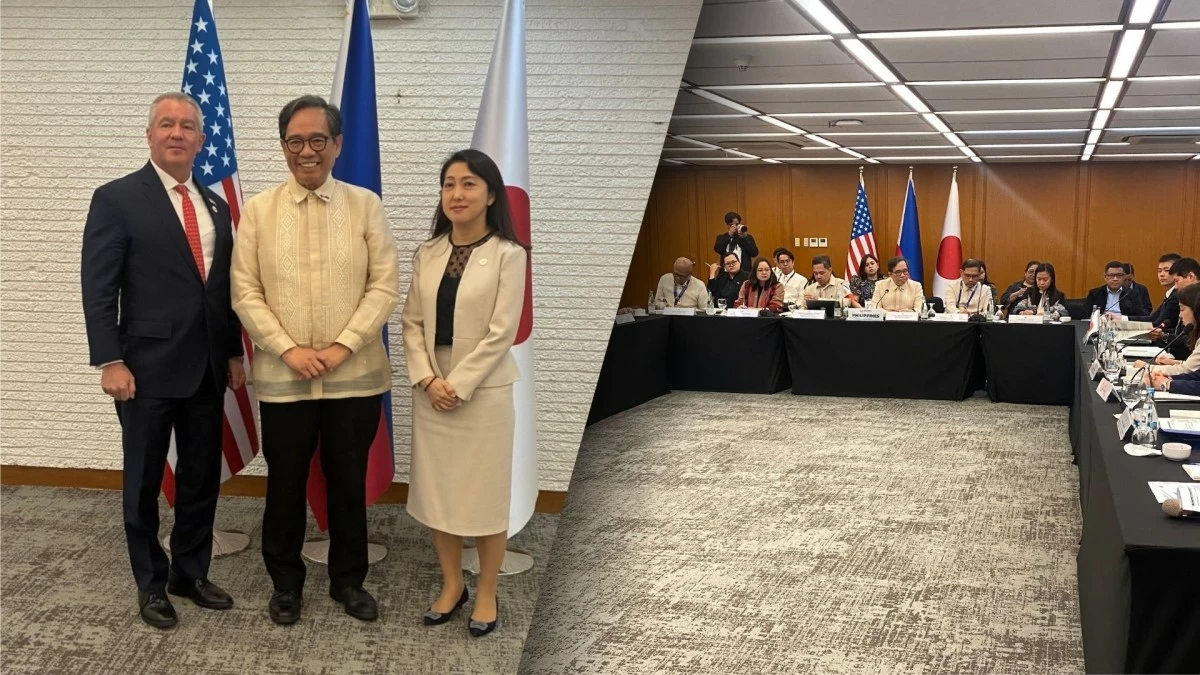
The Philippines, Japan, and the United States have reaffirmed their strong opposition to any unilateral attempts to change the status quo in the South China Sea through force or coercion.
The commitment was made during the Second Japan-US-Philippines Maritime Dialogue held in Manila, where officials from the three countries discussed maritime security, regional developments, and trilateral cooperation.
According to Japan's Ministry of Foreign Affairs, the three sides held "frank exchanges of views" on the recent situation in the South China Sea and agreed on the importance of maintaining a rules-based maritime order.
"The three parties had frank exchanges of views on the recent situation in the South China Sea and reaffirmed their strong opposition to any unilateral attempts to change the status quo by force or coercion," the Japanese foreign ministry said.
Arbitral ruling reaffirmed
The Philippines, Japan, and the United States also reaffirmed the significance of the landmark arbitral ruling on the South China Sea.
The dialogue took place as the region approaches the 10th anniversary of the July 12, 2016 ruling issued by the Permanent Court of Arbitration in The Hague.
"The three parties reaffirmed the significance of the Arbitral Tribunal's award as to the disputes between the Republic of the Philippines and the People's Republic of China on the occasion of its 10th anniversary," Japan's foreign ministry said.
The tribunal ruled in favor of the Philippines in 2016 and invalidated China's expansive "nine-dash line" claim in the South China Sea. China has consistently rejected the ruling.
Trilateral cooperation strengthened
The meeting also highlighted growing cooperation among Manila, Tokyo, and Washington since the first trilateral maritime dialogue in 2024.
The Philippine delegation was led by Foreign Affairs Undersecretary Leo Herrera-Lim and included representatives from the National Security Council, Department of National Defense, and Philippine Coast Guard.
Japan's delegation was headed by Hokugo Kyoko, Deputy Director-General of the Southeast and Southwest Asian Affairs Department of the Ministry of Foreign Affairs, together with officials from Japan's Ministry of Defense and Coast Guard.
The United States delegation was led by Assistant Secretary of State for East Asian and Pacific Affairs Michael George DeSombre, accompanied by officials from the State Department and the US Coast Guard.
The three sides welcomed progress made in trilateral cooperation over the past two years and reaffirmed the importance of continuing collaboration amid evolving regional challenges.
Building momentum
The participants also agreed to further strengthen bilateral and trilateral initiatives in a complementary manner and maintain the momentum of cooperation moving forward.
Japanese Ambassador Endo Kazuya echoed the outcome of the meeting in a social media post.
"Following the successful second Japan-Philippines-US Trilateral Maritime Dialogue, we will build on this momentum by reaffirming our shared commitment to a rules-based maritime order, while opposing unilateral actions that undermine regional stability," Endo said.
The maritime dialogue is part of broader efforts by the Philippines, Japan, and the United States to enhance cooperation in maritime security, coast guard operations, capacity-building, and the protection of freedom of navigation.
The three countries have increasingly expanded trilateral engagements in recent years amid tensions in the South China Sea, where Beijing continues to assert sweeping claims that overlap with the maritime entitlements of several Southeast Asian nations, including the Philippines.