






Manila Bulletin
 Philippines
National
Govt' intensifies SRR ops, relief delivery as death toll in Sarangani quake hits 45
Philippines
National
Govt' intensifies SRR ops, relief delivery as death toll in Sarangani quake hits 45
Philippines
National
Govt' intensifies SRR ops, relief delivery as death toll in Sarangani quake hits 45
Govt' intensifies SRR ops, relief delivery as death toll in Sarangani quake hits 45
OCD says nearly 150,000 individuals were affected by the tremor
Published Jun 10, 2026 01:48 pm


At A Glance
- In a report on Wednesday, June 10, the National Disaster Risk Reduction and Management Council (NDRRMC) said that the earthquake affected 33,596 families or 149,372 persons across 184 barangays in Zamboanga Peninsula (Region 9), Davao Region (Region 11), SOCCSKSARGEN (Region 12), and the Bangsamoro Autonomous Region in Muslim Mindanao (BARMM).
- Thirty-three people died in Region 12 while 11 others perished in Region 11. Meanwhile, 630 individuals were injured while 17 remained missing – 13 in Region 11 and four in Region 12.
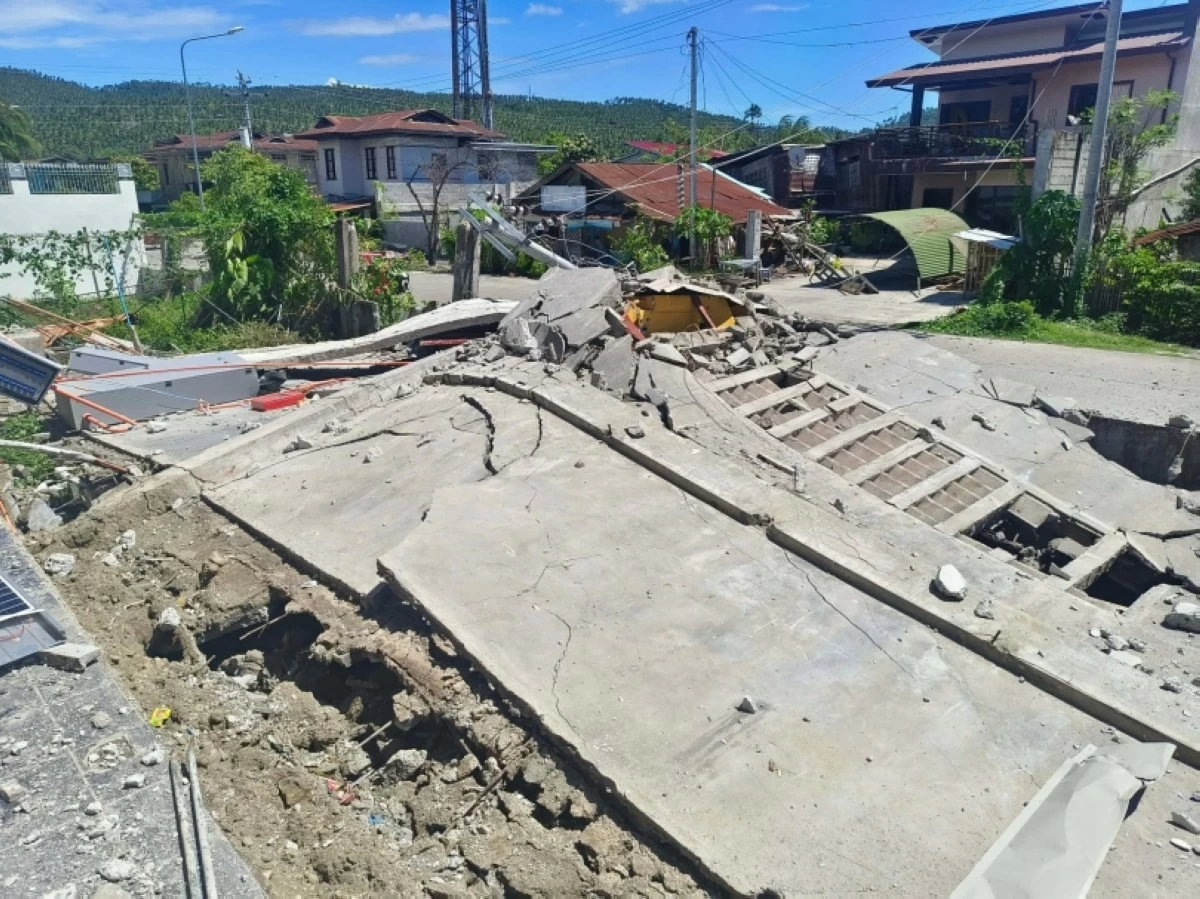
Devastation caused by the 7.8 magnitude earthquake in Glan, Sarangani Province on June 8. 2026 (Photo courtesy of the local government of Glan via Facebook)
National and local response clusters mobilized thousands of personnel, aircraft, and sea vessels to intensify search, rescue, and retrieval (SRR) operations and relief distribution in Mindanao following a magnitude 7.8 earthquake that struck Maasim, Sarangani, which has so far killed 45 people and affected nearly 150,000 individuals
In a report on Wednesday, June 10, the National Disaster Risk Reduction and Management Council (NDRRMC) said that the earthquake affected 33,596 families or 149,372 persons across 184 barangays in Zamboanga Peninsula (Region 9), Davao Region (Region 11), SOCCSKSARGEN (Region 12), and the Bangsamoro Autonomous Region in Muslim Mindanao (BARMM).
Thirty-three people died in Region 12 while 11 others perished in Region 11. Meanwhile, 630 individuals were injured while 17 remained missing – 13 in Region 11 and four in Region 12.
The June 8 quake was felt in many parts of Mindanao and caused widespread destruction in General Santos City, Sarangani, and Davao Occidental.
Office of Civil Defense (OCD) Assistant Secretary Bernardo Rafaelito Alejandro IV and OCD spokesperson Junie Castillo said responders continue to face difficulties reaching some communities because damaged roads and bridges have cut off access to several areas, while aftershocks also hamper response operations.
“In terms of lifeline, 29 roads, 11 bridges, one seaport, and one airport are affected. Again, these are all tentative numbers and the conduct of rapid damage and needs assessment (RDANA) is still ongoing,” Alejandro said.
“There are areas that cannot be reached because roads are damaged. There are needs there such as food. Tent cities also need to be provided for our fellow Filipinos, as well as support for critical infrastructure,” Castillo added.
Fuel was also being transported to sustain power and generators in key facilities, such as hospital, which are catering to many injured patients, according to the OCD.
“Supplies of gasoline and fuel are being delivered for power and generators of critical facilities, especially hospitals,” Castilo shared.
Six areas in Region 11 remain without electricity while power has been restored in seven others after outages hit 13 cities and municipalities.
“There are still establishments that have not reopened after many establishments actually closed. That is why food and non-food items are being provided to our fellow Filipinos,” he said.
He said the government has sufficient food stocks but delivery remains a challenge.
“At present, the Department of Social Welfare and Development (DSWD) has enough food supply. The challenge is how to bring it to the affected areas. But many areas are already being reached by RDANA teams,” Castillo said.
AFP mobilization
The OCD said 21 major logistics assets, including seven aircraft and 14 land vehicles from the Armed Forces of the Philippines (AFP), Philippine Coast Guard (PCG), and DSWD have been deployed, while another 388 assets remain on standby.
Authorities have released more than 12,000 family food packs in General Santos City and Davao Occidental.
“For food and non-food items, around P21.3 million has been prepared and provided to those in need. That accounts for close to 12,086 family food packs released in General Santos City and Davao Occidental,” Alejandro said.
Nearly 3,700 families or about 15,960 individuals remain inside 57 evacuation centers, according to the OCD.
Meanwhile, search operations continue in damaged structures as authorities verify reports of missing persons.
The Philippine Army said its 18-member Urban Search and Rescue (USAR) team conducted SRR operations on Wednesday at a collapsed supermarket in Barangay Calumpang, General Santos City.
The Army also helped evacuate four rescued residents from Balut Island in Davao Occidental through an air casualty evacuation mission.
Army units under the 10th Infantry Division and 6th Infantry Division have been conducting humanitarian assistance and disaster response (HADR) operations in General Santos City, Sarangani and nearby provinces.
AFP Chief of Staff Gen. Romeo Brawner Jr. said foreign partners have offered assistance as recovery efforts continue.
“Many counterparts from different countries called me and offered their help, such as the United States, Japan, Indonesia, and other countries,” Brawner said.
He said the government is still evaluating what assistance may be needed.
“What they told us is that whatever assistance is needed, they can provide. Right now, we are doing the evaluation under the supervision of the OCD,” he said.
Relatedly, Brawner said military facilities were not damaged by the quake.
“So far, we have no military installations that were damaged and there are also no reports of soldiers injured or killed in the earthquake,” he said.
PCG delivers aid to isolated communities
For its part, the PCG turned to sea-based delivery missions to reach isolated communities. On Wednesday, BRP Panglao transported a third batch of relief goods to Sarangani, carrying 400 boxes of relief supplies, potable water, and other essential items.
A day earlier, the vessel delivered 1,200 boxes of relief goods, drinking water, and 106 tents for residents of Glan, Sarangani.
The Coast Guard also reported significant damage at the Gensan Shipyard in Maasim, Sarangani, with initial estimates placed losses to the slipway facility at P50 million.
In total, Alejandro said infrastructure losses in Regions 11 and 12 have reached around P562.8 million.
Damaged houses, HADR ops
The OCD also recorded 3,169 damaged houses, including 2,641 partially damaged and 528 totally destroyed in Regions 11 and 12.
Meanwhile, the Department of Health (DOH) pre-positioned P70.2 million worth of medical commodities for deployment while the Department of Public Works and Highways (DPWH) deployed 34 major assets and 485 personnel for debris clearing and emergency civil works.
PNP focuses on security operations
The Philippine National Police said it has also deployed 2,496 personnel and 463 assets to support response and security operations.
PNP chief Police Gen. Jose Melencio Nartatez Jr. said officers are focusing on communities cut off by damaged infrastructure.
“We have been maintaining police presence in urban areas and town centers since Day One and our deployment in these areas will remain until everything normalizes,” Nartatez said.
“But we are also focusing on maintaining police presence in isolated barangays and communities not only to provide assistance but also to make the affected local residents feel safe with police visibility,” he added.
Preparations for recovery
As rescue operations continue, the OCD said agencies were also preparing for recovery operations.
Castillo said structural integrity assessments are needed before government offices and other buildings can be reoccupied.
“There are buildings that can be seen as not safe for occupancy. Government workers remain outside and no one will be allowed to enter the areas we mentioned, specifically Sarangani and General Santos City,” the OCD spokesperson said.