

ADVERTISEMENT

An underground detector in China unveils its first major findings about mysterious ghost particles

Published Jun 10, 2026 11:08 pm
NEW YORK (AP) — A massive underground detector aimed at understanding the mysterious ghost particles in our universe released its first major results on Wednesday.
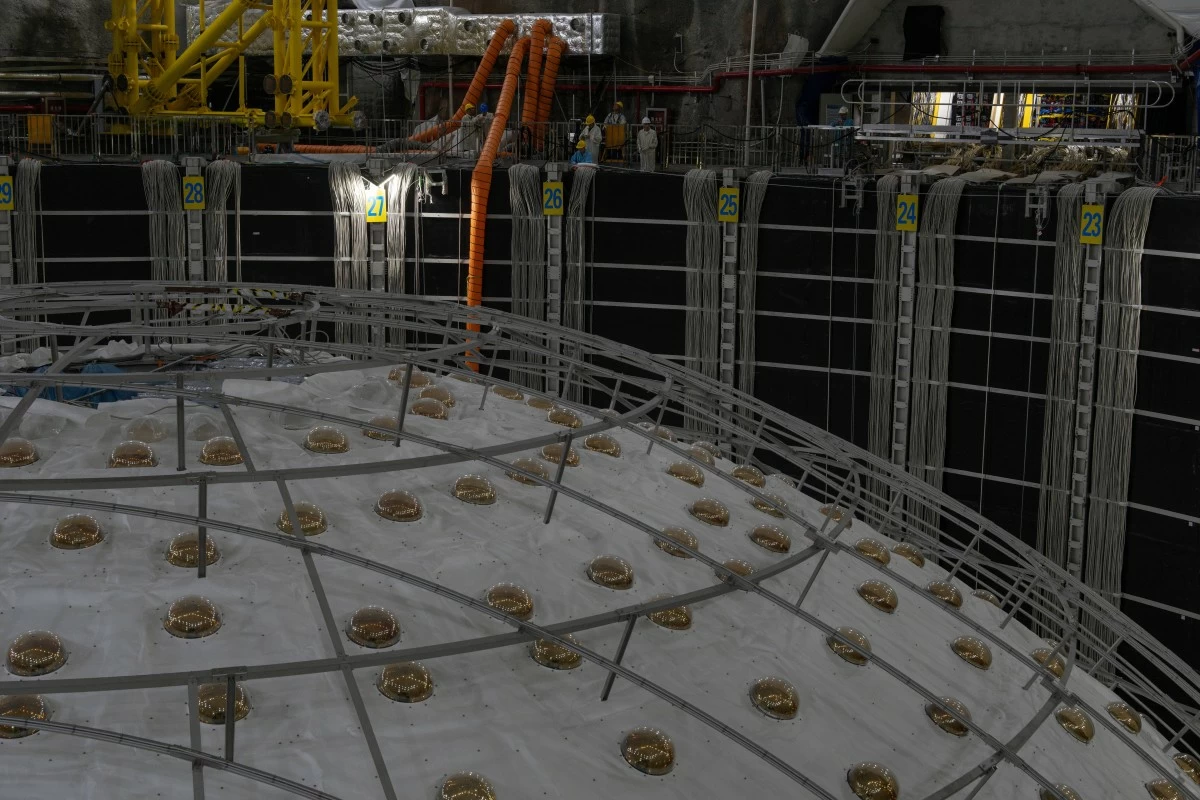
FILE -  Workers labor near the cosmic detector housed underground at the Jiangmen Underground Neutrino Observatory in Kaiping in southern China's Guangdong province, Oct. 11, 2024. (AP Photo/Ng Han Guan, File)
FILE - Workers labor near the cosmic detector housed underground at the Jiangmen Underground Neutrino Observatory in Kaiping in southern China's Guangdong province, Oct. 11, 2024. (AP Photo/Ng Han Guan, File)
The Jiangmen Underground Neutrino Observatory in China started collecting data in August with the goal of understanding neutrinos: tiny cosmic particles that date back to the Big Bang and whiz harmlessly through our bodies by the trillions every second. Yet they weigh almost nothing, making them difficult to sniff out.
In a study published Wednesday in the journal Nature, the JUNO team unveiled its initial findings from two months of data collection — including some of the most precise measurements to date of how neutrinos switch between three varieties, or flavors, as they zip through space.
"It really makes me look forward to more exciting results in the future," said physicist Kate Scholberg with Duke University, who had no role in the new research.
The spherical JUNO detector is located 2,297 feet (700 meters) underground. It examines antineutrinos that come from collisions inside two nearby nuclear power plants. Antineutrinos are equally mysterious, opposite versions of neutrinos that scientists can study to understand their behavior and how neutrinos work.
When the antineutrinos meet particles within the detector, they produce a flash of light.
Scientists are hoping the detector will help resolve the longstanding mystery of how heavy each neutrino flavor is. They think two are similar in weight and that the third is an oddball, but they aren't sure whether two are heavy and the other is light or vice versa.
The initial results haven't answered that question just yet, but they show what the detector is capable of — and that it "will be able to test the finer ripples" that separate the neutrino flavors and their masses, said study co-author Liangjian Wen, a member of the JUNO collaboration.
Two similar neutrino detectors — Japan's Hyper-Kamiokande and the Deep Underground Neutrino Experiment based in the United States — are set to begin data collection within the next decade, cross-checking the China detector's results using different approaches.

Related Tags

world news China
ADVERTISEMENT
.most-popular .layout-ratio{ padding-bottom: 79.13%; } @media (min-width: 768px) and (max-width: 1024px) { .widget-title { font-size: 15px !important; } }

{{ articles_filter_1561_widget.title }}

.most-popular .layout-ratio{ padding-bottom: 79.13%; } @media (min-width: 768px) and (max-width: 1024px) { .widget-title { font-size: 15px !important; } }

{{ static_articles_1562_widget.title }}

.most-popular .layout-ratio{ padding-bottom: 79.13%; } @media (min-width: 768px) and (max-width: 1024px) { .widget-title { font-size: 15px !important; } }

{{ articles_filter_1563_widget.title }}

{{ articles_filter_1564_widget.title }}

.mb-article-details { position: relative; } .mb-article-details .article-body-preview, .mb-article-details .article-body-summary{ font-size: 17px; line-height: 30px; font-family: "Libre Caslon Text", serif; color: #000; } .mb-article-details .article-body-preview iframe , .mb-article-details .article-body-summary iframe{ width: 100%; margin: auto; } .read-more-background { background: linear-gradient(180deg, color(display-p3 1.000 1.000 1.000 / 0) 13.75%, color(display-p3 1.000 1.000 1.000 / 0.8) 30.79%, color(display-p3 1.000 1.000 1.000) 72.5%); position: absolute; height: 200px; width: 100%; bottom: 0; display: flex; justify-content: center; align-items: center; padding: 0; } .read-more-background a{ color: #000; } .read-more-btn { padding: 17px 45px; font-family: Inter; font-weight: 700; font-size: 18px; line-height: 16px; text-align: center; vertical-align: middle; border: 1px solid black; background-color: white; } .hidden { display: none; }
function initializeAllSwipers() { // Get all hidden inputs with cms_article_id document.querySelectorAll('[id^="cms_article_id_"]').forEach(function (input) { const cmsArticleId = input.value; const articleSelector = '#article-' + cmsArticleId + ' .body_images'; const swiperElement = document.querySelector(articleSelector); if (swiperElement && !swiperElement.classList.contains('swiper-initialized')) { new Swiper(articleSelector, { loop: true, pagination: false, navigation: { nextEl: '#article-' + cmsArticleId + ' .swiper-button-next', prevEl: '#article-' + cmsArticleId + ' .swiper-button-prev', }, }); } }); } setTimeout(initializeAllSwipers, 3000); const intersectionObserver = new IntersectionObserver( (entries) => { entries.forEach((entry) => { if (entry.isIntersecting) { const newUrl = entry.target.getAttribute("data-url"); if (newUrl) { history.pushState(null, null, newUrl); let article = entry.target; // Extract metadata const author = article.querySelector('.author-section').textContent.replace('By', '').trim(); const section = article.querySelector('.section-info ').textContent.replace(' ', ' '); const title = article.querySelector('.article-title h1').textContent; // Parse URL for Chartbeat path format const parsedUrl = new URL(newUrl, window.location.origin); const cleanUrl = parsedUrl.host + parsedUrl.pathname; // Update Chartbeat configuration if (typeof window._sf_async_config !== 'undefined') { window._sf_async_config.path = cleanUrl; window._sf_async_config.sections = section; window._sf_async_config.authors = author; } // Track virtual page view with Chartbeat if (typeof pSUPERFLY !== 'undefined' && typeof pSUPERFLY.virtualPage === 'function') { try { pSUPERFLY.virtualPage({ path: cleanUrl, title: title, sections: section, authors: author }); } catch (error) { console.error('ping error', error); } } // Optional: Update document title if (title && title !== document.title) { document.title = title; } } } }); }, { threshold: 0.1 } ); function showArticleBody(button) { const article = button.closest("article"); const summary = article.querySelector(".article-body-summary"); const body = article.querySelector(".article-body-preview"); const readMoreSection = article.querySelector(".read-more-background"); // Hide summary and read-more section summary.style.display = "none"; readMoreSection.style.display = "none"; // Show the full article body body.classList.remove("hidden"); } document.addEventListener("DOMContentLoaded", () => { let loadCount = 0; // Track how many times articles are loaded const offset = [1, 2, 3, 4, 5, 6, 7, 8, 9, 10]; // Offset values const currentUrl = window.location.pathname.substring(1); let isLoading = false; // Prevent multiple calls if (!currentUrl) { console.log("Current URL is invalid."); return; } const sentinel = document.getElementById("load-more-sentinel"); if (!sentinel) { console.log("Sentinel element not found."); return; } function isSentinelVisible() { const rect = sentinel.getBoundingClientRect(); return ( rect.top < window.innerHeight && rect.bottom >= 0 ); } function onScroll() { if (isLoading) return; if (isSentinelVisible()) { if (loadCount >= offset.length) { console.log("Maximum load attempts reached."); window.removeEventListener("scroll", onScroll); return; } isLoading = true; const currentOffset = offset[loadCount]; window.loadMoreItems().then(() => { let article = document.querySelector('#widget_1690 > div:nth-last-of-type(2) article'); intersectionObserver.observe(article) loadCount++; }).catch(error => { console.error("Error loading more items:", error); }).finally(() => { isLoading = false; }); } } window.addEventListener("scroll", onScroll); });

Sign up by email to receive news.