







A truffle hunt and feast in the Italian countryside
Following trained dogs through the Italian countryside in search of one of the world's most coveted culinary treasures
Published Jun 10, 2026 10:11 am


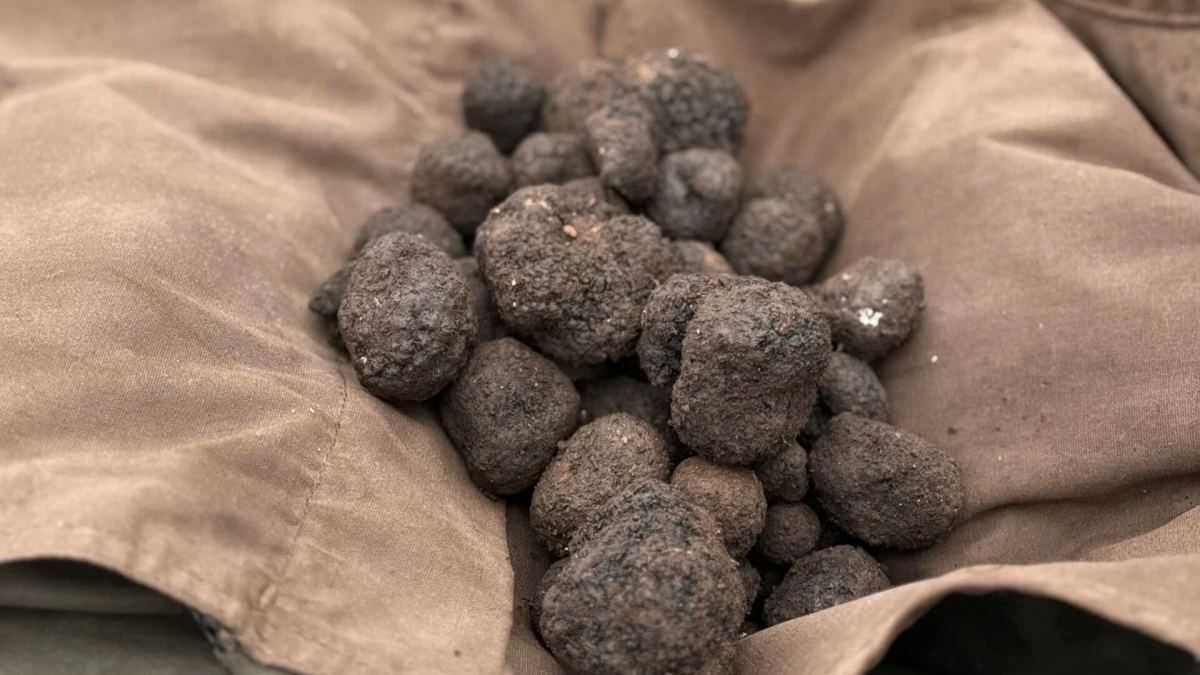
Black truffles (Photo: AM Tartufi)
The Italians call them “Diamanti della Terra,” or “diamonds of the earth.” Nothing says luxury like truffles. Added to food, truffles elevate the dish with their sublime scent and flavor. This is why people are willing to pay hundreds to thousands of euros per kilogram for these prized fungi. Truffles grow in alkaline soil, among the roots of certain trees like oak and poplar, and only in regions with the right weather and moisture content. They are difficult to spot in the wild since they grow underground and blend in with the soil. The most renowned truffles come from Italy, Spain, and France, where the conditions are just right. Truffles are being discovered in more areas of Europe and Asia, but the best truffles are still from the traditional hunting grounds in Western Europe. On our recent trip to Italy, we were fortunate to join a successful truffle hunt with a licensed guide and his dogs on the outskirts of Rome. At the end of our search, we sat down to a sumptuous seven-course meal prepared with the truffles we found.
Truffles are a type of fungus, but they are not mushrooms. Mushrooms reproduce by producing the typical fruiting body that releases spores into the environment. Truffles reproduce by having an animal dig them up from the tree roots where they grow, eat them, and disperse the spores in their stool. To help animals find them, ripe truffles secrete dimethyl sulfide and other compounds, to which some animals, such as pigs, are attracted. It used to be theorized that truffles secrete male pig pheromones that female pigs are drawn to, but this has been debunked. Nevertheless, pigs have been traditionally used to find truffles for this reason. While some truffle hunters still use pigs, most have switched to dogs because dogs are easier to handle and are less likely to eat the truffles before the hunter can retrieve them. It is better to use an animal to hunt for truffles because they will only detect the ripe ones. Unripe truffles are not good to eat, and it would be a waste to dig them up prematurely.
There are several types of truffles used in cuisine, the most expensive of which are white truffles found only in the forests of Piedmont, Italy. White winter truffles have an intense flavor and are very difficult to cultivate, making them very expensive due to their quality and scarcity. Black winter truffles are the next most sought-after and also have an intense flavor. Since it was summer during our visit, we were looking for the more common, milder but still quite expensive black summer truffle.
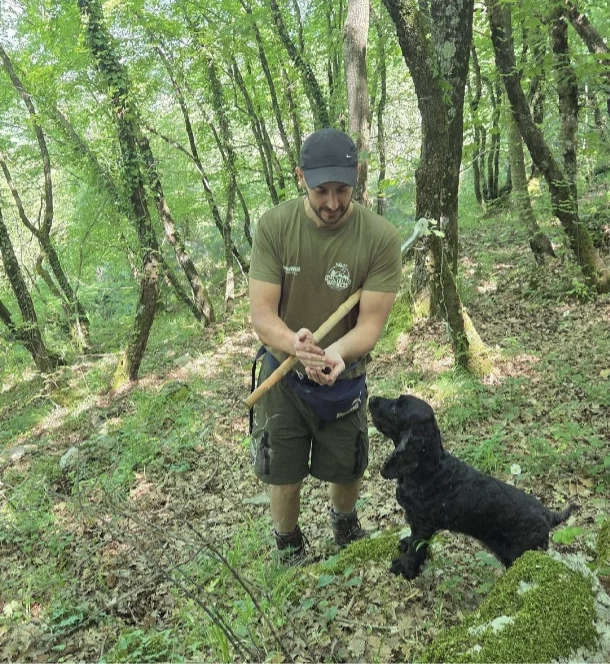
Matteo with the Wendy hunting truffles (Photo: Dr. Edsel Salvana/Manila Bulletin)
Our guide Matteo is a third-generation truffle hunter with 11 trained truffle hunting dogs. He picked up our group from the Pantano metro station, which is the last stop of the Metro C train from Rome, and we drove up the mountains to look for the prized fungi. Matteo took two of his dogs with us: Wendy, an 11-year-old cocker spaniel, and Bobby, a five-year-old Italian water dog. Unlike pigs, which naturally look for and eat truffles, dogs need to be trained to recognize and look for the scent of truffles. According to Matteo, they train the dogs using a hollow ball containing truffles so that they get used to the scent. Traditionally, the Italian water dog, like Bobby, has been used for this purpose, but some breeds, such as cocker spaniels, also occasionally excel at truffle hunting.
Once we arrived at the entrance to the forest area, Matteo unloaded the dogs from the back of the van, and you could tell they were very excited. The sun was shining, and a light breeze was blowing. The thick tree canopy supplied lots of shade, perfect conditions for truffles to grow. We were each given a walking stick since the terrain sloped a lot and was uneven in many places. Matteo and his father each carried a stick tipped with a pointed metal blade like a spear. These were used to dig up rocks and dirt that could be concealing truffles. Matteo released the dogs from their leashes, and Wendy got to work immediately. In no time at all, Wendy started digging, and Matteo ran over to her side to inspect what she had found and to prevent her from eating it. It turns out Wendy likes eating truffles and has to be told to stop. In some cases, truffles had to be retrieved from inside her mouth.
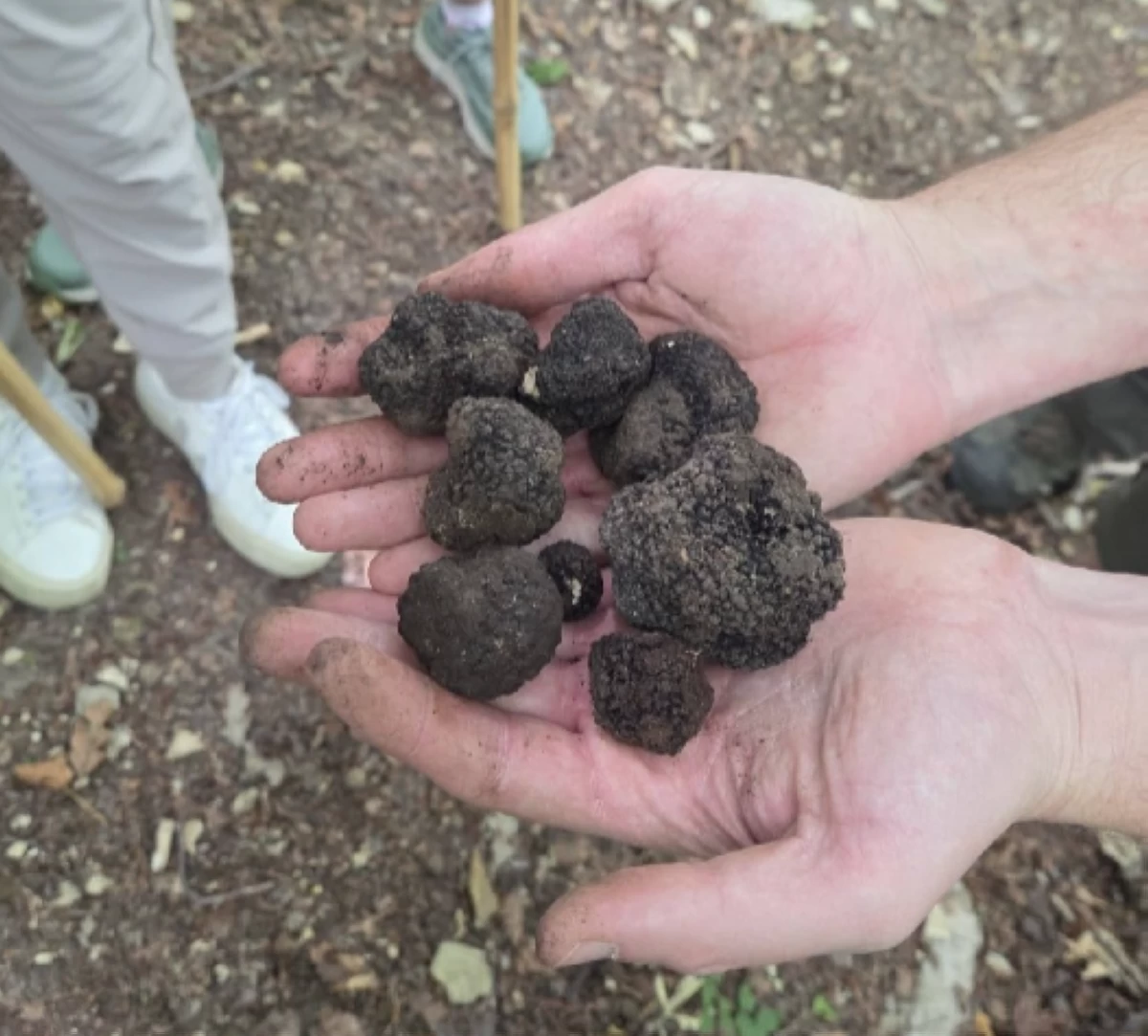
Truffles we gathered from the hunt (Photo: Dr. Edsel Salvana/Manila Bulletin)
The truffle Wendy found was a small one, but it was the first one for the day, and Matteo triumphantly held it up and gave Wendy a small piece of sausage as a reward. Bobby was having a slow start and did not seem interested in hunting at all. We walked through the forest, and Wendy found many more truffles, including a particularly big one that Matteo said was not common to see on these kinds of guided excursions. Matteo had us sniff some of the truffles, and you could detect the subtle aroma that is so sought after. Bobby finally found a couple of truffles at the end of the expedition, but it was clear who the best truffle-hunting dog was by a mile.
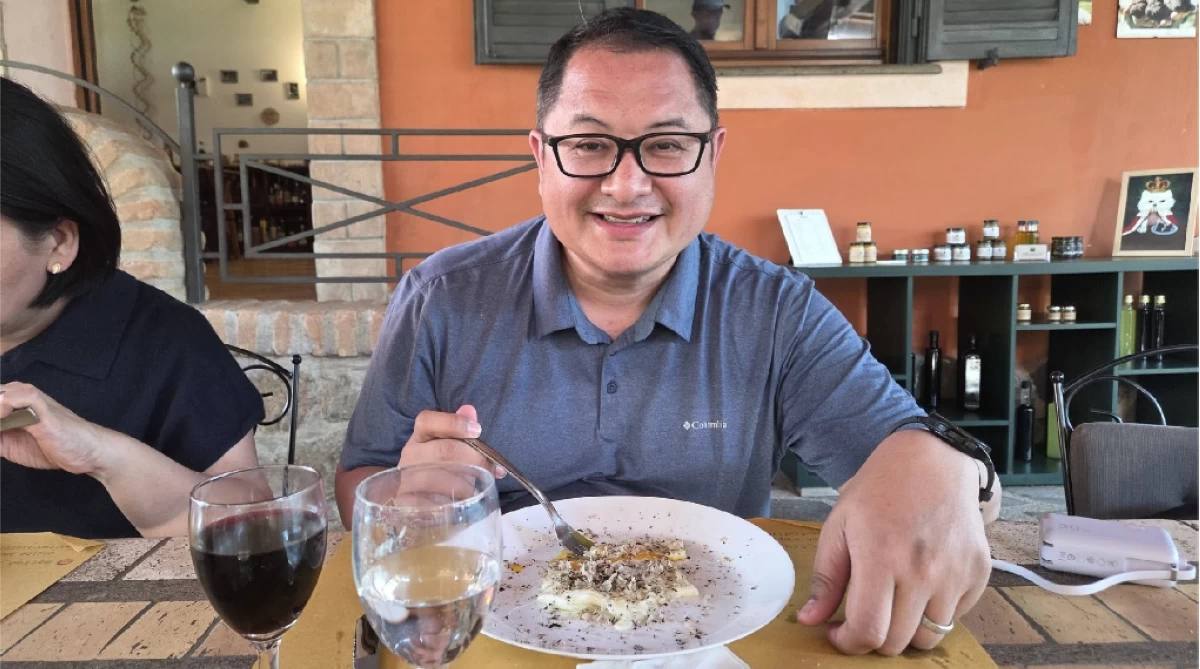
The author enjoying a fried egg with truffle shavings. (Photo: Dr. Edsel Salvana/Manila Bulletin)
After harvesting about 300 grams of truffles, we headed back to Matteo’s villa, where they prepared a feast. The villa itself is a charming property with olive and lemon trees. Matteo makes his own olive oil and limoncello (a lemon-based liquor), and you could tell how fresh these were. We sat down on a long table with free-flowing white and red wine from the area (there were no labels, just bottles), and we were served course after course of food highlighting the truffle flavors. These included bruschettas and tapenades with truffle, orecchiette pasta shaped like ears with slices of truffle, potatoes with truffles, and my favorite, a simple fried egg loaded with truffles. We finished with the limoncello and other liquors, accompanied by Ciambelline al Vino, a rustic Roman biscuit that you dip in wine.
Having eaten our fill and with many unforgettable memories of a truly unique day, Matteo drove us back to the train station for our trip back to Rome. As we said our goodbyes, I cannot help but muse how well the Italians have embraced the finer things in life, and how we should all step back once in a while to savor “la dolce vita.”