






Manila Bulletin
 Philippines
'Modern' PH Navy serves as 'backbone' for archipelagic defense, disaster response – Ezpeleta
Philippines
'Modern' PH Navy serves as 'backbone' for archipelagic defense, disaster response – Ezpeleta
Philippines
'Modern' PH Navy serves as 'backbone' for archipelagic defense, disaster response – Ezpeleta
'Modern' PH Navy serves as 'backbone' for archipelagic defense, disaster response – Ezpeleta
Published Jun 9, 2026 02:19 pm


At A Glance
- During the event, President Marcos Jr. led the formal commissioning of the BRP Rajah Lakandula (PS-21) at the PN headquarters, Naval Station Jose Andrada in Manila. The vessel is the Navy's second offshore patrol vessel (OPV), arriving in Subic, Zambales last May 8, and serving as the sister ship to BRP Rajah Sulayman (PS-20), which was commissioned in February.
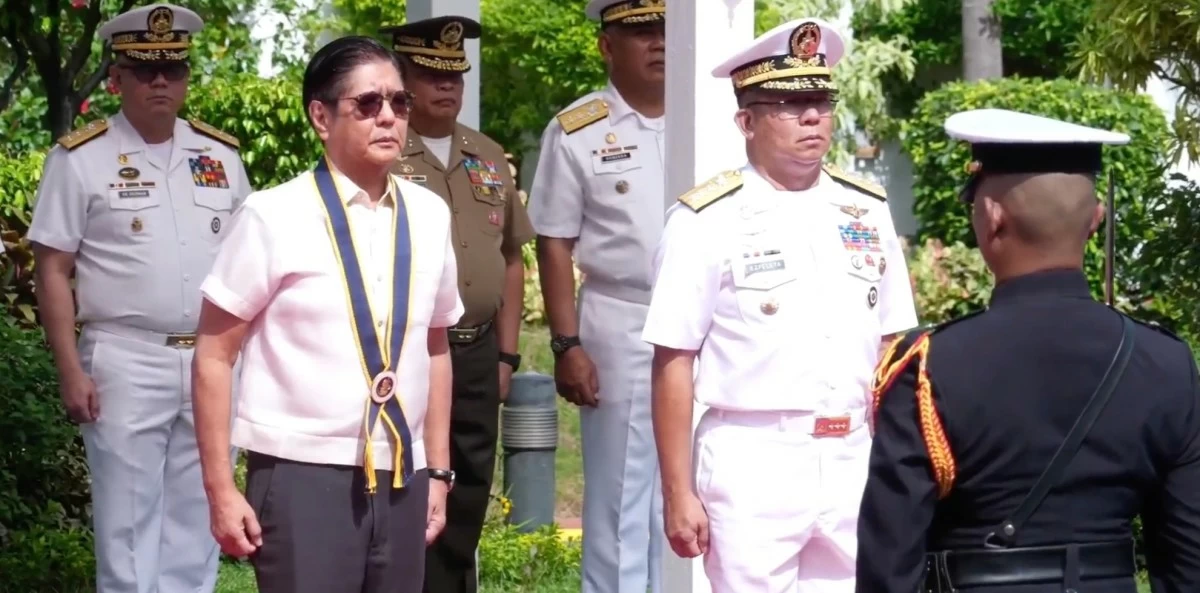
President Ferdinand Marcos Jr. (left) graces the 128th anniversary of the Philippine Navy along with Flag Officer in Command Vice Admiral Jose Ma. Ambrosio Ezpeleta (right), at the PN headquarters, Naval Station Jose Andrada in Manila on June 9, 2026. (Courtesy of RTVM livestream)
The Philippine Navy (PN) marked its 128th anniversary on Tuesday, June 9, with its top commander saying the service has become a “backbone” not only for defending the country’s vast maritime borders but also for disaster response across the archipelago.
The anniversary, themed “Philippine Navy @128: Modern and Ready, Strong and Steady — Credible in Mission, Always Mission-Ready,” served as a showcase for the military's ongoing modernization program.
During the event, President Marcos Jr. led the formal commissioning of the BRP Rajah Lakandula (PS-21) at the PN headquarters, Naval Station Jose Andrada in Manila. The vessel is the Navy's second offshore patrol vessel (OPV), arriving in Subic, Zambales last May 8, and serving as the sister ship to BRP Rajah Sulayman (PS-20), which was commissioned in February.
In his address during the anniversary celebration, PN Flag Officer in Command Vice Admiral Jose Ma. Ambrosio Ezpeleta noted that these acquisitions are rapidly reshaping the country's maritime defense posture.
“The naval assets we have acquired have helped critically augment our frontline forces,” the Navy chief said.
He also mentioned more new ships like BRP Miguel Malvar and BRP Diego Silang, the PN’s most modern and most sophisticated gray ships which were commissioned only last year along with patrol gunboat BRP Albert Majini.
Moreover, he underscored that the fleet further expanded with this year’s addition of the BRP Rajah Sulayman and BRP Audrey Bañares, which have collectively “strengthened our capability to better patrol and secure our maritime domain.”
He also noted the arrival of BrahMos shore-based anti-ship missile systems in 2024, calling it “a milestone for not just our Navy, but for the whole Armed Forces.”
Ezpeleta also revealed ongoing collaborations with technological universities in Cebu and Iligan to develop unmanned surface, air, and undersea systems.
“More notably, we have now further developed locally a cost-effective UAS, or unmanned aerial system, to support our intelligence, surveillance, and reconnaissance operations with some of our platforms able to deploy as far as 120 kilometers,” Ezpeleta explained.
These advancements, according to Ezpeleta, were part of the Navy's Undersea Capability Development Program, which aims to position the fleet as a “respected” regional maritime force.
A ‘modern, ready’ Navy
The Navy chief said the modernization drive is being matched by operational tempo as he reported that from 2025 to early 2026, the PN conducted more than 6,620 naval missions, logging 152,288 hours of steaming time and covering 972,233.27 nautical miles in surface operations.
“This mission has strengthened our assertion of our sovereignty, protecting our territorial integrity, just as we work to uphold the rule of law within our own borders,” Ezpeleta said.
In the skies, naval aviators accumulated over 1,500 missions and 4,142 hours of air patrols, mapping out over half a million nautical miles to boost maritime domain awareness (MDA).
The Navy’s sealift operations also transported nearly 6,000 military personnel, over 1,700 civilians, 3.2 million tons of military supplies, and 200,000 tons of civilian cargo to the country's most remote ports.
Disaster response
The Navy chief stressed that the military’s maritime assets are equally vital during domestic crises, serving as a reliable shield when natural disasters strike the archipelago.
“During the most challenging periods in our country's history, we in the Philippine Navy have served as contingency backbone for logistics and communications of the armed forces. Case in point, apart from carrying needed aid, personnel, and assets, our deployable communications vehicles augmented information sharing and transmission when the 6.9 magnitude earthquake hit Bogo, Cebu last year, or when Mount Kanlaon entered a level 2 eruption phase,” Ezpeleta said.
Joint drills, regional interoperability
To sustain this operational tempo, the Navy has scaled up its combat readiness and joint-force maneuvers. Aside from the annual Balikatan exercises, Ezpeleta highlighted the Pagsisikap Pagsasama 2025 drills, which sharpened skills in surface, anti-submarine, electronic, and air defense warfare.
The Navy also utilized the Kamandag exercises to rehearse integrated air and missile defense operations. More recently, the Navy partnered with foreign allies for the MASA 2026 exercises to demonstrate bilateral joint fires, kill chain integration, and command post operations.
Ezpeleta said new joint operations with other Armed Forces of the Philippines (AFP) units are expected to expand current maritime patrols by an additional 120,000 nautical miles.
“It is therefore my personal dream and professional hope to see more men and women choose to join the Philippine Fleet and the Philippine Marine Corps because I know, I feel, and I am convinced that now, more than ever, the Navy is more ready to protect and safeguard our seas, our country, and above all, our people,” he said.