






Manila Bulletin
 Philippines
National
Emerging threats at sea demand a resilient maritime defense posture—Marcos
Philippines
National
Emerging threats at sea demand a resilient maritime defense posture—Marcos
Philippines
National
Emerging threats at sea demand a resilient maritime defense posture—Marcos
Emerging threats at sea demand a resilient maritime defense posture—Marcos
Published Jun 9, 2026 11:17 am


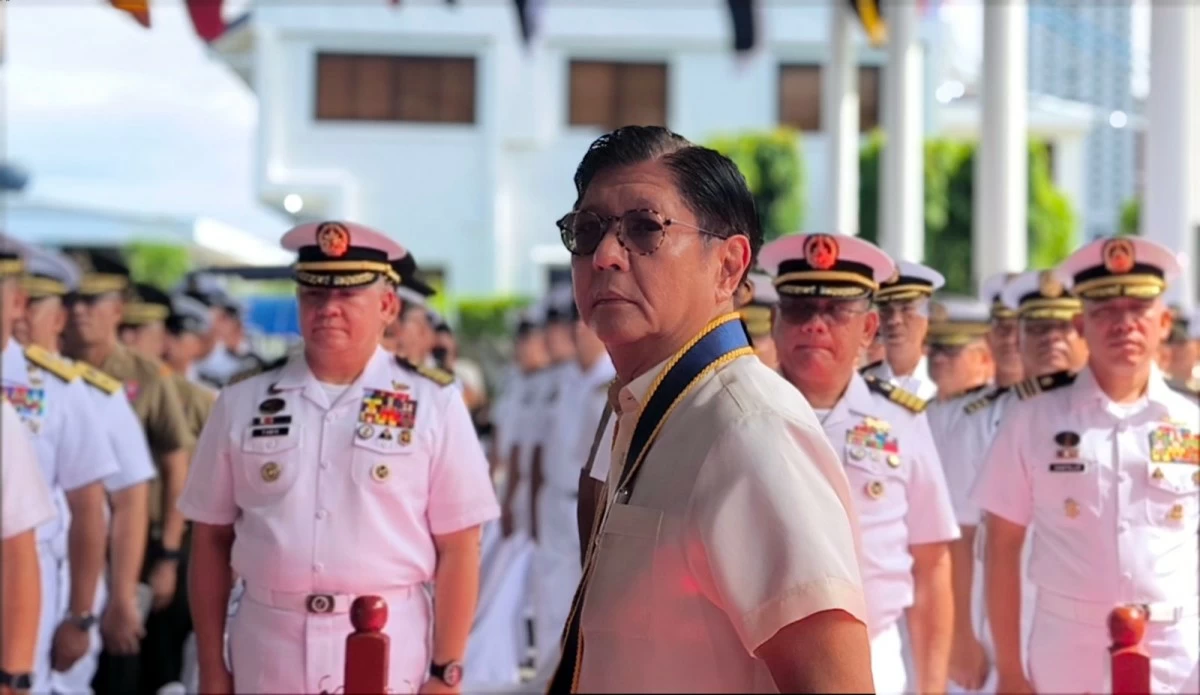
President Ferdinand R. Marcos Jr. graces the 128th anniversary celebration of the Philippine Navy at the Philippine Navy headquarters in Manila on June 9, 2026. (Betheena Unite)
Stressing that seas around the country are "arenas of competition and of conflict," President Marcos underscored the need to continuously strengthen the Philippine Navy's capabilities.
Marcos said this remains essential to protecting the national interest in the West Philippine Sea (WPS).
"Strengthening the Philippine Navy's capabilities remains essential to protecting our interests in the West Philippine Sea in light of the broader realities of our time," Marcos said in his speech as he graced the 128th anniversary of the Philippine Navy on Tuesday, June 9.
He further said that "rapid economic and political developments in the 21st century have reshaped global growth and placed the Indo-Pacific region at the geopolitical and economic center of gravity."
The President pointed out that these developments demand a "resilient maritime defense posture."
"The seas around us are arenas of competition and of conflict. Global instability, shifting alliances, and emerging threats demand that we maintain a resilient maritime defense posture," he said.
"In this environment, a credible Philippine Navy is indispensable to regional peace," he added. "Thus, I have directed the Philippine Navy to further strengthen its capabilities."
The Armed Forces of the Philippines (AFP) was also tasked with further expanding and deepening partnerships, exchanges, and interactions with allies and friendly forces.
Marcos said that through the modernization of the Navy, the administration is safeguarding the country's economic lifelines, protecting its people, and enhancing its ability to contribute to security and cooperation in the region.
He added that training courses continue to be conducted to ensure that Filipino sailors have the tools, information, and protection that will help them carry out their missions effectively.
New offshore patrol vessel
During the event, Marcos also led the commissioning of the BRP Rajah Lakandula, an offshore patrol vessel.
Named after Rajah Lakandula, the pre-colonial ruler of Tondo, the vessel symbolizes Filipino heritage and leadership while serving as a key asset in safeguarding the nation's waters under the Horizon 2 modernization phase.
Marcos said the acquisition of the new vessel is "a pivotal step towards realizing the Navy’s vision of a modern and self-reliant force."
"This vessel enhances our capacity to safeguard our resources and assert our sovereignty," he said.
According to Philippine Navy Spokesperson Capt. Marissa Martinez, the ship will be deployed not only in the West Philippine Sea but across the archipelago.
The new ship, she added, will stretch the Navy's operational reach.
"This ship will strengthen not only our capability in maritime situational awareness—and when I say maritime situational awareness, we are able to detect and identify all the contacts and all the ships and aircraft that are transiting in our maritime domain," Martinez said.
"Secondly, it has strengthened our ability to protect our seas, our sovereignty, and our maritime interest in the area. It stretches our operational reach because the ship itself is modern and definitely it has modern systems that would extend its operation not only in the territorial sea," Martinez added.