






Manila Bulletin
 Philippines
National
Death toll from M7.8 Sarangani quake rises to 37; rescuers search for missing, trapped victims
Philippines
National
Death toll from M7.8 Sarangani quake rises to 37; rescuers search for missing, trapped victims
Philippines
National
Death toll from M7.8 Sarangani quake rises to 37; rescuers search for missing, trapped victims
Death toll from M7.8 Sarangani quake rises to 37; rescuers search for missing, trapped victims
Published Jun 9, 2026 11:19 am
|
Updated Jun 9, 2026 01:33 pm


At A Glance
- Office of Civil Defense (OCD) Administrator Undersecretary Harold Cabreros said 33 fatalities were recorded in Soccsksargen (Region 12) and four were in Davao Region (Region 11).
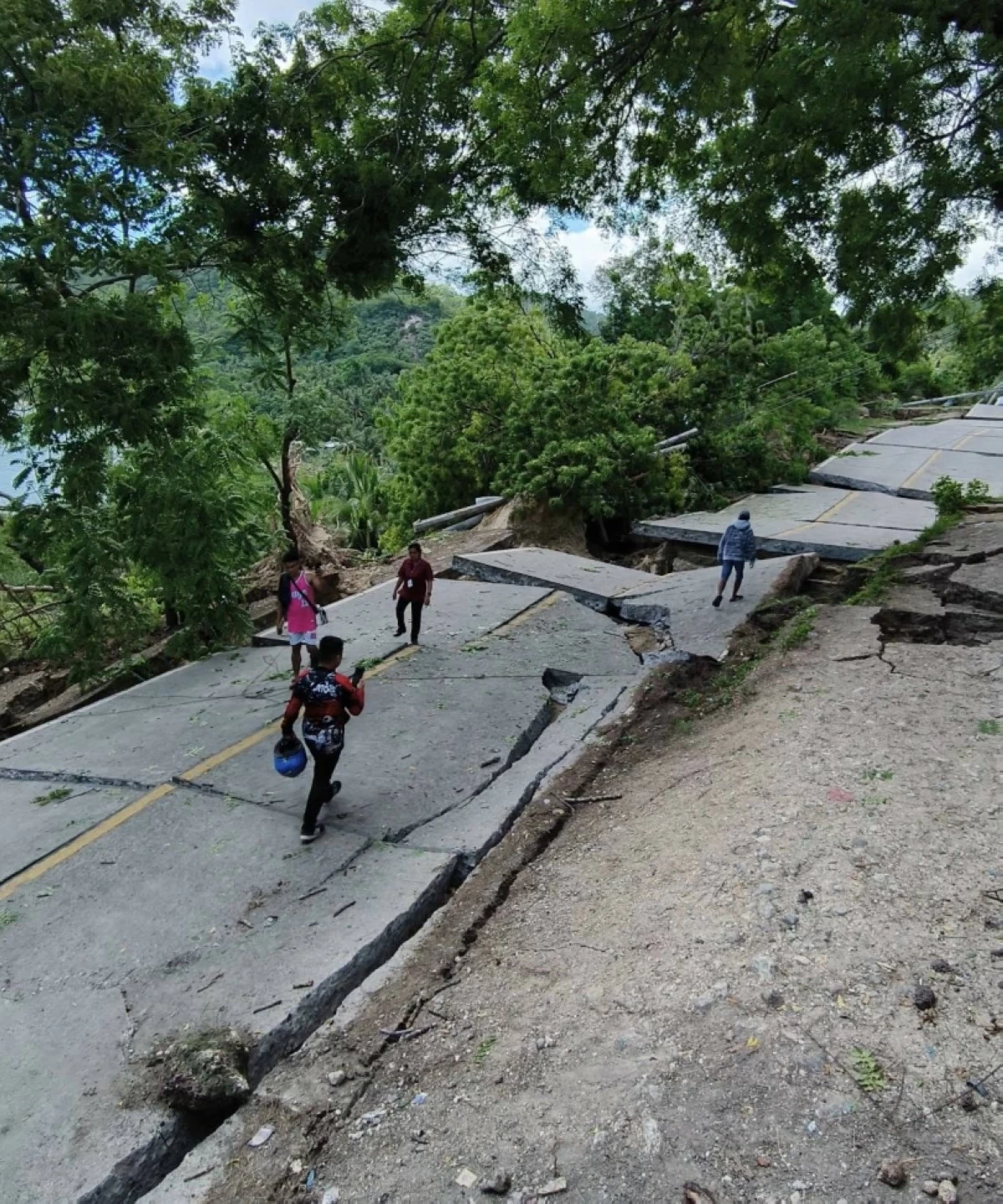
The aftermath of the magnitude 7.8 earthquake that hit Sarangani province on June 8, 2026. (Photo from Vice Mayor James Yap Jr. of Glan, Sarangani)
The death toll from the magnitude 7.8 earthquake that struck off Maasim, Sarangani waters has climbed to 37 as rescuers continued searching for four missing persons and possible survivors trapped beneath collapsed structures, the Office of Civil Defense (OCD) said Tuesday, June 9.
OCD Administrator Undersecretary Harold Cabreros said 33 fatalities were recorded in Soccsksargen (Region 12) and four were in Davao Region (Region 11).
Of those killed in Region 12, there were 18 fatalities in Sarangani, 12 in General Santos City, and three in South Cotabato. The fatalities in Region 11 were in Davao Occidental.
Meanwhile, 479 individuals were injured in Regions 12 and 11 while the remaining missing persons were in Region 12.
The hardest-hit areas were General Santos City and parts of Sarangani province, where search and retrieval operations remained underway a day after the powerful quake struck Mindanao.
“We could say that the damage was not that severe but we still recorded casualties. All in all, we now have more than 30 casualties in Regions 12 and 11,” OCD Administrator Undersecretary Harold Cabreros said during an inspection of affected areas.
88,000 individuals affected
Further, data from the OCD showed that 19,529 families or about 88,000 individuals were affected across 51 barangays in Zamboanga Peninsula (Region 9), Regions 11, 12 and Bangsamoro Autonomous Region in Muslim Mindanao (BARMM).
Of the total, 5,343 families or 19,635 people were staying in 39 evacuation centers while another 264 families or 1,055 persons were being assisted outside evacuation facilities.
Affected areas included Zamboanga del Sur in Region 9; Davao del Norte, Davao del Sur, Davao Oriental and Davao Occidental in Region 11; Sultan Kudarat, Sarangani, and South Cotabato in Region 12; and Basilan in BARMM.
The earthquake also triggered five landslides, one was reported in Sarangani town in Davao Occidental; two in Alabel and one in Glan, both in Sarangani province, and one in Tupi, South Cotabato.
Authorities also recorded damage to 10 road sections and two bridges in Region 11 while power outages affected 12 cities and municipalities in the same region.
At least 10 houses were also damaged in Regions 9, 11, and BARMM.
Infrastructure damage was initially estimated at P15 million across Regions 9, 11 and 12.
Further, classes were suspended in 182 areas while work was halted in 123 areas across the affected regions.
Cabreros said national government officials inspected affected communities in General Santos City and Sarangani province to assess damage and determine urgent needs.
“Our hardest-hit area is General Santos City, although we have also received reports from Glan, Sarangani,” he said.
The inspection team included officials from the Department of National Defense, Department of Public Works and Highways, Department of Social Welfare and Development, Department of Health, and Department of Education.
PCG, Air Force deploys responders
As rescue efforts continued, the Philippine Coast Guard (PCG) deployed 150 responders and additional search-and-rescue dogs to General Santos City.
Three deployable response groups and two SAR dogs were sent to a collapsed commercial building in Barangay Calumpang amid reports that survivors could still be trapped inside.
Two response groups and a Coast Guard High-Speed Response Boat were also dispatched to Barangay Bawing to search for two missing individuals.
Cabreros said hospitals were among the government's immediate concerns due to widespread power interruptions.
“During our visits to hospitals, this was one of the main concerns we focused on because they need a continuous power supply amid the power interruptions. That is why the OCD will provide large generator sets along with fuel to them,” he said.
He added that local governments remained capable of addressing immediate needs but assured residents that national agencies were prepared to provide additional assistance.
The Philippine Air Force (PAF) also deployed an S-70i Black Hawk helicopter to conduct a Rapid Damage Assessment and Needs Analysis (RDANA) mission over affected communities in Sarangani.
The aircraft carried personnel from the OCD for aerial reconnaissance and initial assessment of quake-hit areas.
A C-295 transport aircraft also flew government officials from Manila to Davao City to support inter-agency disaster response operations.
Rescue and retrieval
Meanwhile, Cabreros said rescue and retrieval operations remained a priority.
“We are currently assisting in the retrieval operations for our countrymen who lost their lives. The Bureau of Fire Protection, Armed Forces of the Philippines, Philippine National Police, the Coast Guard, and other local responders are all on the ground,” he said.
The official also urged residents to remain vigilant as aftershocks continued to shake parts of Mindanao.
“We have seen the strength of this earthquake, so we must continue to be cautious and heed the advisories of local governments and warning agencies, especially Phivolcs, because we are still experiencing aftershocks from this powerful quake,” Cabreros said.
“Although the earthquake occurred offshore, out at sea, its impact was strongly felt on land. Even I personally felt how strong it was. The aftershocks are also significant, so everyone should remain vigilant,” he added.