






Manila Bulletin
 Philippines
National
Over 200 aftershocks recorded after destructive Sarangani earthquake
Philippines
National
Over 200 aftershocks recorded after destructive Sarangani earthquake
Philippines
National
Over 200 aftershocks recorded after destructive Sarangani earthquake
Over 200 aftershocks recorded after destructive Sarangani earthquake
Published Jun 8, 2026 05:25 pm


At A Glance
- Phivolcs said the quake was caused by subduction along the Cotabato Trench, based on initial seismic analysis, including the distribution of aftershocks.
- The Cotabato Trench is a major subduction zone capable of generating strong earthquakes, as historical records show at least seven significant events in the region between 1917 and 2023, ranging in magnitude from 5.7 to 8.0.
- The most recent damaging event was a magnitude 6.8 quake in November 2023.
Phivolcs
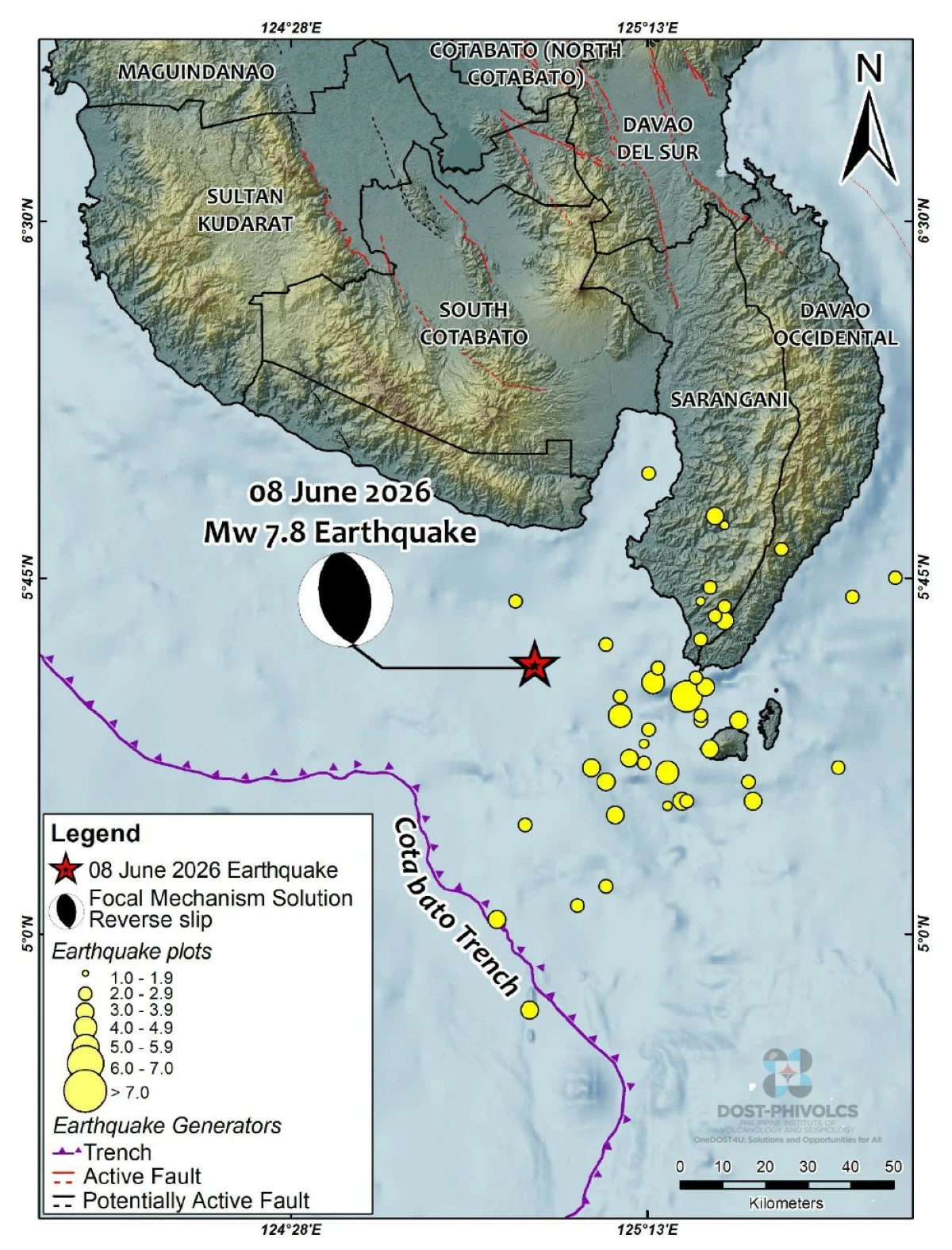
Aftershocks continued to be recorded hours after a magnitude 7.8 earthquake struck Sarangani and nearby provinces on Monday morning, June 8, the Philippine Institute of Volcanology and Seismology (Phivolcs) said.
As of 2 p.m., 258 aftershocks had been logged, ranging in magnitude from 1.3 to 6.7. Ten of these were felt.
Phivolcs said the tremors were recorded by the General Santos City seismic station and the Don Marcelino, Davao Occidental seismic station.
The main earthquake struck at 7:37 a.m., with its epicenter located 32 kilometers west of Maasim, Sarangani, at a depth of 33 kilometers.
Phivolcs said the quake was caused by subduction along the Cotabato Trench, based on initial seismic analysis, including the distribution of aftershocks.
The Cotabato Trench is a major subduction zone capable of generating strong earthquakes, as historical records show at least seven significant events in the region between 1917 and 2023, ranging in magnitude from 5.7 to 8.0, it added.
The most recent damaging event was a magnitude 6.8 quake in November 2023.
“Additionally, there are local faults in proximity, some potentially concealed by recent deposits. The Cotabato Trench and these active faults are capable of generating minor to great earthquakes,” Phivolcs said.
The agency reminded the public to continue to observe safety measures during strong aftershocks.
“In case of strongly felt earthquakes, the public is advised to protect themselves by doing the ‘drop, cover, and hold’ procedure. At home and in workplaces, heavy furniture and appliances should be securely anchored to walls, and hanging objects properly fastened to prevent injuries,” it said.
It added that damaged or weakened structures should be approached with caution.
“Exercise caution around structures that appear weakened or show signs of damage from the MW 7.8 earthquake, as these may sustain further damage by succeeding earthquakes,” it said.
Aside from strong ground shaking, Phivolcs warned of possible earthquake-induced landslides, rockfalls, liquefaction, ground fissures, sand boils, lateral spreading, and coastal inundation in low-lying areas following the June 8 earthquake.
It also cautioned that sinkholes may form in areas underlain by limestone.